Introduction
What would a vibrant Colombian emerald look like if Fernando Botero had shaped it? The celebrated Colombian artist became famous for paintings and sculptures that swell familiar people, animals, and objects into round, generous forms. Admirers call this distinctive style Boterismo. In this article, we imagine how Boterismo could reshape the worlds of gemstones, pearls, laboratory instruments, jewellery, and watches. Importantly, this experiment goes beyond simply making objects bigger. Instead, it explores how volume, bold colour, and softened geometry change the way we perceive a gemstone. Moreover, Botero’s figures feel warm, approachable, and playful, and that mood suits modern jewellery perfectly. Most of all, this creative idea makes gemology friendlier for the 99% who love fine jewellery and design but never read a technical grading report. As a result, everyone can join the creative conversation. Before you explore these concepts, read our guide to gemstone cuts to understand the basics.
Reimagining Gemstone Shapes with Boterismo
Using Boterismo Volume in Coloured Gemstones
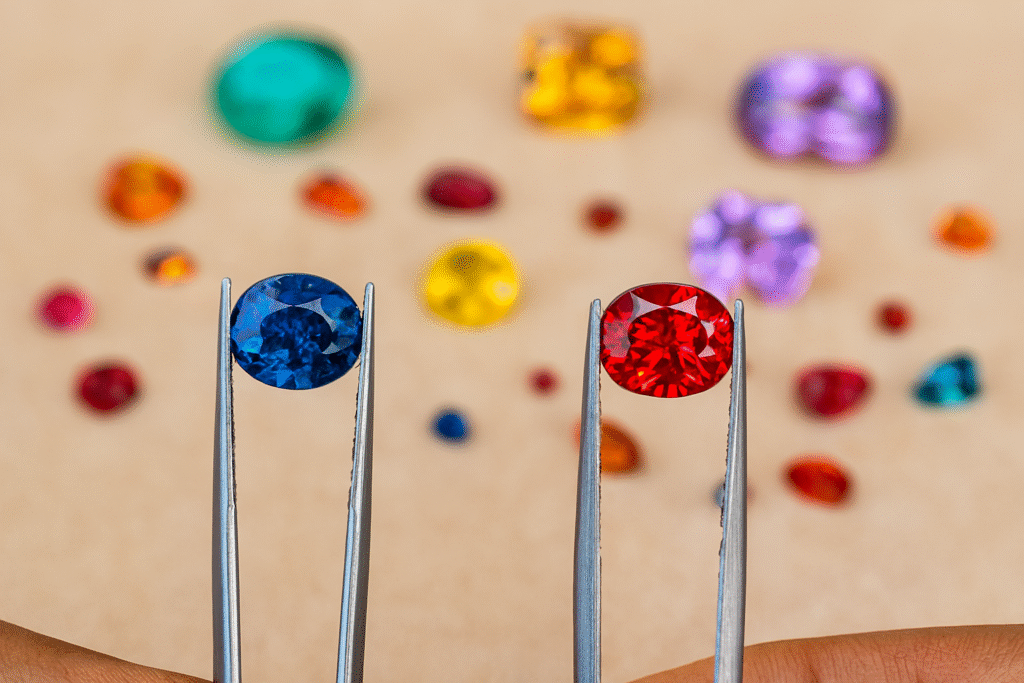
Traditional faceting follows precise optical rules that control brilliance and light dispersion. Boterismo, however, offers a refreshing artistic alternative. For example, a cutter could shape a vivid emerald into a plump, rounded sugarloaf cabochon that highlights its deep green body colour. Similarly, a ruby could become a pillow-shaped cushion with soft, inflated contours. Meanwhile, a blue sapphire could take the form of a sculptural dome. In fact, many of these shapes already exist in traditional lapidary work. Therefore, the experiment needs no new cutting techniques. Instead, it stretches proportions and invites creative interpretation.
Applying the Boterismo Effect to Diamonds
Diamonds usually win attention through their brilliance, fire, and scintillation. Consequently, removing their sharp facets would dull the sparkle that most people love. Designers can still play with volume, however. For instance, they might choose rounded cushion outlines, prominent crowns, or sculptural gold settings. In addition, a rose-cut diamond offers a natural, domed look while it keeps a faceted surface. Overall, the aim is to celebrate volume without sacrificing the diamond’s essential optical performance.
A Bolder Approach to Boterismo Gemstone Colour
Botero loved saturated colour, and gem designers can borrow that same courage. For example, picture a deep green emerald beside an orange spessartine garnet, or a bright pink tourmaline beside a golden citrine. Likewise, opaque stones such as turquoise, lapis lazuli, and malachite add striking contrast to such designs. However, this approach does not create new official colour grades; instead, it explores the balance, saturation, and artistic contrast that make a piece truly memorable.
Reimagining Pearls Through Boterismo Design
Pearls already come in many natural shapes, so they suit this experiment perfectly. Traditional strands, however, prize symmetry and perfect matching. In contrast, a designer inspired by Boterismo would celebrate oversized South Sea pearls and irregular, artistic baroque pearls. For instance, a necklace could mix large pearls of different shapes and colours to create a playful, rhythmic visual. Similarly, earrings could pair a big, lumpy baroque pearl with rounded gold forms. Moreover, asymmetry could replace the usual matched pair. Nevertheless, practical details still matter. Therefore, designers must consider nacre condition, drilling, setting security, and overall wearer comfort. Likewise, our article on pearl care and durability explains these points in detail.
Boterismo Art in the Gemological Laboratory
Scientific Instruments with a Boterismo Sculptural Look
Gemological instruments usually favour technical precision over beauty. Imagine, however, a laboratory where tools also look like high art. For example, a polariscope could wear a rounded, sculptural housing, yet its crossed polarisers would stay perfectly aligned. Similarly, a refractometer could gain a curved brass body while its prism and scale remain accurate. Likewise, a spectroscope could become a pebble-shaped tool with a comfortable grip. In the same way, a jeweller’s loupe could gain a spherical casing, provided the lens arrangement and focal distance stay correct. Even gem tweezers could receive colourful, rounded handles. Their tips, however, must keep the exact geometry that holds small stones safely.
Making Gemology Visual via Boterismo
Hydrostatic weighing, a classic method for measuring specific gravity, shows the same principle. A design studio could add rounded glass vessels and sculptural stands to the setup. Accurate results, nevertheless, still depend on correct weighing in air and water. Similarly, microscope views of three-phase inclusions in Colombian emeralds or rutile silk in sapphires could inspire striking visual art. Therefore, scientific observation and artistic interpretation can complement each other beautifully.
Jewellery and Watches Through the Boterismo Effect
Historic Jewellery Reimagined with Boterismo
Historic jewellery offers endless inspiration. For example, a designer could turn an eighteenth-century giardinetti ring into a garden of oversized gemstone flowers. Likewise, a Victorian brooch could gain bold, rounded gold forms. However, the goal is not to copy the past. Instead, designers keep recognisable references and add volume, softness, and modern colour.
Contemporary Boterismo Jewellery and Watches
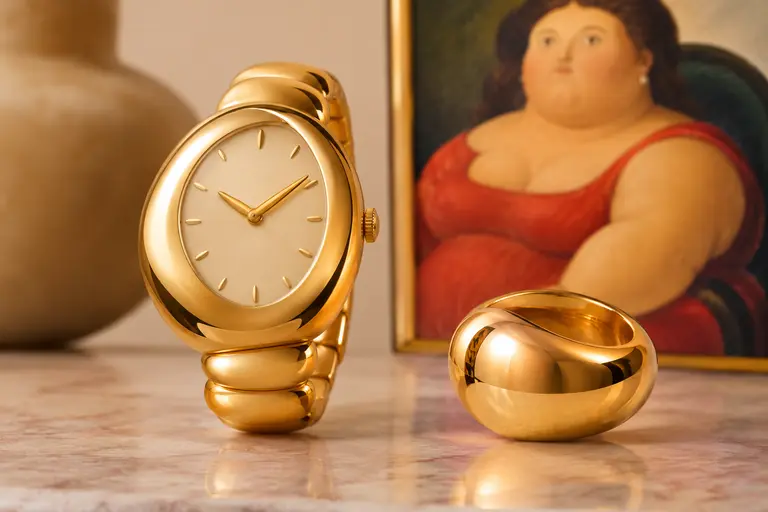
Modern designers could explore chunky gold bands, inflated-looking earrings, and sculptural necklaces. Meanwhile, watchmakers could experiment with pebble-shaped cases, domed crystals, and playful dials. However, watchmaking brings extra challenges. For instance, engineers must protect movement size, dial readability, water resistance, and wrist comfort. Therefore, the Botero effect should shape the look of a watch without weakening its internal mechanics.
Why Boterismo Matters to the 99%
Gemology often sounds technical and distant to the average buyer. Art, in contrast, welcomes everyone. For example, children can discover gemstone shapes through rounded sculptures, and shoppers can see the difference between cabochons and faceted stones at a glance. Furthermore, young designers, students, and small jewellers can borrow these ideas to build fresh collections. In addition, gemologists, artists, industrial designers, and watchmakers could collaborate on public exhibitions. As a result, the public would learn about gemstones through genuine enjoyment instead of confusing jargon. To learn more about the artist, visit the official Fernando Botero website. Similarly, the Gemological Institute of America shares educational resources on gemstone cutting.
Frequently Asked Questions
What is Boterismo?
Boterismo describes Fernando Botero’s unique artistic language. In particular, it uses exaggerated volume, rounded proportions, and rich colour to reinterpret familiar subjects.
Can cutters shape gemstones in the Botero style?
Yes, cutters can fashion exaggerated cabochons, sugarloaf domes, and cushions. However, they must always respect each material’s durability and transparency limits.
Would Boterismo harm gemological instruments?
Not necessarily. Designers can change housings and handles while they preserve the optics, calibration, and working principles of the tools.
Could this idea influence future jewellery design?
Yes, it could inspire experimental collections and art exhibitions. Nevertheless, success would always depend on craftsmanship, wearability, and customer interest.
Disclaimer
This article presents a conceptual design experiment. It does not claim that Botero created these gemstone designs, nor that Boterismo is an established gemological movement. The author has no financial affiliation with the brands or organizations mentioned.