
Introduction
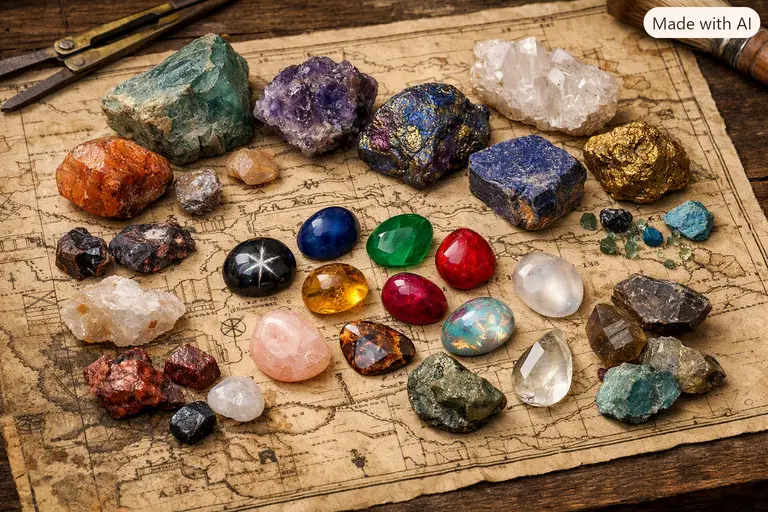
The geology-gemology-archaeology connection offers a unique lens through which we view Earth’s greatest treasures. At first glance, geology, gemology, and archaeology look like three unrelated fields. However, they often meet in one fascinating place: the story of a precious gemstone. Together, these three disciplines explain how a mineral forms, what it eventually becomes, and how ancient people once found, used, and valued it.
Geology explains how the Earth builds its rocks and minerals over millions of years through intense pressure and heat. Meanwhile, gemology studies those minerals to identify their true nature, chemical purity, and quality. Archaeology then uncovers the vital human element by showing how earlier societies mined, traded, and treasured these materials. As a result, when scientists combine all three, they reveal a narrative much bigger than just a beautiful stone.
This connection matters everywhere, but it holds special importance in India. Because the country carries a long history of diamond mining, gemstone craft, and mineral trade, these fields must work in tandem. Therefore, understanding the geology-gemology-archaeology connection helps readers appreciate India’s geological wealth and deep cultural heritage.
Even so, these disciplines do not always work side by side on every discovery. Instead, each one contributes a different kind of evidence. Geology supplies the physical framework, gemology studies the material itself, and archaeology adds the human story. Consequently, the geology-gemology-archaeology connection reveals both Earth’s deep history and humanity’s long relationship with it.
Understanding the Geology Gemology Archaeology Connection in Earth Science
First of all, geology lays the essential groundwork for understanding where gemstones originate. Gemstones never form randomly in the crust. Instead, specific combinations of heat, pressure, chemistry, fluids, and rock types create them over long stretches of time. Therefore, geologists examine rock formations, fault lines, and mineral patterns to predict where certain gemstones might occur.
For example, geological surveys can show whether a region holds the right conditions for emerald, sapphire, or diamond formation. Geologists look for “host rocks” like pegmatites or kimberlites that act as the birthplace for these treasures. Still, a favorable setting alone cannot guarantee a commercial find. As a result, exploration teams must also rely on intensive field sampling and laboratory testing to confirm a deposit’s viability.
Furthermore, geological events like tectonic plate shifts or volcanic eruptions bring these gems closer to the surface. Without these violent Earth movements, most gemstones would remain trapped miles underground. Readers who want to explore this topic further can check the GIA’s research on gemstone deposits and their formation.
How the Geology Gemology Archaeology Connection Shapes Gemstone Identity
Once miners recover a gemstone, gemology takes over the investigation. A trained gemologist determines whether a stone occurs naturally, grows in a lab, or undergoes artificial treatment. Furthermore, gemological testing identifies the stone’s species and variety while revealing its optical and internal features. This scientific analysis is a core part of the geology-gemology-archaeology connection.
Today, gemology reaches far beyond the use of a simple magnifying loupe. This is because modern laboratories now combine advanced microscopy with spectroscopy and trace-element analysis. For instance, tiny inclusions—which are microscopic “birthmarks”—inside a gemstone often preserve clues about the environment where the crystal grew.
That said, geographic-origin testing demands extreme caution. Because similar geological settings in different countries can produce similar-looking stones, laboratories rarely rely on a single clue. For more insights into this process, you can read Sajuelizamma’s guide to gemstone identification.
In short, gemology serves as the vital link between the stone in someone’s hand and the ancient geological world that created it. By identifying the chemical “fingerprint” of a gem, experts can often trace it back to its specific mine, reinforcing the geology-gemology-archaeology connection.
How the Geology Gemology Archaeology Connection Reveals Human History
Archaeology brings yet another layer to this scientific picture. Ancient mines, specialized tools, workshops, beads, and burial ornaments show how earlier communities interacted with minerals. Moreover, this evidence helps researchers understand old technologies, trade networks, and religious belief systems.
For instance, an ancient gemstone discovered far from its geological source proves that long-distance trade once carried it there. If an archaeologist finds a Burmese ruby in an ancient Egyptian tomb, it reveals a massive trade route that existed thousands of years ago. Historical texts often add further detail, and India’s own records include rich information about diamonds and trade routes.
That said, archaeology should never replace geological exploration. Instead, it adds cultural and historical meaning to what geology and gemology already explain. Specifically, archaeology tells us why a stone was valuable, whereas geology tells us how it was made.
Golconda Diamonds: A Geology Gemology Archaeology Connection Example
Golconda offers a striking Indian example of the geology-gemology-archaeology connection. Interestingly, Golconda never referred to a single mine. Instead, the name became linked to a group of historic diamond-producing areas and the massive trading hub built around them.
India’s ancient diamond deposits mostly formed in alluvial settings. Over time, diamonds recovered there entered global trade networks and reached royal courts around the world. The Hope Diamond (Type IIb) and the Koh-i-Noor (Type IIa) are prime examples of historic, high-purity Golconda diamonds. Both historic masterpieces boast remarkable clarity and lack nitrogen, but the Hope Diamond is uniquely defined by trace boron
However, Type IIa status alone cannot confirm a Golconda origin. Instead, experts must marry historical paperwork and tracking (provenance) with modern laboratory testing (gemology). To see how these historic diamonds are categorized today, visit the Indian Bureau of Mines for mineral data.
Proving the Geology Gemology Archaeology Connection in India
Kashmir sapphires illustrate how a single geological event can shape human history. In 1881, a landslide in the remote Pádar region exposed sapphire-bearing rock. This event soon led to one of the most celebrated sapphire discoveries ever recorded. Their intense blue color and “velvety” glow come from microscopic inclusions that distinctively scatter light.
Rajasthan, meanwhile, offers another important chapter in the Indian gemstone story. The state holds notable emerald occurrences around Udaipur, Rajsamand, and Ajmer. These emeralds formed in unique geological conditions involving schist and pegmatite rocks. By using gemology to study these stones, we can identify “Rajasthan emeralds” in historical jewelry collections, proving the reach of ancient Indian mining.
Why the Geology Gemology Archaeology Connection Matters Today
Together, these three disciplines help people understand far more than mere gemstone beauty. First, they explain how Earth built the resources societies have depended on for centuries. Second, they reconstruct human history, since gemstones traveled along trade routes and entered royal treasuries.
Additionally, ancient mining sites reveal the technologies earlier societies used to extract natural resources. This helps historians trace technological progress over time and understand how extraction affects landscapes.
Ultimately, every gemstone carries a geological story, and often, it carries a human one too. For everyday readers who simply admire a beautiful stone, that deeper story can turn a simple gem into something unforgettable. By looking through the geology-gemology-archaeology connection, we see the full brilliance of the natural world and our place within it.
FAQ: Understanding the Geology Gemology Archaeology Connection
Why are gemology, geology, and archaeology connected?
These three fields study different pieces of the same story. Geology explains how minerals form, gemology studies the resulting gemstones, and archaeology shows how people once used them.
Can archaeology help locate new mineral deposits?
Archaeology can reveal ancient mines and trade routes, which offer helpful historical clues. However, it cannot replace modern geological exploration when searching for new deposits.
Can gemologists always determine a gemstone’s origin?
Not always. Laboratories combine inclusions, chemistry, and spectroscopy to estimate origin, but results can remain inconclusive when different regions share similar geological features.
Why do Golconda diamonds matter historically?
Golconda became famous as a historic diamond trading region. Many of its diamonds carry exceptional clarity and Type IIa purity, making them the most sought-after gems in history.
What makes Kashmir sapphires so celebrated?
Their intense blue color and velvety appearance, shaped by rare geological conditions and limited production, earned them global fame and high value.
Why is Rajasthan significant for emeralds?
Rajasthan holds documented emerald occurrences near Udaipur and Ajmer, where distinctive geological conditions shaped stones that have been mined for decades.
Disclaimer
This article serves general educational purposes only. Gemstone identification and origin determination require proper scientific testing and professional interpretation. Because gemstones from different regions can share similar features, origin conclusions sometimes remain inconclusive. Readers should consult qualified geologists, gemologists, or accredited laboratories before making scientific, valuation, or purchasing decisions. The author has no financial affiliation with the labs or organizations mentioned.