Introduction to Zhen’an County Emeralds
A remarkable new gemstone source has quietly emerged from the mountains of central China. Specifically, in 2017, miners first spotted emeralds in drill cores from the Shaanxi Province. This discovery marks the first time anyone has found an emerald deposit within the ancient Qinling Orogenic Belt. Since that time, researchers have confirmed gem-quality surface outcrops. Furthermore, the Gemological Institute of America (GIA) published a full characterization of the deposit in early 2026. What truly sets these stones apart is their extraordinary color. Unlike the warm greens of Colombian stones, Zhen’an County Emeralds display a vivid, cool bluish-green tone. This hue originates almost entirely from vanadium rather than chromium. You should also read our guide on gemstone buying mistakes to understand how to evaluate quality standards for newly discovered origins.
Origins of Zhen’an County Emeralds in Shaanxi
Zhen’an County sits in Shaanxi Province, nestled within the broader South Qinling Belt. Here, emerald crystals grow inside quartz and quartz-calcite veins that cut through metamorphic rocks. Geologists describe this as a metamorphic-hydrothermal origin. In other words, hot, mineral-rich fluids moved through cracks in ancient rocks over millions of years. This process deposited beryl crystals alongside minerals such as muscovite, phlogopite, and fluorite.
Notably, these emeralds form as a by-product of active tungsten-beryllium mining operations. Consequently, miners recover them alongside industrial metals rather than in dedicated gemstone mines. This by-product status directly influences the scale of gem production. Furthermore, it shapes how the industry manages sustainability at the mine level. To see more about the geological mapping of this region, you can visit Mindat.
Why Vanadium Defines Zhen’an County Emeralds
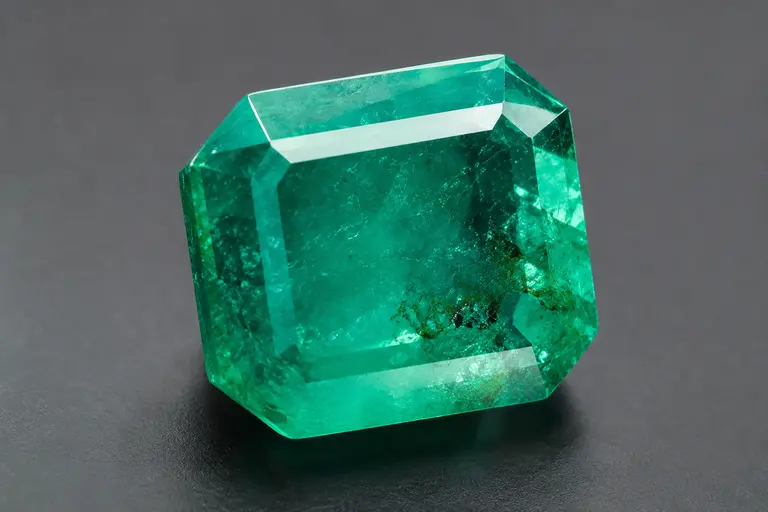
Zhen’an County Emeralds range from light green to intense bluish-green. Many stones lean toward a cool, slightly “aqua” tone that collectors find very attractive. Scientists attribute this specific color to exceptionally high vanadium content. Specifically, measurements show vanadium levels between 1,047 and 3,031 parts per million (ppm). In contrast, chromium levels stay remarkably low—typically under 180 ppm. As a result, the color looks noticeably different from the warmer greens associated with traditional sources.
Color Zoning in Zhen’an County Emeralds
Additionally, many crystals display distinct color zoning. This involves darker green rims surrounding lighter, more aqua-toned cores. This pattern forms because vanadium distributes itself unevenly as the crystal grows over thousands of years. For this reason, the way a gem cutter orients the stone during faceting matters a great deal. A skilled lapidary will always position the stone so that the richest green appears face-up to the viewer. Consequently, the orientation determines the final market value of the jewel.
Identifying Zhen’an County Emeralds Microscopically
Under a microscope, Zhen’an County Emeralds reveal a busy and fascinating interior world. Almost all specimens contain “two-phase” fluid inclusions. These are tiny pockets of gas and liquid trapped during crystal growth. Moreover, mineral inclusions such as phlogopite and albite appear frequently. Many crystals also display unusual surface growth patterns. These include longitudinal striations and inclined growth steps on the hexagonal prism faces.
Gemologists also observe rare “zigzag” or sawtooth-like banding that they rarely see in other deposits. Together, these features provide experts with strong visual clues for origin identification. In addition to visual features, laboratories use chemical fingerprints to confirm authenticity. Specifically, these stones carry unusually high lithium and cesium levels. The gallium-to-cesium ratio also helps labs distinguish these stones from similar vanadium-rich emeralds found in Davdar. To learn more about professional testing, refer to the School of Gemmology, China University of Geosciences in Beijing.
Common Treatments for Zhen’an County Emeralds
Most prospective buyers ask if these stones receive treatments, and the answer is generally yes. Because Zhen’an County Emeralds are often heavily included, dealers routinely fill surface-reaching cracks with oil or synthetic resin. This practice improves the stone’s apparent clarity and is standard throughout the global emerald trade. In fact, the vast majority of commercial emeralds receive some degree of filling.
Therefore, you should always assume a treatment is present unless a lab report states otherwise. Whenever possible, request a third-party report from a respected lab. Such a report will disclose the degree of filling and confirm the geographic origin. You may also read our article on Understanding BIS Hallmark to see how certification protects jewelry buyers in major markets like India.
Buying Advice for Zhen’an County Emeralds
First, you should always expect inclusions. Almost every stone from this region contains visible fluid and mineral markers. Truly “eye-clean” specimens are extremely rare and command a significant premium. Second, you must pay close attention to the color zoning mentioned earlier. Ask your jeweler to verify that the stone has been cut to maximize the face-up saturation.
Third, always ask for full disclosure regarding oiling or resin filling. Fourth, since this is a newly recognized source, Zhen’an County Emeralds may carry a rarity premium among collectors of Asian-origin gems. This means that documentation of origin adds real financial value to the piece. Finally, if you prioritize ethical sourcing, ask your supplier for traceability records. While independent sustainability reports for this locality are still in development, transparency from the seller remains your best protection.
FAQ: Zhen’an County Emeralds
Where are these emeralds found?
Miners recover them in Zhen’an County, Shaanxi Province, China. They appear as a by-product of industrial tungsten-beryllium mining operations.
Why is their color different from Colombian emeralds?
Colombian stones get their color from chromium. In contrast, Zhen’an County Emeralds get their bluish-green hue from vanadium, giving them a cooler appearance.
Are they durable for daily wear?
Like all emeralds, they have a hardness of 7.5 to 8. However, because they are often fractured, you should wear them in protective settings to prevent chipping.
How do labs identify the Zhen’an origin?
Labs look for high lithium and cesium levels. They also search for unique zigzag growth patterns and specific mineral inclusions like scheelite.
Are these stones affordable?
Since they are a relatively new source, they are often more affordable than top-tier Colombian emeralds. However, high-clarity stones with vivid color still attract premium prices.
Disclaimer
This article reflects gemological research available as of May 2026. Individual stones vary significantly, and market conditions change over time. Always consult a qualified gemologist or obtain a laboratory report from an accredited facility before making a purchase. The author holds no financial affiliation with the mining operations in Shaanxi.