Introduction to Diamond Ring Styles by Decade
Diamond engagement rings have not always looked the way they do today. Over the last century, their designs shifted with every generation—shaped by wars, economic swings, celebrity culture, and everyday buyers just like you. Consequently, understanding this history helps you shop smarter and choose with confidence. By studying Diamond Ring Styles by Decade, you can avoid spending money on a temporary trend that may not suit your long-term lifestyle.
This guide walks you through each era’s most popular styles and explains why they captured the public’s imagination. Specifically, we will help you find a ring that fits your budget rather than just a price tag. You should also read our guide on gemstone buying mistakes to understand how quality standards apply across all historical periods. For foundational education, the Gemological Institute of America (GIA) offers free resources on cuts and clarity.
Diamond Ring Styles in the Early 1900s
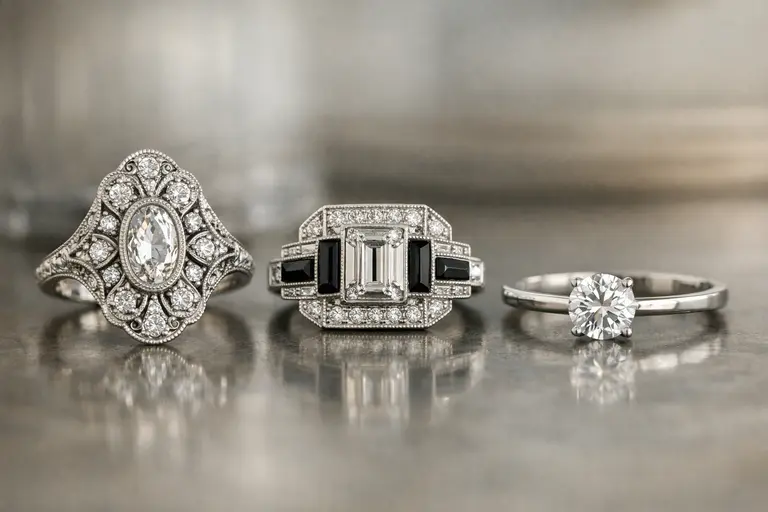
Jewelers during the Edwardian era crafted rings with delicate platinum metalwork and filigree lace patterns. In addition, they frequently used milgrain edges to add texture. Because miners had recently discovered large platinum deposits, this metal became the standard for high-end luxury. Specifically, artisans used “Old European-cut” diamonds, which produced a softer, warmer sparkle than modern precision cuts. As a result, floral motifs appeared everywhere. These rings prioritized romantic artistry above all else. However, they remained largely out of reach for most working-class families until the end of the decade.
Art Deco Diamond Ring Styles by Decade
The Jazz Age brought a dramatic shift in aesthetics. Instead of soft Edwardian curves, Art Deco rings featured sharp geometry, bold symmetry, and striking color contrasts. For example, jewelers often paired emerald cuts and baguette diamonds with sapphires, rubies, and onyx. The 1925 Paris Exposition heavily influenced this aesthetic worldwide. Consequently, many vintage-inspired rings today still borrow directly from this era. Therefore, Art Deco remains one of the most enduring categories in Diamond Ring Styles by Decade. To understand how these geometric shapes are graded today, visit the Smithsonian Institution’s gem records.
Diamond Ring Styles during the 1940s
World War II changed everything in the jewelry industry. Because the government redirected platinum for military use, jewelers switched almost exclusively to yellow gold. Furthermore, economic uncertainty pushed buyers toward smaller stones. To counter this, makers developed clever designs like “illusion settings” and cluster arrangements. These techniques made small diamonds appear significantly larger without the added cost. In fact, this decade made engagement rings more accessible for average households for the first time.
Popular Diamond Ring Styles of the 1950s
In 1947, copywriter Frances Gerety wrote the legendary slogan “A Diamond is Forever.” De Beers placed it in massive ad campaigns from 1948 onward, changing the industry forever. Suddenly, a diamond ring became a standard expectation for every couple, not just the wealthy elite. As a result, the round brilliant solitaire in a four-prong setting became the gold standard. It offered a clean, timeless look that was affordable enough for middle-class budgets. This shift created the iconic style that most people still picture today when they imagine an engagement ring.
Diamond Ring Styles in the 60s and 70s
Social change swept through global culture during these decades, and jewelry reflected this newfound freedom. Consequently, buyers moved away from the single standard solitaire. Instead, they started choosing marquise, pear, and oval diamond shapes. While yellow gold remained popular, textured “bark” finishes and nature-inspired designs also emerged strongly. For the first time, personalization became a real priority for couples. In other words, people started asking, “What fits our unique personality?” rather than simply following tradition.
1980s Diamond Ring Styles: Extravagance
Economic confidence in the 1980s encouraged highly visible luxury. Therefore, larger diamonds, bold yellow gold settings, and dramatic multi-stone designs defined the era. Specifically, the “Princess Cut” rose sharply in popularity during this period. It eventually became one of the best-selling shapes of all time. In addition, channel settings and “baguette” accents reflected the era’s preference for extravagance. If you wore a big, shiny ring in the 1980s, you wore it with pride as a symbol of status. You may also read our article on Understanding BIS Hallmark to see how gold purity standards became more regulated during these high-growth years.
Minimalist Diamond Ring Styles of the 1990s
In sharp contrast to the 1980s, the 1990s favored restraint and simplicity. Platinum and white gold quickly replaced yellow gold as the metals of choice. Similarly, solitaire rings returned to the spotlight, but this time they featured much slimmer bands and cleaner, low-profile settings. Fashion at large moved toward a “grunge” or “minimalist” aesthetic, and engagement rings followed. As a result, the focus shifted from showing off wealth to demonstrating quiet, refined taste.
Diamond Ring Styles in the Digital Age
The internet fundamentally changed how couples shopped for Diamond Ring Styles by Decade. For the first time, buyers could compare diamonds and settings across dozens of global retailers without leaving home. By the 2010s, “Halo” settings—where small diamonds surround the center stone—became the dominant choice. These settings made the main diamond appear significantly larger while keeping the overall cost manageable. Furthermore, rose gold surged back into fashion after decades of absence, driven largely by social media trends and celebrity announcements.
Modern Diamond Ring Styles by Decade: 2020s
Today’s buyers care about more than just a stone’s appearance. In particular, sustainability, ethical sourcing, and long-term value now influence every purchasing decision. Lab-grown diamonds have become a mainstream option, allowing buyers to choose a much larger or higher-quality stone for the same budget as a smaller mined diamond. Above all, this era offers more flexibility than any previous decade. You no longer need to spend three months’ salary to find a meaningful ring. Consequently, the 2020s represent the era of the “smart buyer.”
FAQ: Diamond Ring Styles by Decade
When did diamond rings become the standard for engagement?
Generally, they became the mainstream standard in the 1950s. This occurred after the “A Diamond is Forever” campaign convinced the middle class that a diamond was the only acceptable symbol of commitment.
Which decade is the most popular for vintage-style rings?
The 1920s Art Deco era remains the most popular inspiration for modern vintage-style rings. Its geometric lines and bold use of color appeal to contemporary tastes.
Why did yellow gold lose popularity in the 1990s?
Fashion trends shifted toward a “cool” color palette. Silver-toned metals like platinum and white gold offered a cleaner, more modern look that suited the minimalist aesthetic of the time.
Are halo rings still in style in 2026?
Yes, but they have evolved. Many modern buyers now prefer “hidden halos” or more delicate, thin-walled halos that add sparkle without overwhelming the center stone.
How do I choose the best style for my lifestyle?
You should consider your daily activity level. For example, if you work with your hands, a low-profile 1940s-style illusion setting or a modern bezel setting provides better protection than a high-set 1980s solitaire.
Disclaimer
This article serves educational and historical purposes only. Diamond pricing, resale values, sourcing standards, and design trends change over time. Therefore, before making a major jewelry purchase, always consult a certified gemologist, a trusted jeweler, and reputable grading institutions such as the GIA. No content in this article constitutes professional financial or purchasing advice.