Introduction to Tiffany Blue Book 2026
Tiffany Blue Book 2026 matters for a reason that goes well beyond the staggering prices of its individual masterpieces. While it undoubtedly showcases extraordinary gemstones and world-class craftsmanship, its true significance lies in its role as a cultural barometer for the luxury industry. Specifically, it demonstrates how a global heritage house transforms raw minerals into narratives of prestige and lasting desire. For the discerning buyer in 2026, understanding this collection is essential for navigating the complex intersection of art and asset.
The Artistic Vision of Nathalie Verdeille
, Tiffany’s Chief Artistic Officer, has steered the 2026 collection toward a theme titled Hidden Garden. This collection reinterprets the house’s most famous motifs through the lens of extreme rarity and modern engineering. Nathalie Verdeille reinterprets Jean Schlumberger’s whimsical legacy with 21st-century precision. This approach creates a portfolio that feels both timeless and futuristic. Consequently, the collection serves as a manifesto for the LVMH-led era of , where the goal is to dominate the global high-jewelry conversation.
Smart Buying Strategies for High Jewelry
While the world of six-figure necklaces may seem distant to most, this collection provides invaluable lessons for the broader market. It reveals how luxury brands cultivate value through the careful management of heritage and rarity. Furthermore, it highlights a crucial distinction that every consumer must learn: the difference between a brand’s marketing “halo” and the intrinsic value of the gemstones themselves.
Once you master this distinction, you can make more strategic purchases, whether you are buying a modest engagement ring or a once-in-a-lifetime heirloom. To see how other high-end industries manage quality, you can read our guide on industry sheepdogs in tech and jewelry. By separating the hype from the hardware, you protect your financial interests.
History of the Tiffany Blue Book 2026 Legacy
The history of Tiffany’s Blue Book is a journey through American luxury. Founded in 1845, it originated as a simple mail-order catalogue—the first of its kind in the United States. In those early days, the book featured an eclectic mix of luxury goods, ranging from equestrian equipment to French crown jewels. However, over the following century, it evolved into a highly curated showcase for the world’s most spectacular gems.
Today, the Blue Book is no longer a “catalogue” in the traditional sense. Instead, it functions as an annual high-jewelry event. Tiffany uses this platform to signal its authority as the “Diamond Kings.” The evolution of this book reflects the changing nature of luxury. In the 1800s, luxury was about availability; in 2026, luxury is about exclusivity and “impossible” sourcing.
The 2026 edition continues this tradition by speaking to two distinct audiences. Primarily, it targets the “collectors of the 1 percent”—individuals who view high jewelry as a portable asset class. Secondarily, it targets the global public. Even if a consumer never sets foot in a Tiffany high-jewelry salon, they are influenced by the images of these jewels on red carpets. This massive exposure creates a desire for the brand’s entry-level products. This branding strategy is a masterpiece of the three business models: ants, spiders, and honeybees, where Tiffany acts as the honeybee, transforming raw materials into high-value dreams.
Schlumberger’s Influence on Tiffany Blue Book 2026
Blue Book 2026 stands out because it feels unusually coherent. Rather than presenting a loose gathering of expensive jewels, Tiffany has built Hidden Garden around a clear visual idea. The collection imagines a secret garden where flowers, birds, butterflies, and foliage become sculptural jewels. Importantly, Tiffany grounds that idea in Jean Schlumberger’s specific design language instead of treating it as surface decoration.
Schlumberger joined Tiffany in 1956 and became known for jewels that mixed wit, sculpture, and natural imagery. Birds, leaves, shells, and fantastical creatures all became part of his visual vocabulary. Tiffany Blue Book 2026 does not simply copy his archive. Instead, it reworks his motifs for a contemporary audience while staying true to his original spirit. For instance, the use of custom-cut gemstones to follow the curves of a leaf or a wing showcases a level of precision that Schlumberger could only have imagined.
There is also a Bunny Mellon connection woven into the atmosphere of the collection. Mellon was a devoted collector of Schlumberger’s work—she acquired over 140 of his pieces and forged a close personal bond with the designer. That connection helps explain the “hidden-garden” mood of the 2026 release. Nevertheless, Tiffany’s own framing focuses first on Schlumberger’s artistry and nature’s quiet transformations. Therefore, the Mellon connection works best as an enriching context. To understand how these historical networks influence modern trade, you can .
Exploring the Design Stories of Hidden Garden
The Tiffany Blue Book 2026 is organized into seven distinct “chapters” or design stories. Each narrative explores a different corner of the botanical and animal world while fitting neatly into the larger theme.
Metamorphosis and Butterfly Motifs
The Butterfly story uses white diamonds, Fancy Vivid Yellow diamonds, and rare padparadscha sapphires to suggest movement and wing-like delicacy. The effect feels lively rather than static, which suits the idea of metamorphosis perfectly. Moving to the Jasmine story, Tiffany looks back to Schlumberger’s historic Jasmine necklace. They reimagine it in two directions: one suite uses sculptural platinum silhouettes set with diamonds, while another combines platinum and 18-karat yellow gold with vivid kunzites. Tiffany describes kunzite as a “legacy gemstone,” and that detail matters because it links the collection to the house’s history of introducing new stones to the market.
Twin Bud Gems in the 2026 Collection
The Monarch story draws from an archival Schlumberger necklace in which a hidden butterfly rests among twisting vines. Tiffany updates that idea through a more fluid, contemporary silhouette. Consequently, the design feels connected to the archive without looking trapped in the past. In contrast, the Twin Bud suite pairs sculptural platinum vines with diamonds and magnificent Zambian emeralds. The focus here is on the symmetry of nature and the potential of a flower before it blooms.
Reimagining the Iconic Bird on a Rock
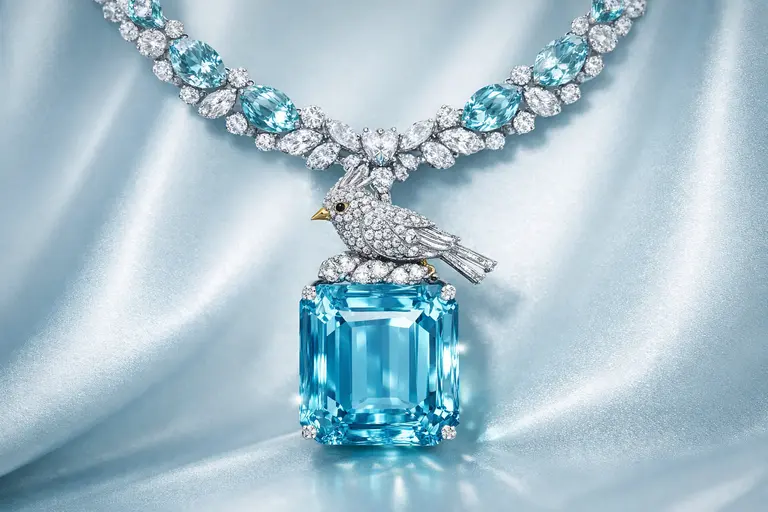
The collection also includes new iterations of Bird on a Rock—one of the house’s most iconic signatures, introduced in 1965. A statement necklace in this story places diamond birds above a 22-carat Santa Maria-hued aquamarine from Brazil. This stone is particularly notable for its saturated blue color. Similarly, the Paradise Bird story pushes the collection toward fantasy through vibrant brooches centered on unusual gemstones with intense color profiles.
Mozambique Rubies in the 2026 Collection
Finally, the Palm story introduces diamond-set leaves paired with unenhanced rubies from Mozambique. These rubies are untreated, meaning they have not undergone heat treatment to improve their color. This highlights Tiffany’s commitment to “pure” sourcing. The rhythmic composition of the leaves mimics the gentle movement of trees in the sun, bringing a sense of warmth and vibrance to the collection. This attention to natural beauty is similar to why Indian designers choose raw diamond and Polki jewelry.
Sourcing the World’s Rarest Gemstones
The “Hidden Garden” theme captures the media headlines, but the gemstones themselves do much of the real financial work. High jewelry is not only about beautiful design; it is also about exclusive access to stones rare enough to justify the prestige of a Blue Book collection. That is why Tiffany emphasizes both exceptional diamonds and unusual colored gemstones throughout the 2026 release. By featuring padparadscha sapphires, kunzites, and yellow diamonds, the collection highlights the house’s sourcing power.
For everyday buyers, the lesson here is direct and powerful. If you pay a premium for any piece of jewelry, you should ask yourself what that premium is actually attached to. Does the price reflect the rarity of the gemstone itself? Perhaps the meticulous craftsmanship justifies the cost. Alternatively, does the brand name drive the majority of the expense? Or is it mainly the marketing aura around the product? Blue Book pieces often combine all of those layers into a single object. Everyday retail jewelry often does not. Therefore, consumers must separate ‘intrinsic value’ from ‘luxury image’ before they spend their capital. Understanding the silver supply chain from mine to jewelry can help you visualize where the raw material costs truly lie
Marketing the Tiffany Blue Book 2026 Launch
Tiffany Blue Book 2026 works on several psychological levels at once, and that is precisely why it remains so influential in the LVMH era. First, it acts as a design showcase. Even people who will never buy a high-jewelry necklace want to see what Tiffany can create when budget and rarity are pushed to their absolute limits.
Second, Blue Book functions as a carefully staged luxury event. Tiffany does not simply release the collection and wait for clients to appear. Instead, it builds the launch through curated editorial imagery and celebrity appearances. That process extends the collection’s reach far beyond the small circle of actual billionaires.
Third, and most relevantly for ordinary buyers, Blue Book creates what marketers call a “halo effect.” The existence of a spectacular high-jewelry collection makes the rest of Tiffany’s product universe feel more glamorous. The customer buying a relatively accessible Tiffany piece is not buying Blue Book. However, that customer is still buying into the prestige that Blue Book helps build every year. Understanding how this engine works helps you become a clearer-eyed buyer. You begin to see where the “prestige markup” ends and the “material value” begins. This awareness is similar to knowing how scent marketing works in jewelry and watch stores to influence your mood.
Indian Houses vs. the Tiffany Blue Book 2026 Model
India possesses one of the world’s oldest and most sophisticated jewelry cultures. Therefore, a comparison between Tiffany Blue Book 2026 and Indian high jewelry is inevitable. However, the two markets operate on very different business models.
Understanding Resale Value in Luxury Assets
In much of the Indian jewelry market, gold purity and resale value still play a central role in the buyer’s mind. As a result, many large Indian jewelry houses focus on collections that can scale across hundreds of stores. They prioritize “investment-grade” gold and bridal demand. The commercial engine, in other words, runs on a different fuel than the Western “one-of-a-kind” model. This is a primary feature of the Chow Tai Fook business model as well, which prioritizes volume and trust.
Global Influence of New York High Jewelry
The marketing ecosystem is also structured differently. Tiffany benefits from a global red-carpet machine that turns a single launch into worldwide content. Indian jewelry certainly has glamour and celebrity power; however, the infrastructure that converts a launch into a global “moment” does not yet operate in the same way. Even so, India has the “bench power” to compete. A growing number of Indian designers are moving toward global high-jewelry positioning to challenge the status quo.
Comparing Jaipur’s Heritage to Western Prestige
If one were to look for an Indian institution that mirrors the prestige of a Blue Book heritage, Gem Palace Jaipur stands as the primary example. The Kasliwal family, who have served as jewelers to royalty since the 1700s, operates with a philosophy that actually predates the Western luxury model.
While Tiffany relies on a public, media-driven showcase, Gem Palace has traditionally operated on a model of “private trust.” Their most spectacular pieces are often shown in private suites or family havelis, rather than on a public stage. This “discreet luxury” model is highly effective. It relies on multi-generational relationships and deep connoisseurship. This contrast shows that there are two ways to achieve high-jewelry status:
- The Public Model (Tiffany): High-visibility, annual launches, and celebrity marketing.
- The Heritage Model (Gem Palace): Private continuity, artisanal loyalty, and word-of-mouth prestige.
Both models produce extraordinary results. For the ordinary buyer, the lesson is that you can find “Blue Book quality” in many places if you know how to look for craftsmanship and stone quality rather than just a logo. To understand the ancient roots of this Indian expertise, you can read our guide on Sanskrit gem knowledge in ancient trade.
Investing in Tiffany Blue Book 2026 Masterpieces
This is a critical section for anyone viewing jewelry as a financial asset. A Tiffany Blue Book 2026 masterpiece is a “collectible luxury object,” not a liquid commodity. Should a piece carry strong provenance or a historically significant gemstone, its value may appreciate at auction. However, the retail markup on high jewelry is significant. Because this markup covers design and global marketing, short-term resale can often disappoint.
Reality of the High-Jewelry Secondary Market
Some Blue Book pieces perform exceptionally well at auction. If a piece has strong provenance (for example, if it was owned by a celebrity) or if it features a “historically significant” gemstone, its value may appreciate. However, the retail markup on high jewelry is significant. This markup covers the costs of design, high-end retail locations, and the global marketing campaigns described earlier. Therefore, if you try to sell a high-end jewelry piece shortly after buying it, you will almost certainly lose money.
Comparing Bullion to the 2026 Collection
For pure investment, a standard gold bar or a certified GIA diamond is more efficient. High jewelry, by contrast, is more like buying a fine painting. You are paying for the artist’s vision and the brand’s story. If your goal is to protect your wealth against inflation, focus on the silver supply chain from mine to jewelry and gold purity standards. If your goal is to own a piece of history, then a Blue Book jewel makes sense.
Critical Takeaways for Every Jewelry Buyer
Tiffany Blue Book 2026 ultimately teaches several practical lessons that apply to any jewelry purchase you make.
Analyzing the Luxury Brand Premium
Realize that a significant portion of the price of a luxury item is for the packaging. Ask yourself if the gemstone itself justifies the investment. Furthermore, you should look for “untreated” stones. Prioritize unheated sapphires or rubies, as these are the materials that houses use to sustain their reputations.
Ultimately, Blue Book is a masterclass in “aspirational living.” By studying it, you can learn to admire the art without being blinded by the hype. You can then take those principles and apply them to your own jewelry collection, ensuring that every piece you own has both material value and personal meaning.
Valuing the Human Hand and Storytelling
In an age where skills are being automated, look for jewelry that shows artisanal work. The “imperfections” of a hand-set stone often carry more soul than a computer-perfect casting. This is especially true for raw diamond and Polki jewelry in India. Additionally, consider the narrative behind your purchase. A jewel that carries your family’s story can matter far more than one that carries a global logo.
FAQ About Tiffany Blue Book 2026
What exactly is the theme of Tiffany Blue Book 2026?
The 2026 theme is Hidden Garden, which explores a secret landscape of nature’s quiet transformations through seven distinct design chapters.
Who designed the Tiffany Blue Book 2026 collection?
Nathalie Verdeille, the Chief Artistic Officer of Jewelry and High Jewelry, designed the collection alongside the Tiffany Design Studio.
What is the most famous gemstone in the 2026 collection?
The most famous stone is arguably the 22-carat Santa Maria-hued aquamarine from Brazil, featured in the “Bird on a Rock” statement necklace.
Are the rubies in the Hidden Garden collection heated?
No, the rubies used in the Palm story are extraordinary unenhanced rubies from Mozambique, chosen for their natural vibrance and warmth.
Why does Tiffany reinterpret Jean Schlumberger’s designs?
Schlumberger is a cornerstone of Tiffany’s high-jewelry heritage. Reinterpreting his work allows the brand to celebrate its history while using modern technology to create even more complex sculptural masterpieces.
Can I view the 2026 Blue Book collection in person?
Highlights from the collection are often displayed at Tiffany’s flagship “Landmark” store in New York or through private exhibitions in major global cities for top-tier clients.
Disclaimer
This article is for educational and consumer-awareness purposes only. High-jewelry investments are speculative and subject to market fluctuations. The author has no financial affiliation with Tiffany & Co. or LVMH. Always consult with a certified gemologist and an independent financial advisor before making significant jewelry or gemstone purchases. Production details and motifs for the Tiffany Blue Book 2026 collection are based on official information from Tiffany & Co. at the time of writing. For official details, please visit the . official website.