Introduction to Sanskrit Gem Knowledge in Ancient Trade
Sanskrit did not build the modern gem industry. Today, that industry runs on laboratory science, spectroscopy, and grading systems developed by institutions such as the Gemological Institute of America (GIA). However, this does not mean Sanskrit played no role in history. In fact, Sanskrit gem knowledge in ancient trade preserved some of the earliest discussions of gemstones, pearls, and provenance.
This distinction matters deeply for historians and collectors alike. If we overstate the role of ancient texts, we mislead readers; conversely, if we dismiss them entirely, we erase a major chapter in commercial history. Sanskrit texts helped preserve an early gem tradition within a civilization that played a central part in the global trade of diamonds and rubies. Consequently, these records shaped the evaluative culture of the trade long before any modern laboratory existed. This historical foundation is as critical as understanding the silver supply chain from mine to jewelry today.
Preserving Sanskrit Gem Knowledge in Ancient Trade
Sanskrit matters because it became the primary language of scholarship, law, and technical writing in ancient India. Once a language takes on this role, it becomes a vehicle for preserving specialized technical knowledge. In the ancient world, gemstones were never simply decorative; instead, they were tied to kingship, ritual practice, and astrology.
Therefore, texts that discussed gems went well beyond poetry. They classified stones, identified defects, and distinguished superior material from inferior ones. While trade was multilingual, involving Prakrits and Persian, Sanskrit became the formal medium for organizing this information. As a result, merchants could transmit knowledge across generations with high accuracy. This systematic approach mirrors the oversight of industry sheepdogs in tech and jewelry who protect market integrity today.
Global Impact of Sanskrit Gem Knowledge in Ancient Trade
To understand the reach of Sanskrit gem knowledge in ancient trade, one must first recognize India’s historical dominance. For centuries, India served as the world’s exclusive source of diamonds. Furthermore, Indian ports connected the subcontinent to the Roman world, Arabia, and Southeast Asia.
Goods moved by sea across the Arabian Sea and overland through Persian routes. Because of this wide commercial reach, Indian ideas about quality traveled alongside the stones themselves. A language tied to a major luxury economy has a greater chance of leaving traces in world trade. Specifically, Indian gemstone names and trade habits became standard across multiple networks. This global influence is a primary goal for those building India’s global brands in the 21st century.
The Arthashastra and Sanskrit Gem Knowledge in Ancient Trade
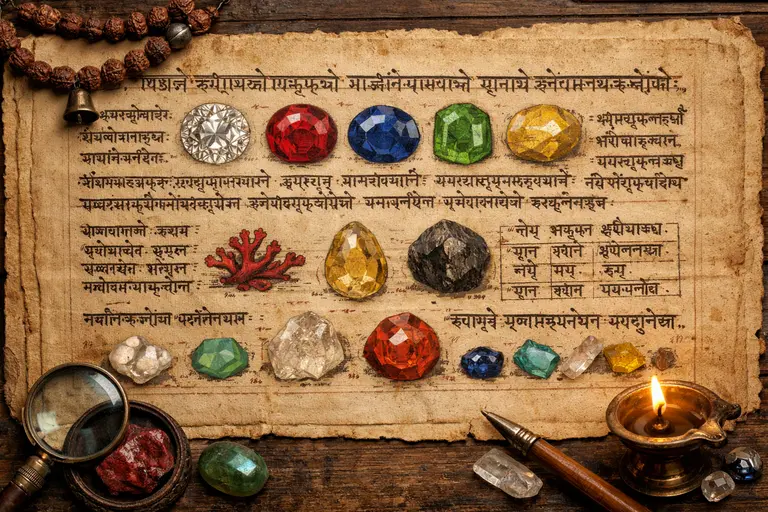
The strongest case for the importance of Sanskrit lies in the actual surviving texts. One of the most significant is the Arthashastra, written by the scholar Kautilya. This work contains a detailed section on examining gems entering the royal treasury. Notably, it includes a classification of pearls by their source and quality.
This matters for two reasons. First, it proves that ancient officials were already paying attention to practical evaluation. Second, it shows that provenance was a core factor in assigning value. For example, the text names specific pearls from the Tamraparni River in Tamil Nadu. Later works, such as the Ratnapariksha expanded on this by discussing color and testing methods. Therefore, Sanskrit literature helped preserve an early Indian habit of examining gems in a structured way. This tradition remains relevant as gold demand shifting from jewelry to investment changes how we value materials today.
Linguistic Traces of Sanskrit Gem Knowledge in Ancient Trade
Sanskrit’s influence becomes even clearer when we examine modern vocabulary. Not every gem name comes from India, yet several traces are hard to ignore. The best-known example is “corundum,” the species containing ruby and sapphire. Scholars generally trace this word through the Tamil kurundam to the Sanskrit kuruvinda.
Similarly, the word “opal” likely carries an Indian connection. Most authorities derive it from the Sanskrit upala, meaning a precious stone. While some etymologies remain debated, the Indic connection remains the leading theory in many cases. Furthermore, “beryl” often links back to the Sanskrit vaidurya. By examining these words, we see that Sanskrit gem knowledge in ancient trade provided a linguistic framework for the entire world. This cultural exchange is similar to the Portuguese and Indian filigree jewelry connection.
Comparing Sanskrit Gem Knowledge to Modern Science
We must clarify that modern gemology is a scientific achievement of the 20th century. Standardized systems like the 4Cs did not descend directly from Sanskrit grammar. Instead, they developed through mineralogy and chemistry.
Ancient texts belong to the earlier history of gem description. They show that traders were already focused on features that still matter today: color, purity, and origin. In that broad sense, Sanskrit texts preserve an early culture of gem examination. However, they are not a substitute for a modern grading report from an institution like IGI (International Gemological Institute). Understanding this distinction helps consumers appreciate both the history and the science of their jewelry.
FAQ About Sanskrit Gem Knowledge in Ancient Trade
Did Sanskrit texts describe diamond cuts?
Ancient texts focused more on the natural crystal shape and clarity rather than modern facets. They valued “perfect” natural octahedral crystals over artificial cuts.
Which Sanskrit text is best for gem history?
The Arthashastra is considered the most important for its early administrative and commercial focus on gemstone quality and treasury management.
How did Indian gem ideas reach Rome?
Merchants carried these ideas through the maritime trade routes of the Indian Ocean and the overland Silk Road, often using Sanskrit-derived terms to describe their cargo.
Is “Ratna-shastra” still practiced today?
Yes, many traditional jewelers and astrologers still refer to the Ratna-shastra (the science of gems) for ritual and symbolic purposes, though commercial trade uses modern lab standards.
Did ancient Indians know about synthetic gems?
No, synthetic gems are a modern invention. However, ancient texts did warn against “simulants” or glass imitations designed to deceive buyers.
Disclaimer
This article provides a historical overview and simplifies complex etymological and archaeological subjects. The author has no financial affiliation with the institutions mentioned. Readers should consult peer-reviewed sources for technical or academic research. Modern gem grading should always rely on certified laboratory reports.