Introduction to Tavernier’s Diamond Trade
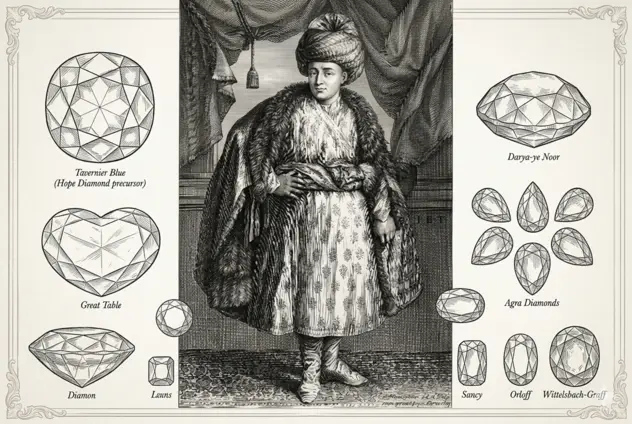
Jean-Baptiste Tavernier was a daring French merchant who fundamentally reshaped the modern diamond industry. Between 1630 and 1668, he completed six arduous trips to the Kingdom of Golconda in India. At that time, this region served as the world’s exclusive source of large, high-quality diamonds. Along his journey, he carefully studied how local traders bought, graded, and sold these precious gems. Notably, he performed these observations long before modern gemology ever existed. As a result, his written records provide one of the clearest windows into the functioning of the global gem market centuries ago. Furthermore, his insights still influence how we discuss diamond quality in the present day. This article explores Tavernier’s Diamond Trade, his innovative methods, and his most famous transactions. You should also read our guide on gemstone buying mistakes to understand how ancient grading systems compare to modern certifications.
The Hub of Tavernier’s Diamond Trade: Golconda
Tavernier focused his attention on two primary locations during his Indian expeditions. First, the Kollur mines served as the principal extraction sites. In these dusty fields, buyers often purchased raw stones directly from the miners. Additionally, the fortress city of Golconda—located near modern-day Hyderabad—acted as the central commercial hub. This city was where the largest and most valuable deals took place under the watchful eye of the Sultans.
Moreover, Tavernier operated as a highly successful private merchant. He successfully negotiated with both independent miners and powerful local brokers. During one of these historic visits, he acquired the legendary 112-carat “Tavernier Blue” diamond. This direct, hands-on approach allowed him to secure the finest specimens. Subsequently, many of these stones ended up in the private collections of European royalty. Consequently, his influence on the Western perception of Indian wealth was immense. To explore more about the history of these mines, visit the Smithsonian Institution’s records.
Payment Rules in Tavernier’s Diamond Trade
Payment rules remained incredibly strict throughout the Indian markets. Specifically, traders only accepted physical cash in the form of gold coins, such as pagodas or gold rupees. In contrast, bartering with finished goods was simply not acceptable for high-value gems. Therefore, Tavernier and his peers had to carry massive amounts of gold at all times. Meanwhile, local brokers managed the movement of stones from remote mines to major cities like Agra. Additionally, miners paid significant royalties to their regional kings, which created a steady income stream for the Sultanate.
Grading Methods in Tavernier’s Diamond Trade
In the 17th century, Tavernier described the finest diamonds as having the “finest water.” This term meant the stone appeared exceptionally clear and pure, resembling a drop of clean spring water. This simple ranking system allowed traders to categorize stones quickly. Specifically, Tavernier valued colorless diamonds above all others. Ironically, his most famous find was a stone he described as “violet,” which we now recognize as a stunning shade of blue.
Furthermore, traders evaluated four specific characteristics: color, clarity, total size, and the presence of internal cracks. Flaws often appeared when miners struck the host rock too forcefully during the extraction process. Consequently, damaged stones received significantly lower grades and sold for less money. Therefore, careful mining techniques mattered greatly to everyone in the supply chain. Today, we use similar criteria, which you can study through the Gemological Institute of America.
Weight Standardization in Tavernier’s Diamond Trade
Weight measurement presented a major challenge for Tavernier’s Diamond Trade. Different mining regions utilized their own local units, including mangelins, grains, and ratis. Because these units varied wildly from one district to another, serious confusion often arose during international transactions.
To solve this persistent problem, Tavernier converted all weights into “Florentine carats” (roughly 0.1972 grams) for his European clientele. Even a microscopic error in this conversion could change a final sale price by thousands of livres. Consequently, successful merchants needed advanced mathematical skills in addition to a keen eye for gemstones. This standardization was a revolutionary step in making Tavernier’s Diamond Trade a truly global enterprise.
Silent Bargaining within Tavernier’s Diamond Trade
One of the most fascinating aspects of Tavernier’s Diamond Trade was the use of a “silent” bargaining method. To keep deal prices private, buyers and sellers held hands under a large piece of cloth. They would press each other’s fingers in specific patterns to represent numbers and bids. As a result, this technique prevented spies, rivals, and government tax collectors from learning the true price of any transaction. This level of discretion ensured that Tavernier could maintain his competitive advantage in the high-stakes world of 17th-century commerce.
The Logistics of Tavernier’s Diamond Trade
Tavernier transported his gems back to Europe primarily through overland caravan routes across the Middle East. This journey often took several years to complete and was fraught with danger. His route usually began in Golconda, moving through Mughal trade hubs like Surat and Ahmedabad. Next, he crossed the sea to Persia before traveling overland through Isfahan, Baghdad, and Aleppo.
Security remained the absolute top priority throughout these voyages. Tavernier typically traveled with a private army of around 60 guards to protect against desert raiders. Additionally, he often joined massive merchant caravans for collective protection. Furthermore, he strategically gave expensive gifts—such as French mechanical watches—to local rulers. He did this to secure safe passage and avoid corrupt inspections at border crossings. Consequently, his survival was as much a feat of diplomacy as it was of logistics.
The French Crown and Tavernier’s Diamond Trade
In December 1668, Tavernier met with King Louis XIV to present his final Indian collection. Subsequently, in February 1669, the “Sun King” purchased the entire lot for 220,000 livres. This collection included the 112-carat Tavernier Blue. In recognition of this massive deal, Louis XIV also granted Tavernier a title of nobility.
Recutting Gems from Tavernier’s Diamond Trade
It is important to understand that the Tavernier Blue underwent significant changes after the sale. In 1673, the king ordered court jeweler Jean Pitau to recut the stone into a 69-carat gem known as the “French Blue.” Later, during the chaos of the French Revolution in 1792, thieves stole the stone from the royal storehouse. It eventually resurfaced in London in 1812, recut yet again to hide its royal identity. Today, we know this legendary stone as the Hope Diamond.
FAQ: Understanding Tavernier’s Diamond Trade
How did Tavernier communicate with Indian merchants?
Tavernier spoke fluent Persian, which was the official court language of the Mughal Empire. He also employed professional interpreters to speak with local miners who used regional dialects.
What does “finest water” mean in diamond grading?
It is an ancient term used during Tavernier’s Diamond Trade to describe diamonds with exceptional transparency and a lack of body color.
Was the Hope Diamond always blue?
Yes, but Tavernier originally described it as “violet.” This was simply the 17th-century terminology for a deep, saturated blue hue.
How did Tavernier protect his diamonds from thieves?
He traveled with 60 armed guards, joined large caravans, and used secret “finger-touch” bargaining to hide the value of his transactions from onlookers.
Are Golconda diamonds still available today?
The mines are largely exhausted. However, “Golconda” remains a premium trade term for Type IIa diamonds that exhibit the same legendary clarity Tavernier documented.
Disclaimer
This article draws from Jean-Baptiste Tavernier’s published travelogues (Les Six Voyages de Jean-Baptiste Tavernier, 1676), the Smithsonian Institution’s Hope Diamond records, and secondary historical analyses. Sale dates, monetary values, and carat weights may vary across scholarly sources due to differences in historical conversion methods and interpretation of original documents. This content is intended for educational purposes only and does not constitute professional gemological or historical advice. For expert guidance, please consult a certified gemologist or an academic historian who specializes in 17th-century trade history.