Introduction to Lipstick vs Gemstone Testing
Millions of people apply lipstick every day, yet few realize that a single tube passes through months of scientific testing before it reaches a store shelf. Meanwhile, colored gemstones undergo an equally rigorous process before they reach a jeweler’s counter. Although a lipstick and a faceted ruby seem entirely unrelated, both industries depend on the same core sciences: optics, chemistry, and microscopy. Therefore, this article explains the fascinating world of lipstick vs gemstone testing, exploring how these methods protect consumers in 2026.
Notably, the goal for both sectors is absolute consistency. While a beauty brand must ensure every batch of a specific shade looks identical, a gemological laboratory must verify that a stone’s color and origin match its certificate. Consequently, both fields rely on specialized instruments to reveal details that the human eye cannot detect. By understanding these processes, you can make smarter purchasing decisions and appreciate the technical oversight that maintains market integrity. To learn more about how these professional standards are maintained, you can read our guide on industry sheepdogs in tech and jewelry.
Cosmetic Preparation for Lipstick vs Gemstone Testing
First, specialized laboratories check physical durability. Technicians press a fully extended lipstick bullet until it breaks; the measured force shows whether the formula balances hardness with flexibility. Next, texture analyzers measure the “glide” and application feel. This step ensures that chemists avoid a product that feels sticky or grainy to the wearer. In addition, quality-control teams inspect the formula under a microscope to catch coarse pigment particles early.
Afterward, environmental chambers test the lipstick at both extreme cold and warm temperatures, often reaching 40°C. This confirms that the product will not melt or “sweat” during shipping through tropical climates like those in India. Alongside this, light-aging tests check whether the color holds up under strong store lighting. Packaging studies further confirm that the formula stays stable inside its container without reacting to the plastic or metal. Every approved product meets strict safety and performance standards before it reaches a retail shelf. This focus on reliability is a core lesson in building India’s global brands.
Product Lifespans in Lipstick vs Gemstone Testing
Even a well-made luxury lipstick does not last forever. Generally, an opened bullet lipstick stays usable for twelve to twenty-four months when you store it in a cool, dry place. In contrast, liquid lipsticks and glosses spoil faster because their applicators repeatedly introduce air and bacteria into the tube. Consequently, most packaging carries a small “Period After Opening” (PAO) symbol, shown as an open jar with a number like “12M.”
Nevertheless, shoppers should still inspect the product itself regardless of the date. A rancid smell, unusual dryness, or uneven application signals that the product belongs in the bin. Specifically, in humid regions, mold can develop if the preservatives break down. This biological vigilance is similar to how the grading standards for juice and gemstones prioritize chemical purity and consumer safety. For further reading, consult the U.S. Food and Drug Administration’s cosmetics resources.
Scientific Logic of Lipstick vs Gemstone Testing
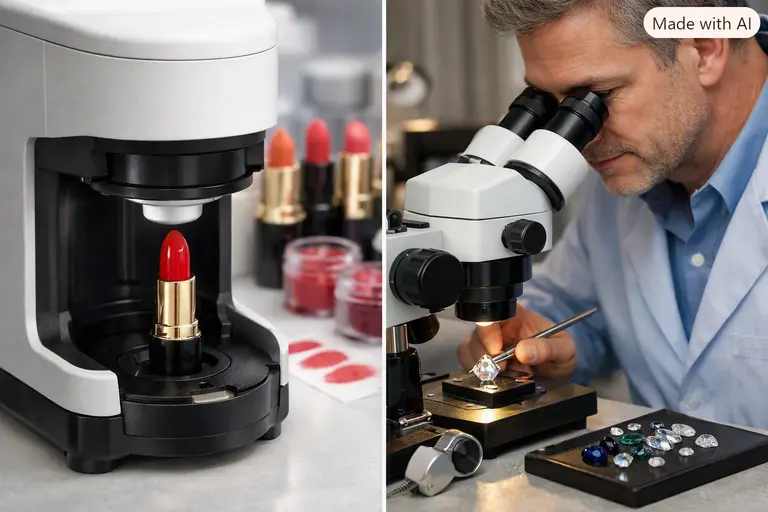
Interestingly, several lipstick tests closely mirror the tools gemologists use every day. Both industries require the same level of lipstick vs gemstone testing precision to verify their claims.
Optical Tools for Lipstick vs Gemstone Testing
Cosmetic scientists rely on spectrophotometers to match lipstick color across batches. Similarly, gemological laboratories use spectroscopes to study how a stone absorbs light. This helps identify a gem’s species and separate natural stones from lab-grown twins. Because color is the primary value driver for both items, these optical measurements are non-negotiable for quality control.
UV Reactions in Lipstick vs Gemstone Testing
Ultraviolet light also plays a vital role in both fields. Cosmetic labs use UV light to study pigments and detect residues that might indicate contamination. Gemologists routinely examine stones under longwave and shortwave UV to spot fluorescence. This can support identification or reveal certain chemical treatments in colored gemstones, such as oiling in emeralds. For official gemstone grading, you can visit the Gemological Institute of America (GIA).
Internal Analysis in Lipstick vs Gemstone Testing
Microscopy connects the two industries through the study of internal structures. Cosmetic chemists inspect pigment particles for even dispersion to ensure a smooth finish. In turn, gemologists study internal “inclusions” that reveal a gemstone’s origin and authenticity. Additionally, while cosmetic labs check if lipstick withstands heat, gemologists use thermal conductivity to identify diamonds. Because diamonds conduct heat far better than most simulants, this test is a quick way to verify carbon purity.
Chemical Accuracy for Lipstick vs Gemstone Testing
Lastly, cosmetic laboratories use Inductively Coupled Plasma Mass Spectrometry (ICP-MS) to confirm that heavy metal levels like lead stay within safety limits. In turn, gemological laboratories use a related laser-based technique called LA-ICP-MS to study trace elements in sapphires and rubies. Specifically, these trace elements can support geographic origin research, such as identifying a stone as a “Kashmir” sapphire. This level of data is essential for a gem trading survival guide in the modern market.
Overall, although shoppers rarely see any of this testing, it builds real confidence in both industries. Cosmetic testing keeps products safe for your skin, while gemological testing helps you trust the value of your jewelry. Ultimately, both fields prove that accurate scientific instruments reveal far more than the naked eye could ever see. This level of critical thinking in modern gemology is what keeps the luxury market honest.
FAQ About Lipstick vs Gemstone Testing
Do lipstick testing and gemstone testing serve the same purpose?
No, they do not. Lipstick testing focuses primarily on safety, shelf-life, and color consistency. Gemstone testing focuses on identifying the mineral species and detecting any artificial enhancements or treatments.
Why do manufacturers rely on spectrophotometers?
Manufacturers use these tools because they provide objective, mathematical color readings. This ensures that every lipstick in a specific line looks the same, regardless of which factory produced it.
Is it possible for a gemstone to “expire” like a lipstick?
No. Natural gemstones are inorganic minerals and do not expire. However, some treatments, like oiling in emeralds, can dry out over time, making the stone appear less clear.
How can I tell if my lipstick is no longer safe to wear?
You should watch for warning signs such as a “vinegar” or waxy smell, a change in texture (becoming too dry or too soft), or any skin irritation after use. If these occur, discard the product immediately.
Why do gemologists examine stones under ultraviolet light?
Gemologists use UV light to look for a specific glow called fluorescence. Specifically, this reaction can help determine if a diamond is natural or if a ruby has been heat-treated with chemicals.
Disclaimer
This article serves general educational purposes only. The author has no financial affiliation with the cosmetics or gemological equipment manufacturers mentioned. Testing procedures vary by brand and laboratory. Always follow manufacturer instructions for makeup safety and consult a certified gemological laboratory like the GIA for high-value gemstone identification. Data reflects industry practices as of August 2026.