Introduction
GIA Origin Reports 2026 bring a major update to the gem industry. Starting January 1, 2026, the Gemological Institute of America (GIA) will begin origin-determination services for Opal, Peridot, and Demantoid Garnet. As a result, this expansion reshapes how buyers in Kerala, Tamil Nadu, and Karnataka evaluate gemstone value and authenticity.
In addition, this article explains the new rules, the redesigned reports, and why this update will change how you price these stones.
Expanding the List: How GIA Origin Reports 2026 Add New Gemstones
This service builds on GIA’s existing prestige. GIA currently offers origin reports for Alexandrite, Emerald, Paraíba Tourmaline, Red Spinel, Ruby, and Sapphire. In addition, they added origin services for untreated Jadeite Jade and Omphacite Jade from Myanmar and Guatemala.
Now, starting in 2026, three new gemstones join this list:
- Opal: Distinguishing Australian (Lightning Ridge) from Ethiopian (Welo).
- Peridot: Tracing origins to Arizona, Pakistan, or Myanmar.
- Demantoid Garnet: Confirming Russian sources versus Namibian material.
Shane McClure, GIA’s global director of colored stone services, says this expansion is backed by decades of research. GIA collected over 32,000 samples through field gemologists to create a reliable global database. When GIA assigns an origin, it is based on proven scientific data.
Why GIA Origin Reports 2026 Matter for You
You may wonder: “I am buying a ring in Kochi or Chennai. Why should I care if the Peridot came from Pakistan or Arizona?”
So, the answer is simple: Value.
Origin determination identifies where your gem formed. GIA uses chemical analysis and inclusion mapping to trace it.
Opal Price Gap Explained in the GIA Origin Reports 2026 Update
Opal is popular in India due to astrology (Venus/Shukra). However, prices vary widely.
- Australian Black Opal: Rare, stable, and extremely valuable.
- Ethiopian Opal: Attractive but usually hydrophane (absorbs water) and more affordable.
As a result, without an origin report, a dishonest dealer may sell Ethiopian Opal at Australian prices. This new GIA service protects your purchase.
Demantoid Horsetail and GIA Origin Reports 2026
Demantoid is among the rarest garnets. Collectors prize Russian stones for their signature horsetail inclusions.
Because of this, Russian Demantoid often commands higher prices than Namibian or Madagascan material. Now, a GIA report confirms this origin officially.
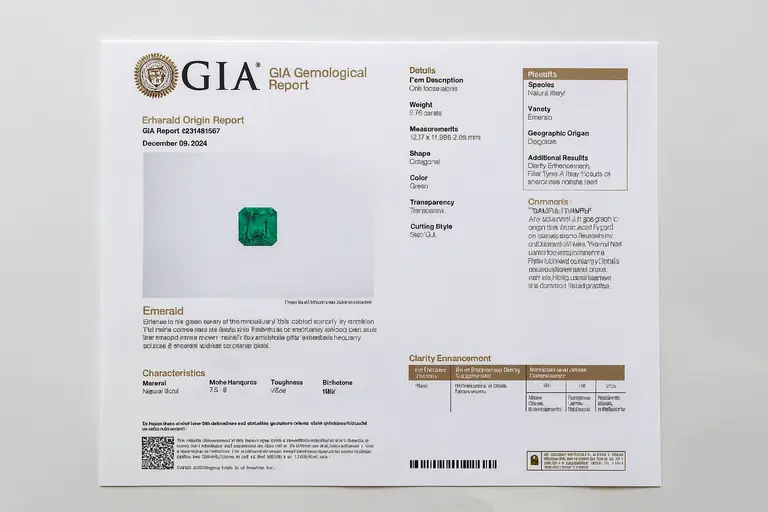
Redesigned Colored Stone Reports for 2026
GIA is also redesigning its colored stone reports.
In 2026, the new format introduces:
- First, Simpler storytelling: Older reports were technical. New ones use clearer diagrams.
- Next, Cleaner layout: Key information appears upfront.
- Finally, Digital integration: Faster loading digital reports for WhatsApp sharing.
Overall, this redesign reflects feedback from dealers who want quick, readable data.
Updated Fees and Weight Categories in GIA Origin Reports 2026
New weight categories and fees take effect on January 1, 2026.
- New tiers: Stones are grouped more logically by weight.
- Cost: Origin service adds ₹4,000 to ₹17,000 (US $50–$200), depending on size.
So, if you hold high-value Opals or Demantoids, consider submitting them after the update to take advantage of the new “Origin” classification.
How to Submit Stones for GIA Origin Reports 2026 in India
If you’re in Kerala, Tamil Nadu, or Karnataka, the GIA India Laboratory in Mumbai handles submissions.
To begin, follow these steps:
- Create an account on the GIA portal.
- Then, select “Identification and Origin” on the form.
- Pack securely and ship via insured services (Malca-Amit or Sequel).
- Processing takes 4–8 weeks. Rush options are available.
For this reason, my advice is simple: start by testing one high-value stone. Then, check if the confirmed origin increases your selling price.
Final Thoughts on GIA Origin Reports: A Win for Transparency
This update is a win for the consumer. Whether you’re buying a Peridot for its fresh green hue (which I compared to Meen Peera in my recent article) or an Opal for astrology, having verified proof of origin builds confidence.
As a result, as we enter 2026, the gemstone market becomes more transparent. So, use these tools to ensure that every stone you buy matches its price and promise.
FAQ
When does GIA start Opal origin services?
Services begin on January 1, 2026.
Which stones currently have origin reports?
As of now, GIA covers Alexandrite, Emerald, Paraíba Tourmaline, Red Spinel, Ruby, Sapphire, and Jade. Now, Opal, Peridot, and Demantoid join the list in 2026.
Does origin affect Peridot’s price?
Yes. Pakistan and Myanmar Peridot often show better size and color than Arizona material.
Where can I submit stones in India?
The most convenient location is the GIA Mumbai Lab. They serve the entire South Asian region with the same standards as GIA Carlsbad.
Do these reports cover treatments?
Yes. Treatment analysis is included. Moreover, origin is an additional layer.
Author Bio
P.J. Joseph, also known as Saju Elizamma, Gemstone & Gold Consultant serving Kerala, Tamil Nadu, and Karnataka.
Credits
This article draws on reporting originally published by National Jeweler.
Credit to journalist Lauren McLemore for first sharing GIA to Offer Origin Determination for 3 More Gemstones.
This story is adapted from the National Jeweler, a leading US-based trade publication and news source for the fine jewelry industry, with additional SEO and contextual research by Saju Elizamma.