Introduction to the Gem Trading Survival Guide
Gemstone trading is currently changing at lightning speed across the globe. Therefore, to survive as a gem trader today and over the next 100 years, you must pivot from being a simple middleman to becoming a master of absolute transparency. This gem trading survival guide identifies why you must embrace technological integration and alternative material markets to succeed in a competitive landscape.
Historically, the business relied on localized secrets and physical handshakes; however, the future demands global data verification and a completely rewritten definition of rarity. Whether you are a retail buyer seeking a secure investment or an aspiring dealer, you must understand these seismic shifts to protect your capital. To understand the roots of this industry more deeply, you can read our guide on Sanskrit gem knowledge in ancient trade.
Traceability: A Gem Trading Survival Guide Pillar
The current market defines its success through a record-high demand for fine colored stones and a massive push for verifiable proof of origin. Specifically, buyers now view government-issued lab reports and provenance as non-negotiable elements of a transaction. Consequently, modern survival requires implementing immutable ledger technology to log a stone’s journey from the mine to the consumer.
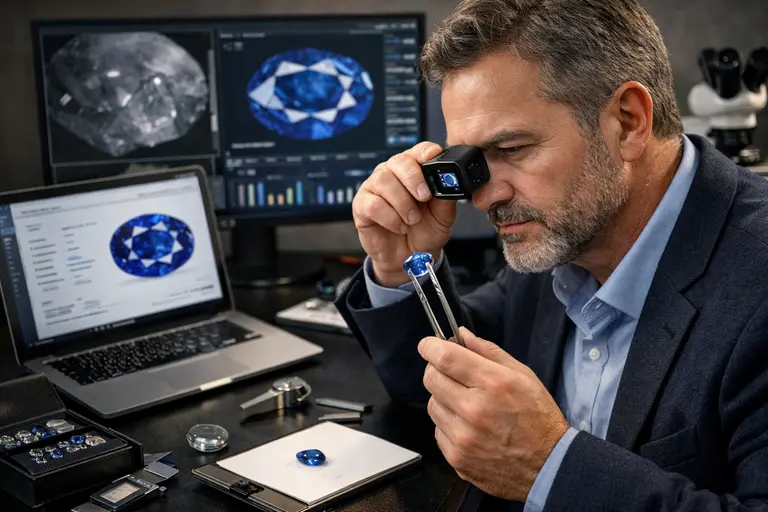
In fact, traditional regional monopolies are fading fast. This means that modern traders survive only by maintaining an active digital footprint. For instance, they utilize digital platforms for rapid transactions and source material directly across global hubs like Jaipur and Colombo. Furthermore, artificial intelligence is heavily entering major gemological laboratories to automate grading and detect synthetics. As a result, this gem trading survival guide recommends that traders understand AI-driven report data to defend their margins. If you want to dive deeper into these international standards, you can explore the Gemological Institute of America (GIA) to understand the baseline of authentication.
India’s Role in the Gem Trading Survival Guide
India provides a highly viable and increasingly robust ecosystem to achieve these future-proofing strategies. Nevertheless, it remains an ecosystem locked in a high-stakes battle between institutional modernization and entrenched socio-cultural traditionalism. For generations, multi-million dollar deals in traditional hubs have been executed on tiny scraps of paper. In contrast, introducing unalterable digital audit trails breaks the traditional cloak of regional anonymity.
To eliminate regional factionalism and unorganized trading, India has established massive centralized hubs that force transparency. Specifically, these infrastructure projects ensure that every player follows the same rules.
Industry Hubs in the Gem Trading Survival Guide
For example, the Surat Diamond Bourse consolidates operations directly at the factory source. This brings the world’s largest cutting and polishing hub under a single regulated trading floor. Similarly, the Jaipur Gem & Jewellery Bourse project brings over a thousand trading offices and advanced gem-testing labs under a single unified ecosystem. This grand infrastructure development directly forces centuries-old family businesses to comply with international traceability standards. Consequently, it makes it much easier for everyday buyers to access certified stocks. This level of oversight is usually managed by industry sheepdogs in tech and jewelry who protect market integrity.
Regional Fault Lines: Gem Trading Survival Guide Tips
You must also factor in the North-South cultural divide because it represents one of the most critical structural fault lines in the modern gem business. While the North dominates the global export and manufacturing of raw stones, South India stands as the powerhouse of domestic consumption and wealth preservation. Specifically, these regions view the intrinsic value of a gemstone through completely different cultural and financial lenses.
The Northern market treats jewelry heavily as a lifestyle statement and fashion accessory. Consequently, this results in a high tolerance for lower-karat gold to hold heavy gemstone settings. Conversely, the Southern market views jewelry primarily as a liquid asset class and a financial safety net. As a result, they remain fiercely loyal to 22-karat and 24-karat gold purity. Because of this structural difference, traditional Southern buyers are historically skeptical of heavy settings. Specifically, they view the weight of the stones as a factor that dilutes the “melt-value” of the gold. This is a vital lesson in building India’s global brands, where regional preferences dictate market penetration.
Future Realities in the Gem Trading Survival Guide
Over the next 100 years, near-surface gem deposits will face severe depletion. To stay in business, the entire market model must evolve toward a circular and recycled economy. Because natural gemstones are a finite, non-renewable resource, primary mining will shift heavily toward estate curation and re-cutting older jewelry. Therefore, the master traders of the next century will not look for gems in the ground. Instead, they will source them from existing private vaults and historical collections.
Furthermore, the stigma around lab-grown gems will likely vanish as technology creates structurally flawless stones. This evolution will eventually split the market into a dual-track reality. Specifically, the natural track will become an ultra-exclusive, hyper-luxury asset class for elite collectors. Meanwhile, the synthetic track will dominate the commercial consumer market. You can analyze these macro-economic shifts by studying the McKinsey Luxury Industry Insights, which tracks how high-net-worth demographics adapt to sustainable tech solutions.
Sourcing Solutions for the Gem Trading Survival Guide
To successfully navigate this evolving market, you should follow a structured approach to buying. First, you must demand verifiable digital audits and never purchase a significant gemstone based on verbal promises. You must insist on looking at a digital blockchain ledger or an AI-graded report. This verification ensures that the stone’s country of origin and treatment history are completely transparent.
Second, you should utilize modular jewelry designs if you worry about gemstones diluting the raw melt value of your metals. You should actively seek out modern systems that feature advanced designs with interchangeable gemstone cassettes. This engineering allows you to easily detach the gemstone module from the gold setting. Consequently, you can calculate or liquidate the exact weight of the metal at any moment without penalty. This gem trading survival guide suggests that these technologies help bridge the gap between beauty and financial security.
FAQ: Mastering the Gem Trading Survival Guide
How does AI grading change the value of gemstones?
AI grading removes human bias and community favoritism from the appraisal process. Consequently, this technology ensures that you receive an objective evaluation of the stone’s quality, which prevents dealers from artificially inflating prices.
Why is modular jewelry becoming popular?
Modular jewelry separates the gemstone from the high-purity metal setting using mechanical locking mechanisms. As a direct result, this design allows buyers to verify the exact weight of their gold without destroying the piece.
Will natural gemstones retain their value?
Yes, natural gemstones will likely appreciate significantly because they will become an ultra-rare historical asset class. While lab-grown stones dominate fashion, certified natural anomalies will become increasingly exclusive.
What is the risk of buying gems without a blockchain audit trail?
Buying without a digital audit trail exposes you to significant financial risks. Specifically, future international regulations will likely penalize untracked assets, making un-traceable stones incredibly difficult to resell through legitimate channels.
Does this gem trading survival guide apply to retail buyers?
Absolutely. Retail buyers must now act with the same level of technological scrutiny as professional dealers to protect their investments and ensure authenticity.
Disclaimer
This article provides educational information and does not constitute formal financial, investment, or legal advice. The author has no financial affiliation with the companies mentioned. Gemstone markets are inherently volatile; therefore, you should consult with certified professionals before making substantial capital allocations.