Introduction to LA ICP MS in Gemstone Testing
The rise of LA ICP MS in Gemstone Testing marks a significant shift in how the global jewelry industry verifies precious stones in 2026. Because of rapid technological progress, gemstone treatments have become far more advanced and difficult to detect. Moreover, synthetic stones now mimic natural gems with a level of accuracy that surprises even veteran collectors. At the same time, modern buyers increasingly demand proof that a gemstone is natural, untreated, and ethically sourced.
As a direct result of these shifts, traditional gemological tools no longer answer every critical question. While microscopes and refractometers still play a vital role, they often fall short when a laboratory needs to detect atomic-level treatments. Specifically, this is where the LA ICP MS in Gemstone Testing becomes an indispensable asset. The full name is“Laser Ablation Inductively Coupled Plasma Mass Spectrometry.” In plain terms, this instrument reads the chemical fingerprint of a stone with extraordinary precision. Today, major institutions like the Gemological Institute of America (GIA) rely on this technology for origin analysis. You should also read our guide on gemstone buying mistakes to understand how combining science with market knowledge protects your assets.
Why Old Methods Fail vs LA ICP MS in Gemstone Testing
Traditional gemological tools work exceptionally well for many basic tasks. For example, a refractometer separates a sapphire from common glass. Similarly, a high-power microscope reveals natural growth patterns and mineral inclusions. In addition, standard X-ray fluorescence systems can quickly identify several common elements.
Nevertheless, modern gem treatments frequently operate at a level these older tools simply cannot reach. Beryllium diffusion treatment, for instance, became one of the industry’s biggest challenges in the early 2000s. Treated sapphires flooded the market, yet standard X-ray systems could not detect the beryllium because it is an extremely light element. Consequently, LA ICP MS in Gemstone Testing changed the situation entirely. The instrument successfully identified trace amounts of beryllium hidden inside corundum. As a result, it helped laboratories separate treated stones from natural material once again. This technology is now essential for protecting the integrity of the gemstone trade.
The Mechanics of LA ICP MS in Gemstone Testing
The process of LA ICP MS in Gemstone Testing allows scientists to measure trace elements at incredibly low concentrations. Specifically, it detects elements down to parts-per-million and even parts-per-billion levels. Therefore, no other common tool in a jeweler’s toolkit comes close to this level of sensitivity.
Trace Element Analysis via LA ICP MS
Every gemstone forms under unique geological conditions millions of years ago. During this formation, a stone absorbs tiny amounts of surrounding minerals from the host rocks. Because these chemical environments differ from one region to another, each gemstone develops a unique signature. Furthermore, human-made treatments leave behind their own specific chemical clues. Analysts look for unusual concentrations of lithium, boron, and gallium. Consequently, these clues help laboratories draw solid scientific conclusions instead of relying only on visual guesswork. To learn more about the science of trace elements, visit the RRUF Database.
Detecting Treatments with LA ICP MS in Gemstone Testing
Gem treatments continue to evolve at a rapid pace in 2026. High-heat treatment now utilizes highly controlled atmospheric conditions to alter color. Moreover, clarity enhancement methods have grown more sophisticated over time. For instance, some emeralds now contain advanced polymer fillers that mimic the stone’s refractive index perfectly.
Because of these advances, visual inspection alone can easily miss treatment evidence. Therefore, LA ICP MS in Gemstone Testing provides a reliable scientific method to detect the chemical residues that these treatments leave behind. Specifically, the instrument can detect flux residues or glass components used to fill fractures. As a result, this technology adds a much-needed layer of confidence to every laboratory report. You may also read our article on Understanding BIS Hallmark to see how certification protects you in other areas of the luxury market.
Determining Gem Origin with LA ICP MS
Geographic origin now plays a massive role in determining a gemstone’s market value. For example, a ruby from Myanmar (Burma) often sells for significantly more than a similar ruby from Mozambique. Likewise, Colombian emeralds frequently carry higher price tags than those from Zambia.
Because of these extreme price differences, laboratories require strong scientific support before they issue an origin report. Fortunately, LA ICP MS in Gemstone Testing makes this identification possible. By comparing trace-element patterns against massive reference databases, scientists can identify the exact region where a stone formed. Although origin determination is a complex field, chemical fingerprinting remains the most reliable support available today. Consequently, buyers can make more informed decisions based on credible, data-driven reports from institutions like the Swiss Gemmological Institute (SSEF).
Identifying Synthetic Gems using LA ICP MS
Synthetic gemstones have improved their quality enormously in recent years. Specifically, hydrothermal and flux-grown stones now display convincing internal features that can fool an untrained eye. In some cases, therefore, visual separation becomes difficult even for expert gemologists.
However, laboratory-grown stones still carry chemical evidence tied to their artificial growth environments. For example, LA ICP MS can detect tiny traces of platinum contamination from the synthetic growth crucibles. Natural gemstones, by contrast, typically display more complex and irregular trace-element patterns formed over millions of years underground. Therefore, trace-element fingerprinting adds a reliable safeguard in the identification process. Even as synthetic producers improve their methods, replicating the chaotic chemistry of nature remains almost impossible.
Safety of LA ICP MS in Gemstone Testing
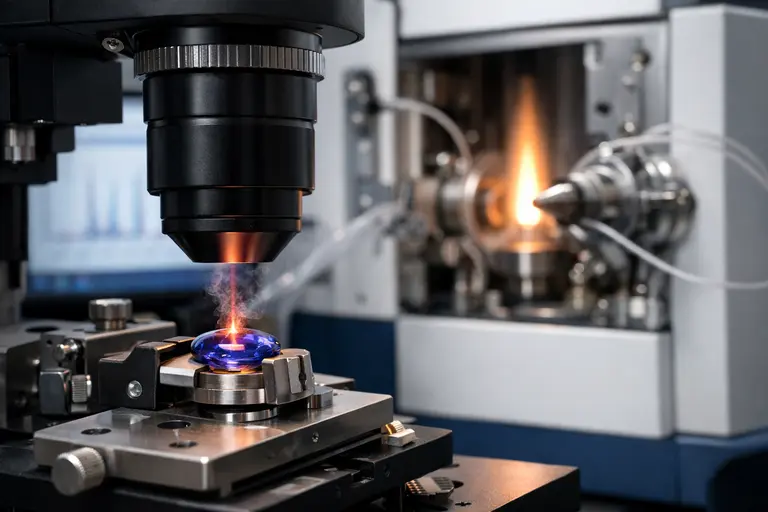
One major reason LA ICP MS in Gemstone Testing gained wide acceptance is its safety for finished stones. Traditional mass spectrometry often required dissolving a sample in acid, which is impossible for a valuable jewel. This technology solves the problem through a process called “Laser Ablation.”
A microscopic laser targets a tiny area of the stone, usually along the girdle or an unpolished edge. The laser then vaporizes a minute amount of material for analysis. The resulting crater typically measures only 20 to 50 microns wide. By comparison, a human hair is roughly 70 microns thick. Additionally, the actual material loss is negligible. In most cases, therefore, the mark remains completely invisible to the naked eye. For this reason, laboratories classify the technique as minimally destructive and safe for high-value items.
FAQ: LA ICP MS in Gemstone Testing
What is the main benefit of LA ICP MS?
It provides the highest level of chemical sensitivity available, allowing gemologists to detect treatments and origin clues that are invisible to other instruments.
Can LA ICP MS detect all treatments?
It is exceptionally effective at detecting chemical diffusion and fillers. However, it is usually used alongside microscopic exams to provide a complete picture of the stone’s history.
Does it lower the value of my diamond?
No. Because the laser removal is microscopic and typically done on the girdle, it does not affect the clarity grade or the overall carat weight of the diamond.
Is this test expensive?
Because the equipment is very costly, this test is usually part of a “Premium” or “Origin” report package at major labs. However, for high-value stones, the added certainty is worth the investment.
Which gemstones require this testing most?
Rubies, sapphires, and emeralds are the primary candidates. These stones have the highest price variations based on treatment and geographic origin.
Disclaimer
This article is for educational purposes only. Laboratory standards and technology fluctuate over time. Always consult with a certified gemologist or a reputable laboratory like GIA or SSEF before making significant purchase decisions. The author holds no financial affiliation with laboratory equipment manufacturers.