Introduction
Can grapevines really survive above 3,500 metres? Indeed, Pazhu Winery in Tibet answers that question every harvest. Specifically, the producer grows vines across the Lhasa and Shannan regions, at altitudes reportedly reaching up to about 3,700 metres. However, one distinction matters here. According to Guinness World Records, the Pure Land & Super-high Altitude Vineyard in Lhasa, sitting at 3,563.31 metres, officially holds the title of the world’s highest vineyard. Meanwhile, industry reporting notes that Tian Lu claims to operate a facility at roughly 3,911 metres. Some outlets describe this as the world’s highest winery, though this claim has not received independent verification. So, overall, Pazhu Winery earns its fame as one of the world’s most extreme high-altitude wine producers, even though the “highest winery” title technically sits elsewhere. By exploring these extreme conditions, we understand how viticulture adapts to the world’s toughest terrains.
What Makes Pazhu Winery Remarkable?
According to Chinese wine-industry reporting, the team began planting grapes in the early 2010s. At first, growers experimented with a small plot and tested many grape varieties to see what could survive. Eventually, only a handful proved hardy enough for the harsh plateau conditions, and the winery went on to release its earliest experimental vintages soon after. As a result, the story of Pazhu Winery centres less on finding easy land and more on adapting viticulture to one of the toughest growing environments on earth.
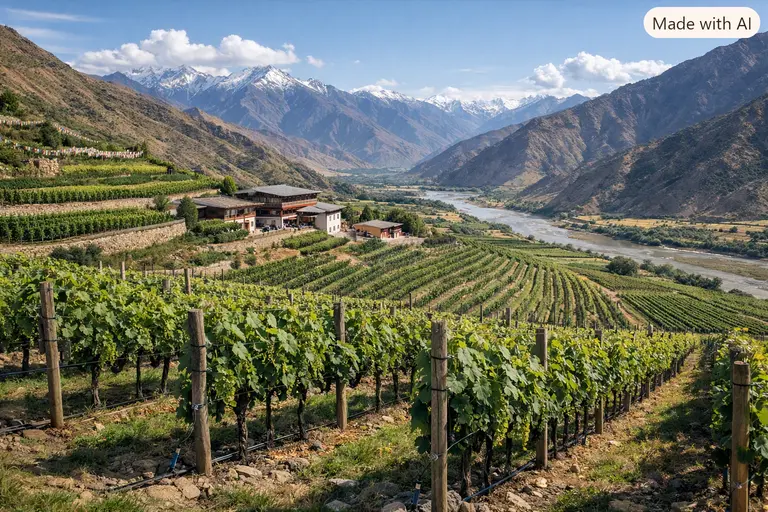
Today, the winery farms vineyards across the Lhasa River Valley and the Yarlung Tsangpo River Valley, with elevations reportedly reaching close to 3,700 metres. In January 2026, the company also completed its first international export, sending wine to Hong Kong. This represents a sign that its high-altitude wines are beginning to reach markets beyond Tibet. Additionally, Chinese wine-industry sources report that the company received separate certification for a high-altitude Vidal planting area, distinct from the Guinness vineyard title. Consequently, readers should not confuse the two records.
Why Is Growing Grapes at This Altitude So Difficult?
Undoubtedly, high-altitude viticulture brings several serious obstacles. For example, the Tibetan Plateau combines intense sunlight, thin air, freezing nights, sharp temperature swings, dry spells, and sudden frost. On top of that, strong winds and sandstorms regularly threaten young vines. Consequently, growers on the plateau had to invent new techniques rather than simply copy methods from traditional wine regions. They improved the soil, managed water carefully, installed drainage systems, and relied on drip irrigation to keep vines alive. Meanwhile, the strong sunlight and cool nights shape how the grapes ripen and develop acidity. Still, altitude alone never guarantees a better wine; rather, it creates unusual conditions that demand careful management.
How Pazhu Winery Adapted Through Research
Above all, the progress made at Pazhu Winery shows why patient experimentation matters. Early on, the team tested numerous varieties against Tibet’s punishing climate. Over time, researchers and growers narrowed the list down to plants that could genuinely thrive there. One notable outcome, for instance, is Yajiang No. 1, a red grape bred specifically for high-altitude conditions. Currently, ongoing studies continue to examine how it adapts and performs on the plateau. Ultimately, this process teaches a broader lesson: when standard methods fail, real progress starts with understanding the environment rather than fighting it.
Lessons for the Gem, Jewellery, and Food Industries
Parallels in the gemstone industry
Interestingly, the journey of Pazhu Winery offers a useful parallel for gem and jewellery businesses. Both wine and gemstones draw part of their appeal from geography and geological origin. For example, gemologists study colour, tone, saturation, clarity, and treatments—and, where relevant, geographic origin—when evaluating coloured stones. Likewise, winemakers explain how altitude, climate, and soil shape their product. Even so, the comparison has limits. Namely, a prestigious origin never guarantees a superior gemstone, just as an extreme altitude never guarantees a superior wine. Therefore, the real lesson for jewellers is to present provenance honestly, without turning it into a substitute for quality.
H3: Innovation in technology and food
In addition, the winery demonstrates how technology supports agriculture in extreme settings. Specifically, soil improvement, irrigation systems, and careful variety selection made high-altitude farming possible. For technology companies, the takeaway is simple: difficult environments often spark genuine innovation because ordinary solutions fail. Similarly, food and beverage producers can highlight the link between place and flavour without overselling it. Coffee, tea, cocoa, honey, and cheese makers already build their identity around geography. In the same way, high-altitude wine turns its unusual setting into part of its story while letting the finished product speak for itself.
Hospitality and Travel Connections
Furthermore, Pazhu Winery shows how farming can become part of a destination’s appeal. Notably, vineyard development in this region has created local jobs, including opportunities for Tibetan communities. As a result, wine tourism connects visitors directly with the landscape and local economy. Importantly, the same idea works well beyond Tibet. For instance, a tea plantation, spice farm, craft workshop, or traditional food producer gives ordinary travellers—not just luxury tourists—a deeper connection to the place they visit.
What Consumers Can Learn from High-Altitude Producers
Ultimately, the clearest lesson for consumers is this: rarity and quality are not the same thing. Certainly, a wine grown above 3,500 metres offers an unusual story. But grape variety, winemaking skill, vintage, and sensory quality still matter most. In the same way, this logic applies to jewellery too. A gemstone from a famous locality deserves attention, yet buyers should still examine colour, clarity, treatments, and cut before deciding its true worth.
Frequently Asked Questions
Is Pazhu Winery the world’s highest winery?
Not exactly. Guinness World Records recognises a Lhasa vineyard at 3,563.31 metres as the highest, while other sources credit Tian Lu with a facility at about 3,911 metres. These titles are not interchangeable.
How high are the Pazhu Winery vineyards?
Recent reporting places their vineyards at elevations reaching up to roughly 3,700 metres. Chinese wine-industry sources report a separately certified planting area, though this figure requires further verification.
Does high altitude automatically produce better wine?
No. Rather, altitude creates distinctive growing conditions, but quality still depends on grape variety, vineyard care, harvest timing, and winemaking skill.
What can the jewellery industry learn from Pazhu Winery?
Businesses should present origin honestly and explain how natural conditions shape a product, without implying that unusual provenance alone guarantees superior quality.
Why does Pazhu Winery matter to the wine industry?
It proves that commercial viticulture can succeed at exceptional elevations. Its history shows how research and local adaptation turn a harsh environment into a viable production landscape.
Disclaimer
This article is intended for general education. Vineyard elevations, record titles, certifications, and production figures may change as new measurements emerge. Some details reported by Chinese wine-industry sources have not been independently verified and appear here as reported. References to wine characteristics reflect general educational observations and do not constitute professional wine ratings or investment advice. The author has no financial affiliation with the brands or organizations mentioned.