Introduction: Why You Should Teach Gemology to Kids in Keralam
Naturally, children love colourful stones, sparkling crystals, and the idea of hidden treasures. Because of this innate curiosity, gemology offers a wonderful way to introduce complex scientific concepts through observation, discovery, and hands-on play. Instead of relying only on static textbooks, parents and teachers can mix experiments with storytelling to make the subject genuinely fun. Specifically, when you teach gemology to kids in Keralam, you provide them with a lens to view the natural world with greater precision.
Keralam gives children an excellent setting for this kind of experiential learning. Although the state is not known for massive commercial gemstone mining, it possesses mineral-rich beaches and rivers full of geological history. As a result, children can link scientific lessons to landmarks they already recognise. Furthermore, India carries a remarkable gemstone history that spans millennia. Stories about the Golconda diamonds and royal jewellery collections help children see that gemology involves far more than pretty ornaments. Instead, it blends chemistry, physics, and history into one fascinating subject. To build a strong foundation, you can explore our dedicated gemology section for beginner-friendly resources.
Why it is Easy to Teach Gemology to Kids in Keralam
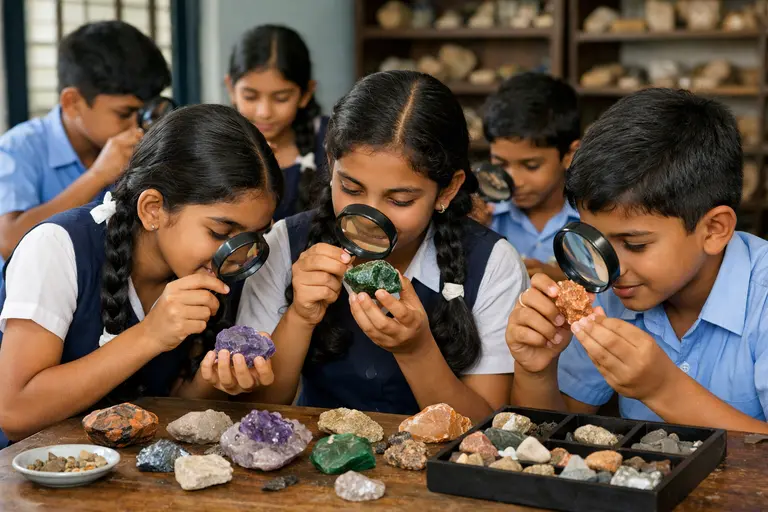
Children learn best when they can see, touch, and explore; therefore, gemology suits the “active learning” model perfectly. Every mineral carries its own unique colour, crystal shape, and hardness. Consequently, every stone becomes a small scientific mystery waiting for a solution. Rather than simply memorising definitions, children can compare physical specimens and examine “internal worlds” through a jeweller’s loupe. Because of their natural enthusiasm for shiny objects, it is remarkably easy to teach gemology to kids in Keralam.
Moreover, gemology connects directly to multiple school subjects at once. Earth science explains how minerals form under pressure, while chemistry introduces the concept of repeating atomic patterns in crystals. Physics explores the magic of light and refraction, and history reveals how rare stones shaped ancient trade routes. In short, one single stone opens the door to an entire world of knowledge. This multidisciplinary approach is essential for building India’s global brands in the future, as it fosters innovative thinking from a young age.
Practical Ways to Teach Gemology to Kids in Keralam
To begin the journey, young learners should work with safe, everyday materials. For instance, teachers can introduce mineral hardness by letting children test which objects scratch easily. This mirrors the logic of the Mohs Hardness Scale. You can use a fingernail, a copper coin, and a steel nail to show the hierarchy of resistance. These practical methods make it simpler to teach gemology to kids in Keralam in a classroom setting.
Crystal Growing and the Streak Test
Crystal-growing experiments offer another engaging lesson. Children can grow sugar or alum crystals at home and watch as the atoms arrange themselves into orderly, geometric patterns. Additionally, the “streak test” provides a surprising revelation. By rubbing a mineral on an unglazed porcelain plate, children learn that a stone’s powder colour can differ from its outer appearance. For example, a metallic-looking hematite leaves a distinctive reddish-brown streak. This helps them understand that chemical treatments in colored gemstones can sometimes mask a stone’s true nature.
Using the Jeweller’s Loupe
A small LED torch and a 10x jeweller’s loupe let children study transparency and internal features. They can look for “inclusions” in quartz or agate, which act like a biological time capsule. Throughout these activities, children learn the value of patience. They must examine the evidence first and conclude afterward, which forms the true foundation of the scientific method. For professional standards on identification, visit the Gemological Institute of America (GIA).
Using Local Landscapes to Teach Gemology to Kids in Keralam
Science sticks best when it links to familiar surroundings, and Keralam offers plenty of opportunities for field exploration. A walk along the coast can easily turn into a mineral hunt. Specifically, the famous black sands of Chavara contain garnet alongside ilmenite and monazite. While these grains are not gem-quality crystals, they demonstrate how heavy minerals travel from the mountains to the shore. This geographic context is a powerful way to teach gemology to kids in Keralam effectively.
Similarly, rivers running through Wayanad and Idukki contain rounded quartz pebbles, shaped smooth by thousands of years of flowing water. Keralam’s jewellery traditions add a vital cultural layer as well. Children see gold ornaments during every festival and wedding. By learning about these materials, they build an appreciation for the silver supply chain from mine to jewelry and the ethics of sourcing. This local context makes the science feel relevant and alive.
Cultural Ties When You Teach Gemology to Kids in Keralam
Storytelling makes science memorable; therefore, educators should introduce gemstones through India’s cultural history. The Navaratna tradition offers a gateway to nine culturally significant stones. Teachers can explain that each stone has a scientific identity: ruby belongs to the corundum family, and diamond consists purely of carbon.
Furthermore, teaching Malayalam gemstone names alongside scientific terms links tradition with modern science:
- Vairam (വൈരം): Diamond
- Manikyam (മാണിക്യം): Ruby
- Marathakam (മരതകം): Emerald
- Muthu (മുത്ത്): Pearl
By using these familiar words, you make the subject accessible to the local community. This preservation of language is a key lesson from the world’s oldest company lessons for Keralam, where tradition supports longevity.
External Trips to Teach Gemology to Kids in Keralam
Indeed, field trips make science feel real to a child. The Natural History Museum in Thiruvananthapuram introduces geological subjects, while the Kerala State Science and Technology Museum offers interactive exhibits. Furthermore, a visit to a trusted jewellery store or a gem-testing laboratory shows children how professional instruments like refractometers and spectroscopes work.
Cities such as Kochi and Thrissur can support “Jeweller for a Day” programmes. In these sessions, children compare rough minerals with polished, faceted ones. They learn how a skilled cutter plans precise angles to control how light behaves. Such programmes also teach the importance of scent marketing in jewelry stores to understand the retail environment. Overall, these experiences are the best way to teach gemology to kids in Keralam while sparking lifelong interests in geology and design.
FAQ: How to Teach Gemology to Kids in Keralam
What is the best age to start teaching gemology?
Most children are ready by age six or seven. At this stage, they can explore basic concepts like colour and texture. As they reach ten or eleven, they can handle more complex topics like crystal systems and chemical formulas.
Do I need to buy expensive gemstones for these lessons?
No, you do not. You can start with “rough” mineral sets or even stones found in nature, such as river quartz or beach garnets. These are much more affordable and allow for a more tactile learning experience.
How can I explain the difference between real and fake gems?
You should explain that “real” gems are made by nature over millions of years, while “lab-grown” gems are made by humans in a machine. Both are beautiful, but they have different origins and values.
Is gemology a good career path for kids in Keralam?
Yes, it is an excellent path. Keralam has a massive jewellery industry that constantly needs skilled graders, designers, and gemologists. It is a stable, high-value career that rewards scientific expertise.
What safety precautions should I take?
Always supervise children when using small stones to prevent choking hazards. If you are doing hardness tests with sharp objects like nails, ensure the children use them carefully and under adult guidance.
Disclaimer
This article serves educational purposes only. The activities described introduce children to basic concepts and should not be treated as professional identification methods. Gemstone valuation and certification require qualified professionals and laboratory equipment. The author has no financial affiliation with the museums or organizations mentioned. Always consult with a certified gemologist for high-value asset appraisal.