
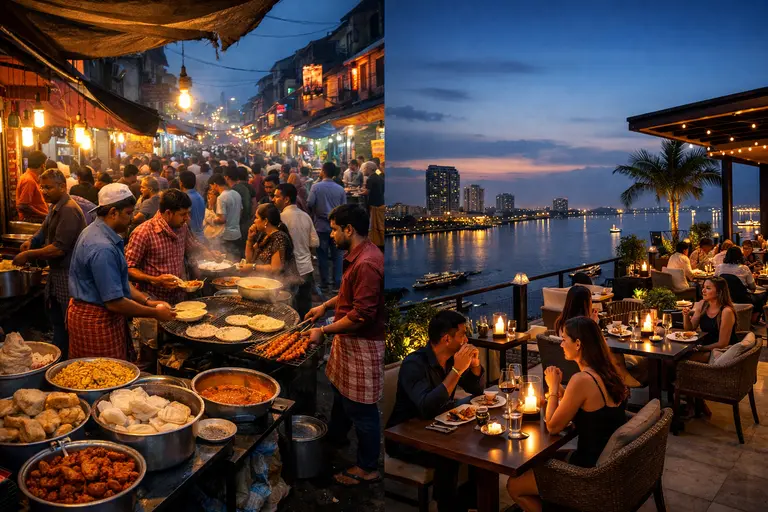
Introduction to Food Cities vs Restaurant Cities
Not every city with unforgettable food earns a reputation as a great restaurant city. Likewise, not every city packed with luxury dining spots offers a deep, authentic food culture. People often use these terms interchangeably; however, they actually describe two entirely different urban realities. Understanding the distinction between food cities vs restaurant cities helps travelers and diners see why a great meal never actually requires an expensive reservation.
A food city grows organically through tradition. Families pass down secret recipes, street vendors feed entire neighborhoods, and local pride keeps old flavors alive for centuries. A restaurant city, on the other hand, grows through strategic investment. Hospitality capital, international tourism, and rising disposable income build these scenes from the ground up. Essentially, the difference comes down to culture versus capital. While one develops over generations through community habits, the other expands through rapid economic growth and changing lifestyles. To see how these professional standards are maintained, you can read our guide on industry sheepdogs in tech and jewelry.
Rules for Food Cities vs Restaurant Cities
Great food and successful restaurants rest on completely different foundations. Specifically, ordinary people build a food city’s reputation because they cook extraordinary meals as part of their daily life. These recipes evolve across generations, and cooks source ingredients from the nearest local markets. Consequently, customers return again and again because the food tastes “real” and remains affordable.
In contrast, a restaurant city requires serious financial backing to survive. Fine-dining spots demand costly interiors, highly trained chefs, and massive marketing budgets. As a result, these businesses must attract a specific demographic of diners who are willing to pay premium prices for an “experience.” They also depend on globalized supply chains and standardized service levels. Therefore, a city can absolutely produce legendary dishes without ever becoming a global fine-dining hotspot. This is similar to how building India’s global brands requires a balance of artisanal skill and professional management.
Authenticity in Traditional Food Cities
Many of the world’s most respected food cities became famous through humble roadside stalls rather than luxury hotels. Bangkok, Hanoi, and Mexico City prove this point exceptionally well. In these locations, family-run kitchens and bustling night markets serve the most celebrated meals. Consequently, visitors travel to these cities chasing authentic flavor rather than fancy décor.
Local communities, not just tourists, keep these food cultures alive by supporting traditional vendors every single day. Because the demand is consistent, the culinary heritage stays strong across generations. For more information on regional tourism and local heritage, visit the Kerala Tourism website. These authentic spots often represent the “honeybee” model of value, which we discuss in our article on the three business models: ants, spiders, and honeybees.
Capital and Investment in Restaurant Cities
Restaurant cities follow a completely different evolutionary path. Major hubs like New York, London, and Mumbai support thousands of upscale restaurants because they sit on strong economic ground. High real estate rents and skilled staff push operating costs up sharply. Consequently, restaurant owners need a constant flow of customers with significant spending power.
Moreover, they lean heavily on business travelers and corporate professionals who dine out regularly for networking. Industry data from Restaurant India consistently shows that Tier-1 cities attract the most investment as they house dense and affluent populations. Without this economic base, luxury dining venues struggle to survive, regardless of how good the local traditional cuisine actually is. This commercial focus is identical to the Chow Tai Fook business model, which uses scale and capital to dominate a market.
Indian Models of Food Cities vs Restaurant Cities
India showcases the food cities vs restaurant cities contrast beautifully. For centuries, home kitchens, temple trusts, and local markets shaped Indian food culture. Amritsar and Lucknow represent this heritage well. Their kulchas and galouti kebabs pull in visitors through taste alone, often from very modest stalls.
Meanwhile, Delhi, Mumbai, and Bengaluru showcase India’s booming restaurant economy. In these cities, corporate hubs and tech professionals fund constant culinary innovation. Furthermore, these cities act as gateways for global variety. While a food city perfects its own regional cuisine, a restaurant city competes through diversity, offering everything from Japanese sushi to French pastries under one skyline. This is why airports as travel destinations are now including high-end food courts to bridge these two worlds.
Keralam’s Mix of Food Cities vs Restaurant Cities
Keralam captures this balance perhaps better than anywhere else in the country. Kozhikode leads the state’s food culture, and its reputation reaches well beyond the borders of India. Malabar biriyani and seafood from legendary eateries like Paragon draw food lovers from every continent. In fact, Paragon has earned global recognition as one of the world’s most iconic restaurants, a remarkable feat for an 85-year-old family eatery.
Kochi, by contrast, leads Keralam’s restaurant scene. Its IT parks, international airport, and cruise tourism have pulled in major hospitality investment. As a result, the city now offers rooftop dining, contemporary fusion menus, and chef-led experiences. Therefore, Kochi serves as the state’s primary restaurant city, while Kozhikode remains the ultimate food city. For those interested in regional differences, our guide on flavours and gems of Keralam offers a district-wise breakdown.
FAQ About Food Cities vs Restaurant Cities
Can a city be both a food city and a restaurant city?
Yes, cities like Tokyo and Paris successfully manage both. They preserve ancient local traditions in small back-alley shops while simultaneously hosting the highest number of Michelin-starred restaurants in the world.
Is the food better in a food city or a restaurant city?
This is subjective. If you value authenticity, history, and raw flavor, you will prefer a food city. If you value presentation, comfort, service, and global variety, a restaurant city will suit you better.
Why does Kozhikode rank so high in global food lists?
Kozhikode ranks highly because it maintains an unbroken chain of culinary tradition. Restaurants like Paragon use the same spice blends and techniques today that they used decades ago, providing a rare level of consistency.
Do I need a high budget to eat well in a restaurant city?
Generally, yes. While small gems exist, the “restaurant city” label implies that you are paying for the infrastructure, service, and atmosphere of organized hospitality.
How does the “food city” model benefit local farmers?
In a food city, the connection to the land is usually more direct. Cooks often source directly from local markets, supporting the regional agricultural network more effectively than large chains that use centralized industrial suppliers.
Disclaimer
This article offers a general comparison based on hospitality trends and economic factors as of July 2026. The author has no financial affiliation with the restaurants mentioned. Food preferences remain subjective, and readers should explore both street stalls and fine-dining rooms to form their own opinions. Always check local health ratings before dining.