
Introduction to Gemstones in Indian History and Belief
Throughout the centuries, humans have rarely viewed diamonds and colored jewels as simple ornaments. Instead, the enduring role of gemstones in Indian history and belief reveals a deep connection between precious minerals, political power, and spiritual protection. Rulers traditionally wore these stones to project immense wealth and strengthen their sovereign authority among the public. Moreover, religious traditions frequently assigned specific astrological powers to various gems, turning them into sacred talismans. Consequently, these stones became more than just luxury items; they served as vital tools for trade, diplomacy, and cultural expression. Therefore, understanding this intersection of science and sentiment is essential for anyone exploring India’s rich heritage.
India shows this connection between gemstones in Indian history and belief more clearly than almost anywhere else in the world. For dozens of generations, Indian rulers built extraordinary collections of jewels, while spiritual traditions layered additional meaning onto particular minerals. Therefore, the story of gemstones extends far beyond the jewelry box. It also tells a story of commerce and culture that still speaks to ordinary people today. To understand how these traditions influence modern purchasing, you can read our guide on gemstone buying and quality.
Sovereign Power and Gemstones in Indian History and Belief
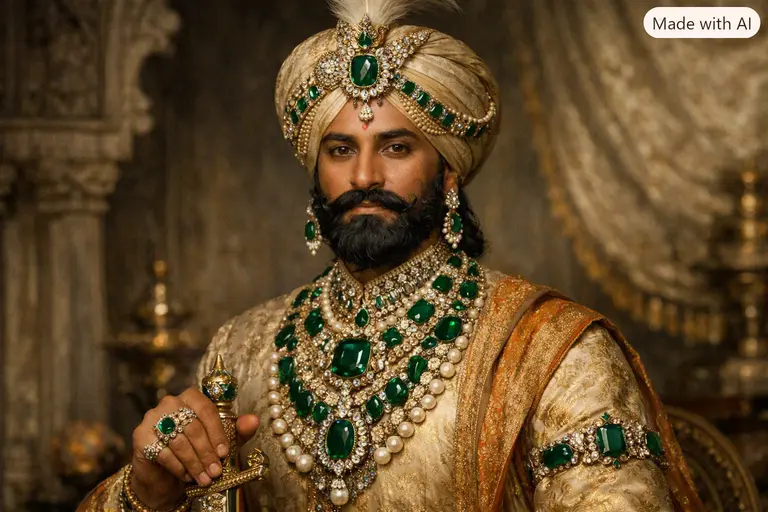
Ancient and medieval rulers needed visible signs of authority; consequently, they decorated crowns, thrones, and ceremonial weapons with the most valuable gemstones available. Because ordinary citizens rarely owned large collections of precious stones, gems instantly communicated a monarch’s absolute wealth. Moreover, royal treasuries gave rulers practical resources, since they could offer gems as diplomatic gifts or tribute to avoid warfare.
India illustrates this pattern especially well. According to research from the Gemological Institute of America (GIA), gemstones played a defining role in Indian royal culture. Skilled craftsmen carefully maintained these treasures to ensure the “visual language of sovereignty” remained clear. Even so, gemstones never granted rulers supernatural political power on their own. Instead, their political weight came from what the public believed they represented: legitimacy, prestige, and control over scarce natural resources. This level of oversight is handled today by the industry sheepdogs in tech and jewelry who maintain modern quality standards.
Diamonds as Vital Gemstones in Indian History and Belief
India also shaped the entirety of early international diamond history. For centuries, Indian deposits supplied the vast majority of the world’s known diamonds. In fact, India remained the only significant source of diamonds before major Brazilian production emerged in the early eighteenth century.
Golconda’s Legacy for Gemstones in Indian History and Belief
Importantly, “Golconda” describes a historic diamond-producing region rather than a single individual mine. Several deposits across this broader area produced diamonds that later became world-famous. Specifically, the GIA links India’s historic fields near Golconda to celebrated stones such as the Hope Diamond and the Koh-i-Noor. This geographic origin is a cornerstone of gemstones in Indian history and belief, representing the pinnacle of geological rarity.
Sourcing Gemstones in Indian History and Belief Globally
At the same time, India did not produce every colored gemstone used at its prestigious royal courts. Instead, extensive “hidden networks” brought rubies from Myanmar and sapphires from Sri Lanka. Consequently, India’s gemstone culture grew through both local production and global trade. This interconnectedness is a primary theme in our study of hidden networks in nature and business.
Imperial Conquest and Gemstones in Indian History and Belief
As royal treasuries grew, rulers used gemstones to signal complex political relationships. Rulers often offered precious objects as diplomatic gifts to cement alliances. However, military conquest could completely transform a gemstone’s meaning. A jewel that once symbolized one ruler’s sovereignty could quickly become a trophy of another ruler’s total victory.
The Koh-i-Noor diamond demonstrates this shift more vividly than any other stone. The diamond passed through several South Asian ruling dynasties before it reached the Sikh ruler Ranjit Singh. After the British annexation of Punjab in 1849, the East India Company took possession of the diamond and subsequently presented it to Queen Victoria. Consequently, the Koh-i-Noor became far more than a famous diamond; it became a lasting symbol of imperial conquest and contested cultural heritage. This historical weight is why Indian designers choose raw diamond and Polki jewelry today—to reclaim and celebrate their indigenous heritage.
Spiritual Significance of Gemstones in Indian History and Belief
Political symbolism tells only half the story. Spiritual and astrological traditions also gave gemstones in Indian history and belief their deep cultural weight. The best-known example is Navaratna, a Sanskrit term meaning “nine gems.” Traditional Indian astrology connects nine specific gemstones with nine celestial bodies. For instance, the ruby corresponds to the Sun, while the pearl corresponds to the Moon.
Still, readers should not assume that the Navaratna system existed in its modern form since the earliest periods. Instead, historical sources trace its formal mention to around the tenth century. This shows that the system developed gradually through India’s religious and artistic traditions. For believers, these stones serve as talismans linked to planetary protection. Nevertheless, these effects belong to traditional belief rather than scientifically proven properties. This distinction is critical for anyone performing gemstone identification in a laboratory setting.
Modern Evolution of Gemstones in Indian History and Belief
Gemstones retained their political and social importance even as the world transitioned to modern commerce. During the nineteenth century, discoveries in South Africa transformed the industry entirely, creating new fortunes and reshaping economic power. In response to the dark side of this growth, the international community established the Kimberley Process in 2003 to ensure that “conflict diamonds” stay out of the legitimate trade.
Today, diamonds and colored gemstones continue to carry immense social weight in India. A large diamond still signals wealth, while traditional Keralam Kadas express family heritage. In India, many people still choose stones because they believe those minerals support favorable life outcomes. However, modern consumers benefit most when they separate gemological facts from traditional lore. By combining critical thinking in modern gemology with an appreciation for history, you can enjoy these treasures for both their science and their soul.
FAQ About Gemstones in Indian History and Belief
Why was India the only source of diamonds for so long?
For nearly 2,000 years, India had the only known geological conditions suitable for diamond formation that humans could access. These were primarily “alluvial” deposits found in riverbeds.
What is the most important stone in the Navaratna?
The ruby, representing the Sun, is considered the center of the Navaratna arrangement. It symbolizes life force and leadership in gemstones in Indian history and belief.
Is the Koh-i-Noor still the largest diamond in the world?
No. While it is famous, it has been surpassed in size by several stones, such as the Cullinan diamonds found in South Africa.
Do gemstones actually have healing powers?
There is no scientific evidence to support the idea that gemstones have medical or planetary healing powers. These attributes are based entirely on traditional and cultural belief systems.
Can I visit the Golconda mines today?
The original Golconda mines are mostly depleted and closed. However, you can visit the Golconda Fort in Hyderabad, which served as the legendary trading center for those stones.
Disclaimer
This article separates historical and cultural beliefs from scientifically established facts. References to gemstone powers or astrology describe traditional beliefs only. Readers should not treat this as medical or financial guidance. The author has no financial affiliation with the jewelry brands or organizations mentioned. Data reflects historical research available as of August 2026.

Pingback: China vs India Jewelry Market Leadership Explained -
Pingback: How Young Indian Jewelry Designers Can Turn Ideas Into Stories -
Pingback: Do Indians Feel Guilty About Spending? -