Introduction
Why do one gemstone flash rainbow colours while another seems to show doubled images? The answer lies in how light behaves inside different materials. Visual gemology lets ordinary people explore these effects with curiosity instead of requiring expensive, professional equipment. For the 99 percent who love gemstones but never trained as formal gemologists, this approach makes complex science feel friendly and accessible. Moreover, it teaches buyers to ask better questions before they purchase expensive jewellery. However, this approach has clear limits, so this article explains both its scientific value and its practical boundaries. For practical shopping advice, read our guide to buying gemstones wisely.
Understanding the Science of Visual Gemology
Refraction and the Refractive Index
Light slows down when it passes from air into a gemstone, so it usually changes direction. Scientists call this bending refraction. Furthermore, the refractive index compares the speed of light in a material with its speed in a vacuum. Generally, a higher index bends light more significantly.
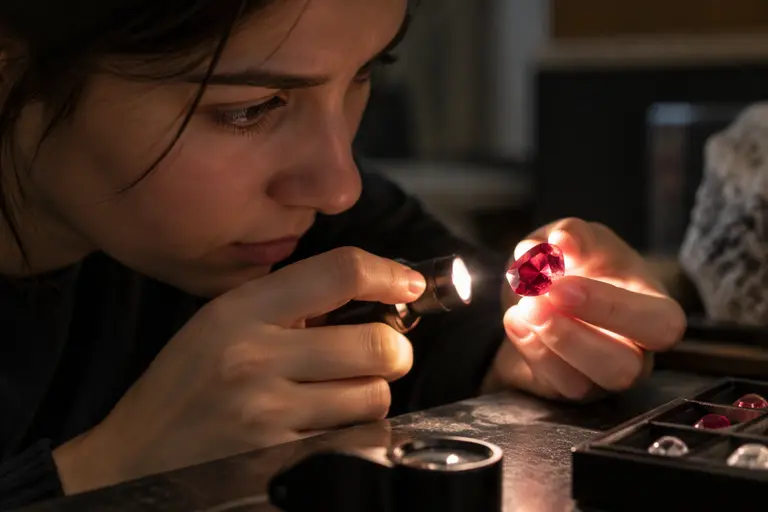
Gemologist Alan Hodgkinson developed a method that builds on this basic optical idea. First, observers look through a faceted stone toward a distant point of light and study its specific behaviour. Nevertheless, the method relies on visual comparison, not precise measurement. For a deeper introduction, explore Visual Optics.
Double Refraction and Dispersion
Some gemstones, including ruby and quartz, are anisotropic. Depending on the viewing direction, they split light into two rays with different refractive indices. Gemologists call this effect birefringence. By contrast, diamond, garnet, and ordinary glass are generally isotropic.
However, apparent doubling does not always signal double refraction. For example, internal reflections and facet arrangements can mimic it, and internal strain can even make garnet or glass show weak doubling. Therefore, treat every visual pattern as a clue, not as absolute proof.
Next, dispersion splits white light into spectral colours and produces the flashes gemologists call fire. Diamond, cubic zirconia, and moissanite all show noticeable fire. Still, cut, lighting, and viewing conditions change the effect, so colourful flashes alone never establish a gemstone’s identity.
Bringing Visual Gemology to Everyday Consumers
The Art of Observing Light
Beginners can start with verified reference stones, a suitable point light, and a simple observation sheet. First, hold each stone under steady light and tilt it gently. Next, describe the colours and reflections you see. Then, compare the stones and explain the differences.
Additionally, this exercise builds awareness without using dense jargon. Furthermore, it shows how cut and transparency shape a gemstone’s look. Similarly, a smartphone flashlight and a white card can demonstrate light and shadow effectively. However, that setup does not reproduce the official Hodgkinson Method, which requires looking through the stone toward a distant point source.
Science, Art and Logical Thinking
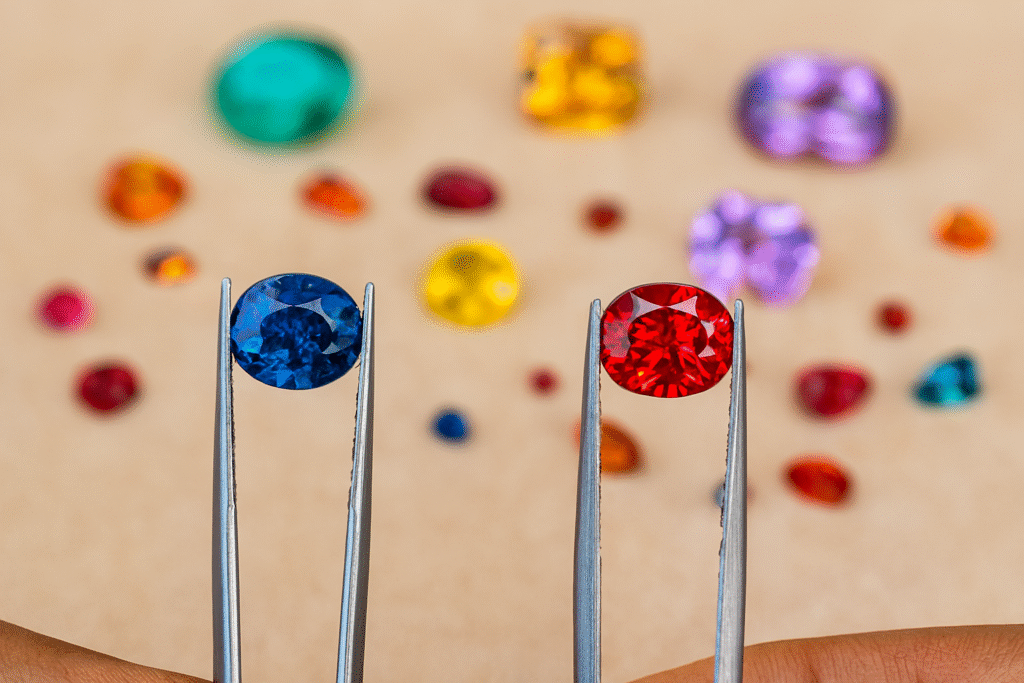
Consider three red materials: ruby, garnet, and red glass. Although they look similar, their structures differ. Ruby belongs to the corundum family and is anisotropic, while garnet and glass are generally isotropic.
Therefore, these differences create a fun, interactive detective game. Participants observe each material, record findings, and test which explanations fit the evidence. Nevertheless, apparent doubling alone cannot prove a stone is ruby. Likewise, a single image cannot separate garnet from glass, because cutters also facet glass carefully. Ultimately, the goal is not to guess right every time. Instead, learners practise comparing evidence and questioning their own assumptions.
How to Run a One-Hour Workshop
Five short activities fill a 60-minute session perfectly. First, spend ten minutes explaining refraction. Next, use fifteen minutes to compare known gemstones and discuss apparent doubling. After that, explore dispersion for fifteen minutes. Then, give participants fifteen minutes for a mystery-stone challenge, where they record observations and name the extra tests they need. Finally, use the last five minutes to discuss responsible buying habits.
Prepare reference stones with independently verified identities. In addition, provide good lighting and teach safe handling protocols. Encourage participants to share their findings aloud, because group discussion deepens understanding. Never aim a powerful light directly into anyone’s eyes. For more guidance, see our gemstone care and handling tips.
What Visual Gemology Cannot Prove
Visual gemology introduces optical behaviour, but it cannot replace professional identification. For example, natural and laboratory-grown rubies share the same essential chemistry and structure. Consequently, observation alone cannot tell them apart. Likewise, it cannot reliably detect every treatment, pinpoint geographic origin, or set market value.
In these cases, a professional gemologist may use a microscope, refractometer, or spectroscope. Moreover, the GIA gemstone analysis guide explains how professional examination supports identification. In practice, visual gemology encourages informed questions, while laboratory testing answers the questions that observation simply cannot.
Frequently Asked Questions
Can beginners learn visual gemology?
Yes. Beginners can learn to notice reflections, dispersion, and apparent doubling. However, accurate interpretation takes practice and comparison with verified reference stones.
Can a smartphone identify a genuine gemstone?
No. A flashlight supports simple demonstrations, but it cannot authenticate a gemstone or prove its natural origin.
Can visual gemology replace a laboratory report?
No. Only professional testing can establish identity, investigate treatments, and assess natural or laboratory-grown origin.
Why should ordinary consumers learn visual gemology?
It builds curiosity and critical thinking. As a result, consumers appreciate gemstones more and ask sharper questions when they buy jewellery.
Does visual gemology suit schools and community workshops?
Yes. Indeed, with verified stones and proper supervision, it introduces optics, mineral science, and evidence-based reasoning.
Disclaimer
This article offers educational information only. Observations with the unaided eye cannot guarantee a gemstone’s identity, authenticity, or value. Consult a qualified gemologist when you need reliable identification.