Disclosure: This post contains Blue Nile affiliate links to help you find the perfect diamond ring. If you make a purchase through them, I may earn a small commission at no extra cost to you.
Introduction
Buying a diamond ring feels complicated when technical terms, grading reports, and fluctuating prices compete for your attention. Many modern customers find it convenient to select a loose diamond first and then explore compatible options using the Blue Nile Design Your Own service. The real advantage comes from understanding how these two choices—the stone and the setting—work together to create a balanced piece. Therefore, you do not need advanced gemology training to make a great decision. Instead, you need enough knowledge to compare stones, judge quality, and avoid paying for features you cannot see. This guide serves the 99% who value long-term quality and fair pricing over temporary status.
How the Blue Nile Ring Builder Works
Shoppers can start their journey by choosing either a loose stone or a specific setting. For instance, if you prefer the elegance of oval-shaped diamonds, you can filter settings that are specifically engineered to fit that shape.
However, keep in mind that not every diamond shape fits every setting style perfectly. Consequently, you must confirm the diamond dimensions, the setting specifications, the metal type, your correct ring size, and the final price before you finalize your order. Taking these extra steps prevents compatibility issues and ensures the ring meets your expectations.
Understand the Four Cs Before You Buy
Diamond Ring Cut Quality and Sparkle
Cut controls how well a diamond handles light. Therefore, shoppers who love brilliance should study cut quality first. Shape and cut, however, mean different things. Shape describes the outline, such as round, oval, or emerald, while cut describes proportions, facets, and light performance. Moreover, the GIA provides an official cut grade only for round brilliant diamonds, so you should compare fancy shapes through high-quality photographs and videos. Blue Nile’s diamond education guide provides excellent context for these technical distinctions.
Diamond Ring Colour and Clarity Grades
Diamond colour grades start at D (colourless) and move toward warmer tones. Grades G through J fall into the near-colourless range. Yellow gold can flatter a warmer diamond, while white gold and platinum provide a cooler contrast. Still, yellow gold does not effectively hide a diamond’s natural body colour if the stone is very yellow.
Many VS2 and SI1 diamonds appear eye-clean, yet true visibility depends on the size, position, and type of each inclusion. The GIA grades clarity under 10× magnification. So, you should inspect images and videos yourself instead of trusting the grade alone.
Diamond Ring Carat Weight and Visible Size
Carat measures weight, not face-up size. As a result, two diamonds with the same carat weight can look different because their shapes and proportions vary. Instead of chasing the biggest stone, remember that a smaller, lively diamond often offers better value than a larger stone with distracting, visible inclusions.
Matching Settings to Your Diamond Ring
Choosing Metal for Your Diamond Ring Setting
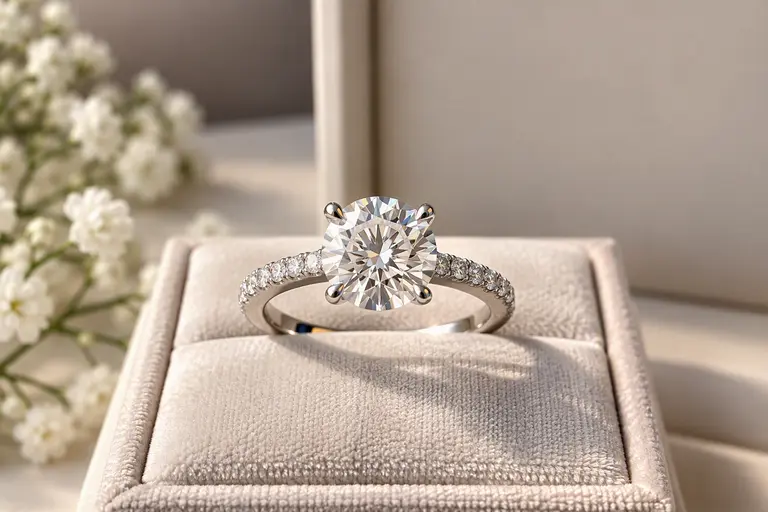
The setting shapes the appearance, comfort, durability, and total cost of your ring. For example, a solitaire highlights the centre diamond, whereas a halo surrounds it with smaller, accent stones. Consequently, a halo can make the centre stone look larger without adding carat weight. Step-cut diamonds, including emerald and Asscher shapes, show inclusions more easily because their broad facets create a mirror-like look. Therefore, examine these stones closely before you choose a minimalist setting.
Protecting Your Diamond Ring for Daily Wear
A bezel setting wraps metal around the diamond’s edge, which protects it from daily knocks and snags. By contrast, traditional prong settings expose more of the stone to view. Still, neither style guarantees complete protection. Therefore, if you lead an active lifestyle, you should inspect the prongs regularly to catch loose ones early.
What Indian Consumers Can Learn from Blue Nile
Calculating Diamond Ring Costs Separately
Indian jewellers price their products in diverse ways. Some give itemised quotations, while others quote one combined price. Therefore, always ask how each component—the stone, the gold, and the labour—adds to the total. Wherever a listing shows diamond and setting prices separately, compare them individually. Likewise, request specific details of gold weight, purity, making charges, diamond characteristics, and taxes. Our guide to gold purity and making charges explains how to read those line items.
Moreover, gold purity and diamond quality measure different things. An 18K setting does not improve a diamond’s grade, so you must evaluate each part on its own merits.
Using Grading Reports for Your Diamond Ring
The GIA and the International Gemological Institute (IGI) both grade diamonds. However, a report does not guarantee resale value or investment returns. Before you buy, verify the report number, confirm whether the stone is natural or laboratory-grown, and make sure the report matches the specific stone on offer. For more guidance, read the GIA diamond education resources. Additionally, explore our visual gemology articles to see how observing light builds genuine gemstone knowledge.
Frequently Asked Questions
Do consumers need gemology training to buy a diamond ring?
No. Basic knowledge of the Four Cs, grading reports, and setting styles gives you a solid start. However, you should still examine individual diamonds carefully.
Does Blue Nile guarantee a perfect diamond and setting match?
No. Its tools help you explore combinations, but you must confirm compatibility and specifications before you confirm your order.
Can Indian consumers apply these lessons locally?
Yes. Request itemised pricing, check gold purity, and examine diamond documentation. As a result, you can buy confidently from trusted local jewellers.
Is the highest diamond grade always the best choice?
Not necessarily. A balanced mix of appearance, durability, and affordability often delivers significantly better value.
Disclaimer
This article offers general consumer education and is not a professional diamond appraisal or a guarantee of quality. Prices, availability, and website features may change. Therefore, verify current specifications, grading reports, and taxes before you purchase.