Introduction
In the vast world of mineralogy, some stones glitter, while others tell a story of geometry. Trapiche Gemstones captivate collectors with their rare, wheel-like internal patterns. Unlike the moving star of a Star Sapphire (Asterism), these unique minerals feature fixed, radial spokes of inclusions that mimic a sugar mill wheel.
At first glance, they look painted by a human hand. However, they are formed under precise geological conditions deep within the Earth. As a Gemologist, I find them fascinating because they turn “Impurities” into “Art.” In this article, we will explore their formation, the difference between a “Star” and a “Trapiche,” and the specific varieties found in Emeralds, Rubies, and Sapphires. Furthermore, I will explain why these gems are becoming the new favorites for bespoke jewelry in Kerala.
Formation of Trapiche Gemstones
First, let’s understand the name. The word “Trapiche” comes from the Spanish word for the cogwheels used to crush sugar cane. The six spokes of the gem look exactly like the spokes of the mill.
Technically, the pattern arises internally during crystal growth. Unlike Asterism, where the star glides across the surface as you move the light, a Trapiche pattern is static. It is part of the stone’s skeleton. Moreover, formation happens in symmetrical crystals like hexagonal Beryl (Emerald) or Corundum (Ruby). These grow in high-pressure hydrothermal veins.
As the crystal expands, impurities—such as black carbon or minerals like Albite—are pushed toward the center. They align along the growth sector junctions. Therefore, this creates six-rayed “arms” radiating from a dark core. Consequently, this natural geometry sets Trapiche Gemstones apart. Gemologists study them to learn about ancient Earth processes. For more on crystal growth, check my guide on Multiphase Gems and Maldives.
Visuals and Rarity of Trapiche Gemstones
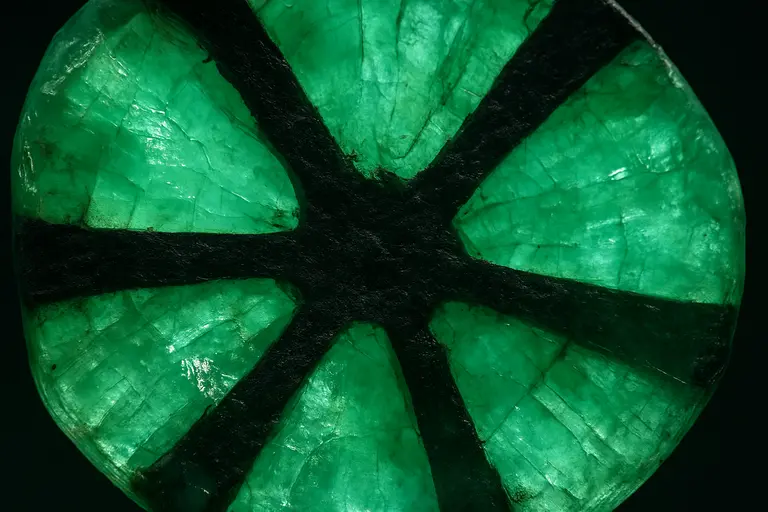
What do these gems look like? They reveal a clear, six-armed star or wheel when cut into a flat slice or cabochon. Typically, a central core anchors dark spokes separating colored sectors.
Furthermore, rarity drives their appeal. Trapiche stones are scarce due to specific formation needs. Collectors prize them over clarity alone. Instead, value hinges on pattern symmetry and arm definition. For example, a perfectly symmetric Trapiche Emerald might outshine a flawless but ordinary one.
Therefore, prices soar for top specimens. However, size often stays small, under 1-2 carats. Cutting demands skill to highlight the pattern without losing it. According to the GIA, these gems blend art and science. Their uniqueness also inspires jewelry designers in places like Kerala, where traditional motifs (like the Chakra) echo such natural symmetry. You can read about local designs in Temple Jewelry South India.
Trapiche Rubies: Fiery Burmese Stars
Now, consider Trapiche Rubies. These show six transparent ruby sectors divided by yellow or white inclusion planes. The result? A bold, fixed six-rayed star.
Origins trace primarily to Mong Hsu, Myanmar (Burma). Additionally, finds occur in Kashmir, Pakistan, and Sierra Leone. However, Burmese examples dominate the market. They tend to be tiny—often under 1 carat. Therefore, cutters slice them thinly to showcase red fire and pattern.
Moreover, their value reflects rarity. Semi-translucent pieces with sharp arms fetch premiums. For buyers, authenticity matters; lab reports confirm the Trapiche Gemstones effect. Learn more about Ruby origins in my Kempu Ruby: Tamil Nadu vs Kerala guide.
Trapiche Sapphires: Blue Wheels of Wonder
Shifting to Sapphires, Trapiche versions feature a dark core with six white or brown arms framing blue sectors. The wheel-like look mesmerizes.
They entered markets in 1996 from diverse spots: Australia, Madagascar, and Sri Lanka. However, fine transparent material remains extremely rare. Most pieces appear opaque or semi-translucent. As a result, top Trapiche Sapphires command high prices. For instance, a vivid blue stone with crisp white arms rivals classic sapphires in beauty. Pair this with my article on Kashmir Sapphire vs Grandala for deeper insights into blue gems.
Trapiche Emeralds: Colombia’s Green Masterpieces
Arguably, the stars of the show are Trapiche Emeralds. They boast dark carbonaceous (black) spokes against vivid green Beryl. This six-pointed pattern creates a dramatic contrast.
Primarily, they hail from Colombia’s Muzo and Coscuez mines. Unlike standard Emeralds, where clarity rules, Trapiche value centers on the distinctness of the black spider-web pattern. Therefore, here, inclusions enhance rather than detract from beauty.
Additionally, cutting preserves the radial design. For emerald fans, they blend Kerala’s love for green gems (like Meen Peera and Green Stones) with global rarity.
Trapiche Amethysts: Purple Quartz Surprises
Finally, Trapiche Amethysts add variety. As Quartz, they show purple shifts with inclusion “arms.” Patterns mimic true Trapiche but may differ slightly (often called “Trapiche-like”).
Brazil yields most finds. GIA notes that Quartz can display these effects due to organic inclusions. Nonetheless, they thrill collectors. Affordable yet unique, they suit everyday wear. This connects to the affordability of Traditional Maharashtrian Jewellery styles.
Conclusion on Trapiche Gemstones
In summary, Trapiche Gemstones transform impurities into art. From the red fire of Rubies to the green soul of Emeralds, each type offers geological poetry. Ultimately, they remind us that perfection is boring. It is the “flaw” that creates the star.
FAQ: Trapiche Gemstones
What causes the pattern in Trapiche Gemstones?
Impurities (like carbon or albite) get trapped along the growth sectors of the crystal during formation. This creates fixed radial arms that look like a wheel.
How rare are Trapiche Emeralds?
Extremely rare. They are found primarily in the Muzo mines of Colombia. Finding a stone with a perfect, centered six-spoke pattern is a once-in-a-lifetime event for many miners.
What is the difference between Trapiche and Asterism?
Trapiche is a static, fixed pattern built into the stone. Asterism (Star effect) is a moving light reflection caused by needles. The Trapiche star does not move when you tilt the stone.
Where are Trapiche Rubies found?
Primarily in the Mong Hsu mines of Myanmar (Burma). They are also found in Guinea and Pakistan, but Burmese stones are most famous for their red/white contrast.
Are Trapiche Sapphires valuable?
Yes, especially if they are transparent. While opaque stones are affordable curiosities, a gem-quality transparent Trapiche Sapphire is a high-value collector’s item.
Author Bio
P.J. Joseph, also known as Saju Elizamma, Gemstone & Gold Consultant serving Kerala, Tamil Nadu, and Karnataka.