Introduction
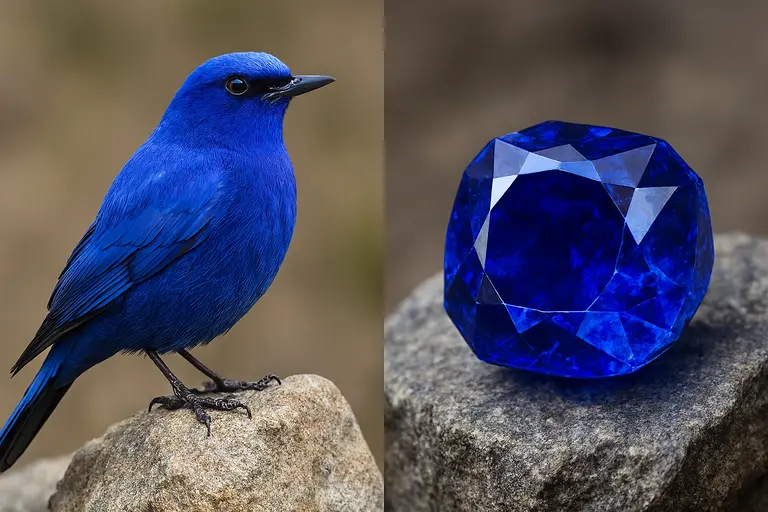
In the world of natural wonders, the comparison of Kashmir Sapphire vs Grandala captivates the imagination. Both are blue legends of the Himalayas—one buried in the earth, the other flying in the sky.
In this comparative study, we will explore the Kashmir Sapphire vs Grandala—analyzing the difference between the “Velvet Blue” of the stone and the “Electric Blue” of the bird. As a Gemologist who loves nature, I find this comparison fascinating. Both embody luxury in their realms, yet their blues differ dramatically in intensity and texture. Let us delve into what makes each a “blue jewel.”
The Gem Profile: Kashmir Sapphire vs Grandala
First, let us look at the stone. Kashmir Blue Sapphires are legendary not just for being blue, but for being “sleepy.” Specifically, they stand out for their signature “Cornflower Blue” hue. According to the GIA (Gemological Institute of America), this hue arises from microscopic “silk” inclusions (rutile needles) and trace elements like magnesium and titanium.
As a result, the color appears rich yet subdued. It has a “velvety” texture. Unlike other sapphires that sparkle sharply, a Kashmir stone glows. It diffuses light softly, creating a hazy, almost otherworldly luminescence. Therefore, collectors seek them not for brilliance, but for this softness. It reminds one of the mist over the Kashmir valley.
If you are interested in how gem colors are graded, read my guide on Colored Stone Grading.
The Male Grandala: The Electric Spark
Shifting focus to the sky, the male Grandala (Grandala coelicolor) boasts an intense, vibrant royal blue. In contrast to the sleepy stone, the bird is “Electric.” Weighing only 38-52 grams, this bird creates a visual impact that defies its size.
What causes this color?
It is not pigment. It is Structural Color. The feathers are arranged in nanostructures that reflect blue light dynamically. In fact, birdwatchers describe it as a bold spectrum ranging from cornflower to neon. Consequently, as the bird moves, the color shifts and pops. It turns the bird into a living spectacle against the grey Himalayan rocks and white snow.
For more on this species, you can check the profile on eBird.
Texture Comparison: Kashmir Sapphire vs Grandala
Transitioning to texture, the difference is stark.
The Sapphire’s Texture
The texture of a Kashmir Blue Sapphire is defined by “Silk.” Even without touching it, the visual effect is soft. The light scattering (Tyndall effect) makes the stone appear to be made of blue fabric rather than a hard crystal. Moreover, this velvety feel enhances its appeal in fine jewelry. For example, when cut into a smooth Cabochon, the stone’s texture amplifies its milky depth.
The Bird’s Texture
On the other hand, the Grandala’s feathers shimmer with Iridescence. This creates a sharp, popping visual effect, especially against its jet-black wings. As light shifts, the blue intensifies, mimicking a gem’s fire but in motion. Unlike static stones, the bird’s texture feels alive. Thus, it earns the nickname “flying blue gem.”
Intensity and Rarity: Kashmir Sapphire vs Grandala
Now, let’s compare them directly in terms of intensity and context.
- The Stone: Its intensity is Passive. It absorbs light and glows. It symbolizes Enduring Rarity (since the Kashmir mines are mostly exhausted).
- The Bird: Its intensity is Active. It projects light. It symbolizes Fleeting Vibrancy (it is there one second, gone the next).
Furthermore, owning a Kashmir Sapphire is a matter of wealth. Seeing a Grandala is a matter of effort (trekking to 4,000 meters). Therefore, both are trophies—one for the safe, one for the soul.
You can read more about travel-related gems in my post on Synthetic Gemstones for Travel.
Conclusion: Kashmir Sapphire vs Grandala
Ultimately, the comparison of Kashmir Sapphire vs Grandala reveals nature’s incredible artistry. Whether it is the inclusion-driven haze of the stone or the structural magic of the feather, the Himalayas have produced the world’s best blues. For the collector, the sapphire is a legacy. For the traveler, the bird is a memory. Both are priceless.
FAQ
What defines the Kashmir Sapphire vs Grandala difference?
Its unique “milky” or “velvet” appearance comes from microscopic silk inclusions that scatter light, creating a glowing Cornflower Blue that is distinct from the sharp blue of Sri Lankan sapphires.
How does the Grandala bird’s blue compare?
It is far more electric and iridescent. While the sapphire is soft and hazy, the bird’s feathers reflect light sharply, creating a neon-like pop.
Can you still buy Kashmir Sapphires?
Yes, but they are extremely rare and expensive antiques, as the original mines were exhausted in the late 19th century. In contrast, the Grandala can still be seen if you trek high enough.
Which blue is rarer?
Geologically, the Kashmir Sapphire is rarer because the supply has stopped. The Grandala, while elusive, is a thriving species in its high-altitude habitat.
Author Bio
P.J. Joseph, also known as Saju Elizamma, Gemstone & Gold Consultant serving Kerala, Tamil Nadu, and Karnataka.