Introduction
You love the deep red of a Kempu ruby. Yet when you compare Kempu Ruby Tamil Nadu Kerala markets, you see clear differences in color, treatment, and cut. As a result, you must know why these gaps exist before you spend your money.
How Kempu Ruby Tamil Nadu Kerala Sourcing Changes Your Stone
To begin with, sourcing plays a key role in the Kempu Ruby Tamil Nadu Kerala market divide.
Tamil Nadu often brings in rubies from Mozambique and other African mines via Thailand. In contrast, Kerala shops lean more toward Burmese and certified stocks sourced through established trade hubs.
Tamil Nadu wholesalers focus on high volume for Chennai, Coimbatore, Madurai, and temple jewelry hubs. Meanwhile, Kerala jewelers select smaller lots for astrology and premium buyers in Calicut, Trivandrum, Kochi, and Thrissur.
As a result, Tamil Nadu offers mixed origins, while Kerala shows more uniform lots. Therefore, you should always ask for a gemstone’s origin and cross-check with labs like GIA, IGI, or GII.
Why Kempu Ruby Treatments Differ Between Tamil Nadu and Kerala
Next, you need to look at treatments.
Most commercial rubies receive heat treatment to boost color and clarity. However, treatment levels differ between Tamil Nadu and Kerala.
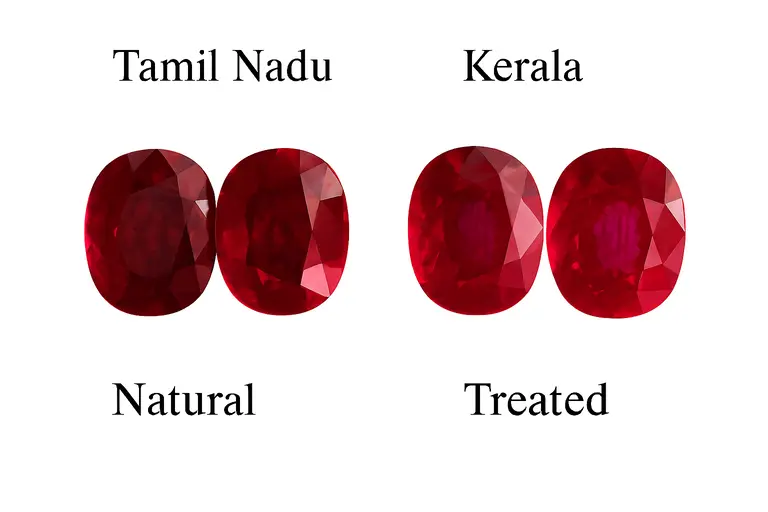
Tamil Nadu Kempu used for Bharatanatyam, temple sets, and bridal work often includes glass filling or composite structures (assembled rubies) to keep prices low. Many stones arrive from Thailand, the global heat-treatment hub.
Kerala markets usually carry fewer glass-filled stones because many buyers want gems for astrology and pooja use. If doubtful, ask the jeweler.
Therefore, you must inspect your stone with a 10x loupe. If you see gas bubbles or flat glassy patches, the ruby may be glass-filled. In this case, consider a lab test or consult a reputed gemstone analyst or gemologist.
How Local Demand Shapes Kempu Ruby Tamil Nadu Kerala Quality
After treatments, local demand shapes the quality gap in Kempu Ruby Tamil Nadu Kerala markets.
Tamil Nadu buyers want strong color and size for stage and wedding photos. Meanwhile, Kerala buyers value a natural look and belief value.
As a result, Tamil Nadu markets offer Kempu from INR 2,000 to 50,000 per carat, mixing natural, treated, and synthetic stones. Kerala stores push certified Burmese or premium African rubies at higher prices for planetary benefits.
So, ask yourself: do you want an eye-catching stone for design use, or a trusted gem for astrology?
Cut, Clarity, and What You See in Kempu Ruby Tamil Nadu Kerala Stones
In addition, cutting style creates a visible gap.
Tamil Nadu cutters keep more weight and size (ratti). Kerala suppliers prefer symmetry and polish.
As a result, Tamil Nadu Kempu looks bigger but often shows windowing and inclusions. Kerala stones may appear smaller in size but return more light with cleaner facets.
Therefore, always tilt the stone under direct light. If the center looks flat, you may be paying for weight—not beauty.
Practical Kempu Ruby Tamil Nadu Kerala Buying Steps for You
To make a smart choice, follow these steps:
- Fix your purpose: design, astrology, or collection.
- Decide your budget per carat before visiting Tamil Nadu markets.
- Ask for written details on gemstone origin and treatment.
- Demand a lab report from GIA, IGI, or GII.
- Compare one or two Kerala-certified stones with Tamil Nadu options.
You may also check trusted sellers such as Brahma Gems to benchmark price and quality.
FAQ
Why do Tamil Nadu Kempu rubies look brighter?
They often look brighter due to glass-filling and strong heat treatment. These treatments push color toward the surface.
Are Kerala rubies always better?
No. Kerala rubies are not always better. However, higher-end shops often focus on certified gems for astrology. Always check the lab report.
How does origin affect price?
Burmese and fine African origin can push prices above INR 50,000 per carat in Kerala. Tamil Nadu markets offer mixed African material at lower rates.
Author Bio
P.J. Joseph, also known as Saju Elizamma, Gemstone & Gold Consultant serving Kerala, Tamil Nadu, and Karnataka.