
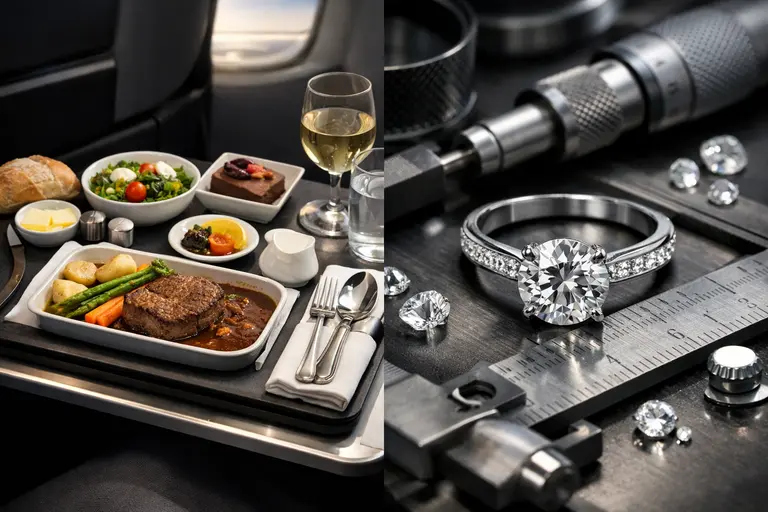
Introduction to Jewelry Business Lessons from Airline Catering
While fine jewelry and flight meals seem miles apart, smart entrepreneurs are increasingly looking for jewelry business lessons from airline catering to improve their own operational efficiency. Every single day, giant airport kitchens prepare tens of thousands of meals for flights that cannot wait for a single minute. From Dubai to Hong Kong, these massive operations run on absolute speed, hygiene, and mechanical precision, providing a perfect blueprint for any high-precision workshop. Consequently, understanding these aviation systems can help jewelers cut waste and improve customer satisfaction.
At first glance, airline catering and fine jewelry seem to share nothing in common. However, both industries must assemble small, delicate components into valuable, finished products under exceptionally strict quality standards. Therefore, lessons from the airline catering business can offer highly useful insights for jewelry manufacturers, retailers, and repair centers. Whether you run a large factory or a small family workshop, understanding these “industrial sheepdog” systems can transform your efficiency. To learn more about how airports are evolving, you can read our guide on airports as travel destinations.
Precision Workflows: High-Volume Airline Catering Lessons
Because international flights cannot wait for late meals, airline kitchen’s function more like lean manufacturing plants than traditional restaurants. First, executive chefs plan complex menus months in advance. They must adjust recipes constantly because dry cabin air and low pressure significantly dull a passenger’s sense of taste. Consequently, chefs add extra umami and natural seasonings without making the food too salty.
Next, specialized workers prepare ingredients in dedicated zones where automated equipment handles high-volume tasks. After cooking, staff members rapidly chill each dish through a specialized “cook-chill” process that ensures maximum food safety. Then, employees arrange trays on high-speed conveyor belts that match each specific airline’s order and class. Finally, refrigerated trucks carry sealed carts to the aircraft. This ensures that airlines receive fresh, safe food just before departure. For a deeper look at these massive facilities, visit the Emirates Flight Catering official website.
Reliability Models: Applying Airline Catering Logic to Jewelry
Ownership structures differ across various international airports; however, the core operating principles stay similar everywhere. For example, some legacy carriers like Cathay Pacific and Emirates own their facilities. They often use their spare capacity to serve other airlines, thereby maximizing their profit margins.
Meanwhile, independent companies like Gate Gourmet and LSG Sky Chefs run kitchens at major hubs under long-term contracts. This allows airlines to avoid the massive expense of building kitchens at every destination. In addition, SATS grew out of Singapore Airlines and now operates as a global leader in food and gateway services. Regardless of who owns the facility, every team focuses on reliability and on-time delivery. This “Ant” business model—focusing on logistics and systems—is a core part of the three business models: ants, spiders, and honeybees we analyzed previously.
Implementing Jewelry Business Lessons from Airline Catering
The most practical jewelry business lessons from airline catering involve “mise-en-place,” or having everything in its place. Since professional kitchens never let workers search for missing ingredients during a shift, every item reaches the station before production begins.
Likewise, jewelry workshops can apply this principle immediately. Before a goldsmith starts a custom ring, every gemstone, fitting, and design drawing should already sit ready in a pre-organized kit. As a result, craftsmen spend their time creating rather than hunting for small materials. Similarly, watch repair centers can organize specific movements and gaskets the same way. This speeds up service and reduces the risk of losing tiny components. This level of organization is exactly what industry sheepdogs in tech and jewelry do to maintain market stability.
Security Secrets for Jewelry and Airline Catering Industries
Security in aviation catering is non-negotiable. To prevent theft and tampering, caterers move sealed carts through controlled zones and record every single handover digitally. In the same way, jewelry businesses can implement tamper-evident containers and real-time digital tracking. When every piece stays accounted for at each stage, it builds unbreakable customer trust.
Design also deserves your full attention. Airline chefs design meals that still taste good after being chilled, transported, and reheated at 35,000 feet. Similarly, jewelers should design pieces for real life rather than just the showroom lighting. For instance, the humid heat of South Asia calls for durable coatings, while older customers often prefer magnetic clasps that are easy to fasten alone. Ultimately, user comfort and longevity matter as much as visual appearance. This focus on durability is a primary theme in our steel jewellery buying guide.
Operations: A Jewelry Business Lesson from Airline Catering
The real strength of airline catering lies in its repeatable systems, not just its food. Because clear procedures and shared understanding run across every department, thousands of meals reach aircraft on time daily. Jewelry businesses, even those in smaller towns across Keralam, can benefit through better digital inventory tools and standardized workflows.
Often, these improvements cost far less than buying new machinery. By optimizing your process, you can handle higher volumes without increasing your stress. In the long run, well-designed systems deliver better quality and higher customer satisfaction. For more information on global logistics standards, visit the SATS Official Website.
FAQ About Jewelry Business Lessons from Airline Catering
Why do airline kitchens prepare meals so early?
Strict flight schedules require early preparation. By using the “cook-chill” process, they can ensure the food stays at a safe temperature until it is loaded and reheated for the passengers.
How does digital tracking help a small jewelry workshop?
Digital tracking allows you to see exactly where a customer’s repair or order is at any moment. This reduces errors, prevents loss of stones, and allows you to give accurate updates to your clients.
Can these lessons work for a retail jewelry store?
Yes. By organizing your sales floor and stockroom with the same logic as a catering hub, your staff can find items faster and serve customers more efficiently during peak hours.
Is it expensive to implement these systems?
No. Many of these jewelry business lessons from airline catering involve changing your habits and using affordable software rather than buying expensive equipment.
What is the “halo effect” in this context?
When your business runs with the efficiency and hygiene of a world-class airline caterer, customers perceive your brand as more professional and trustworthy.
Disclaimer
This article serves educational purposes only. The author has no financial affiliation with the catering companies mentioned. Business practices vary by region; therefore, readers should evaluate these ideas based on their local regulations and specific operational needs. Always consult with professional business advisors before making major structural changes.