Introduction to Modern Gemology Technology
Gemology used to function as a primarily hands-on craft. For several centuries, gemologists relied almost exclusively on magnifying loupes, microscopes, and years of field experience to identify and grade precious stones. Today, however, the profession looks completely different. Modern Gemology Technology now integrates artificial intelligence, blockchain tracking, and advanced spectroscopy to shape every stage of the industry. As a result, the field has evolved into a high-tech science that blends luxury with forensic analysis.
For everyday buyers and collectors, these changes matter greatly. Specifically, understanding how these tools work helps consumers make smarter, safer purchases. You should also read our guide on gemstone buying basics to see how traditional knowledge pairs with these new scientific standards. For foundational education, the Gemological Institute of America (GIA) remains the global leader in training the next generation of tech-savvy gemologists.
Detection Trends in Modern Gemology Technology
In the past, researchers focused primarily on the discovery of new deposits. Today, the industry focuses heavily on the detection of synthetic stones and sophisticated treatments. Laboratories now spend enormous resources identifying lab-grown diamonds and chemically treated emeralds. Consequently, Modern Gemology Technology operates as a scientific defense system for consumers.
This shift ensures that market trust remains intact. Because treatments like beryllium diffusion or high-pressure heating are invisible to the naked eye, laboratories must use atomic-level analysis. Furthermore, these advances allow labs to issue reports with nearly 100% certainty. Therefore, even if you are not an expert, you can rely on the data provided by modern certification bodies.
Spectroscopy in Modern Gemology Technology
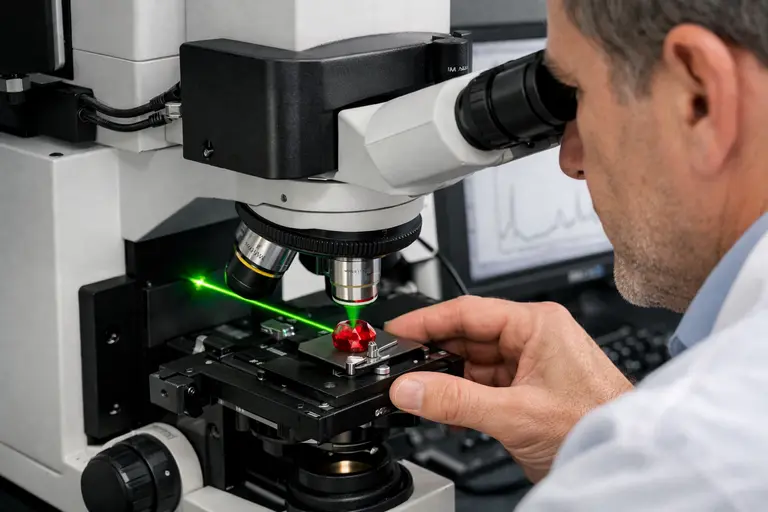
Modern labs now utilize laser analysis and chemical fingerprinting to study gemstones at the molecular level. Because of these advanced tools, technicians can determine a gemstone’s geographic origin with remarkable accuracy.
Analytical Tools in Modern Gemology
For example, the Swiss Gemmological Institute SSEF pioneered advanced laser ablation testing for high-value rubies and sapphires. Their instruments analyze microscopic trace elements that no human eye could ever detect. Similarly, the Gübelin Gem Lab developed AI-powered systems that combine microscopy and chemical databases to improve origin determination. Consequently, laboratories today blend human expertise with data-driven Modern Gemology Technology to deliver results that were impossible a decade ago. Moreover, machine learning improves consistency in diamond grading, reducing the risk of human error during repetitive tasks.
Innovation and Modern Gemology Technology
The rise of lab-grown diamonds acted as a catalyst for rapid change across the entire sector. Unlike natural stones, lab-grown diamonds develop inside controlled plasma reactors. Therefore, they often display very specific growth structures that require specialized equipment to identify.
At the same time, the popularity of synthetics pushed the natural diamond industry to improve its own transparency. As a result, major mining companies invested heavily in blockchain. For instance, the De Beers Tracr Platform tracks natural diamonds from the initial mine to the final retail showcase. As of 2026, this platform has registered millions of stones, allowing consumers to verify the exact country of origin using a smartphone. This level of traceability is a hallmark of Modern Gemology Technology.
India’s Influence on Modern Gemology Technology
India currently stands at the absolute center of this global transformation. Specifically, the cities of Surat and Mumbai process around 90% of the world’s diamonds. Because of this enormous scale, Indian manufacturers adopted automation and AI faster than almost any other region.
Modern Indian factories rely on AI-powered laser mapping to analyze rough crystals and calculate the most efficient cutting patterns. Companies like Sarine Technologies supply advanced scanning systems that are now standard in Indian workshops. In fact, millions of diamonds go through these Galaxy scanning systems every year. Furthermore, India has become a global force in lab-grown production, using advanced chemical vapor deposition (CVD) technology. Therefore, India is no longer just a polishing center; it is a major technology engine for the 2026 jewelry trade. You may also read our article on Understanding BIS Hallmark to see how India is standardizing metal purity alongside gemstone tech.
Why Modern Gemology Technology Benefits Buyers
Modern Gemology Technology benefits the 99% of buyers in several practical ways. First, consumers now receive much stronger protection against fraud. Digital certificates and secure online databases make it difficult for dishonest sellers to pass off imitations as natural gems.
Second, blockchain systems improve the ethical standing of your jewelry. Consequently, you can ensure that your purchase does not support conflict or environmental destruction. Third, AI-assisted grading ensures that the price you pay matches the actual quality of the stone. Finally, these advances help preserve the long-term resale value of your collection. A stone with a verified digital history is significantly easier to insure or pass down to future generations. In short, technology has made the dream of owning a rare gemstone safer for everyone.
Challenges Facing Modern Gemology Technology
Despite these massive leaps, the industry still faces significant hurdles. Most colored gemstones originate from small artisanal mines in Africa and South America. Unfortunately, many of these miners cannot afford expensive lab testing or digital tracking systems.
Furthermore, the global supply chain remains highly fragmented. Stones often change hands five or six times before reaching the end consumer. Consequently, maintaining a 100% accurate digital record throughout the entire chain remains a difficult goal. However, as the cost of Modern Gemology Technology decreases, smaller players will likely gain access to these tools. This will eventually create a truly transparent global market.
FAQ: Modern Gemology Technology
Is traditional gemology becoming obsolete?
No. Traditional skills like identifying inclusions are still vital. However, Modern Gemology Technology provides the extra data needed to confirm those visual observations with scientific proof.
How does AI help in gemstone grading?
AI systems analyze thousands of images to grade color and clarity with perfect consistency. This eliminates human bias and ensures that two different stones receive the same grade for the same quality.
Can blockchain prove a gemstone is “conflict-free”?
Yes. By recording every transfer of ownership on an unchangeable digital ledger, blockchain ensures that the stone’s journey from an ethical mine is fully documented.
What is the “paternity test” for emeralds?
It is an advanced technology where DNA-based nanoparticles are placed inside the rough stone at the mine. This allows any future lab to verify the stone’s exact origin with 100% certainty.
Why is India so important for jewelry tech?
India’s massive production volume makes it the perfect testing ground for new technology. Specifically, Indian manufacturers lead the world in adopting AI for diamond cutting and CVD diamond growth.
Disclaimer
This article is for educational purposes only. Gemological standards and technologies fluctuate based on new research. Always consult a certified professional or a reputable laboratory before making significant investment decisions. The author has no financial affiliation with the brands or laboratories mentioned.