Introduction
India loves gemstones. Families buy them for weddings, for savings, and for Jyotish traditions. Because of this demand, sellers use the term gemstone certificate as a powerful, persuasive selling point. However, many buyers mistakenly assume every certificate carries the same scientific weight; unfortunately, this assumption often leads to financial loss. A proper gemstone report reveals exactly what a scientific examination found. Consequently, before you spend a large sum, you must learn how to read that report, verify the laboratory, and match the physical stone to the paperwork. By following these steps, you protect your investment and ensure you receive exactly what you paid for.
A Gemstone Certificate and a Laboratory Report Differ
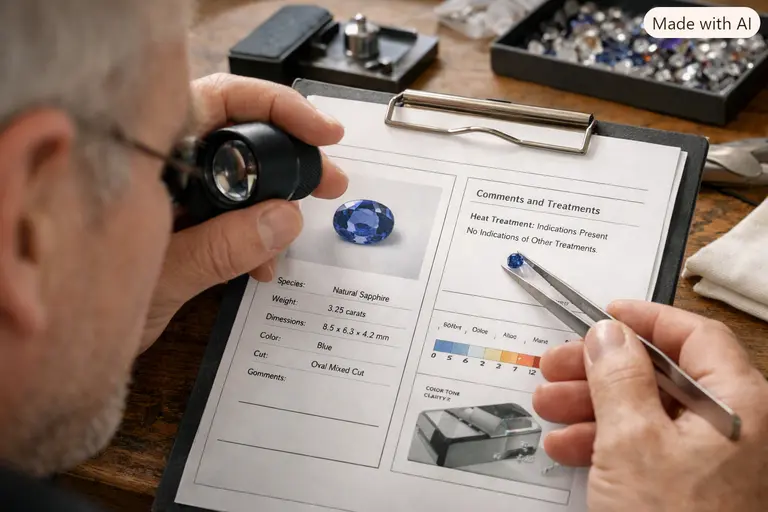
Jewellers often use the terms “gemstone certificate” and “laboratory report” interchangeably. Still, you should look past the label and examine what the document actually states. A laboratory report records the objective findings of an examination, identifying the gemstone, stating whether it occurs naturally or grows in a lab, recording the weight and measurements, and disclosing any detected treatments.
A gemstone certificate, meanwhile, works as a broader, often vague commercial term. Sellers frequently attach it to all sorts of paperwork, regardless of the document’s actual content. Therefore, never assume the word “certificate” automatically guarantees quality, rarity, market value, or lasting condition.
Consider the Gemological Institute of America (GIA). GIA explicitly states that it does not certify or appraise gemstones; instead, it issues reports that share technical findings, not appraisal values. Trade professionals still say “gemstone certificate” out of habit, but GIA itself correctly labels the document a report.
A laboratory report does not guarantee a price
This distinction becomes crucial when you buy a ruby, sapphire, emerald, or any high-value gemstone certificate-backed stone. A laboratory report rarely tells you what a stone should cost. Instead, it provides technical facts that you, your jeweller, or an independent appraiser can use to judge the item.
As a result, colour, clarity, size, cut, treatment, rarity, origin, and demand make two natural sapphires carry very different price tags. Consequently, never confuse a lab’s identification with a financial valuation.
Watch for Misleading Gemstone Certificate Claims
First, do not assume every gemstone certificate proves authenticity. A glossy card with a logo, hologram, or QR code does not automatically carry scientific weight. Some documents come from labs you cannot independently verify, or from a seller’s own affiliated testing operation. Always check the laboratory’s reputation before you trust the paper.
Second, pay close attention to treatment disclosure. A gemstone can occur naturally and still undergo treatment through heating, fracture filling, or diffusion—practices that occur throughout the international gem trade. GIA, for instance, documents heat treatment, glass, or flux treatments in rubies, and polymer, resin, or oil treatments in emeralds. Consequently, “natural” never means “untreated,” so read the treatment section carefully.
Treatment does not equal a fake stone
At the same time, avoid the opposite mistake. Treatment does not automatically make a gemstone certificate document a record of a fake or worthless stone. Many treated gemstones serve as legitimate jewellery materials. Yet, treatment can significantly change desirability, rarity, and price. For example, a heated ruby and an unheated ruby of similar quality command very different prices. So, instead of simply asking whether a stone underwent treatment, ask what specific treatment the lab detected, how clearly, it disclosed that fact, and how the process affects this particular stone.
How You Can Spot a Reliable Gemstone Certificate
Start by identifying the issuing laboratory, then visit its official website on your own rather than relying on a QR code the seller hands you. Next, enter the report number into the lab’s official verification system, if one exists. Check the gemstone’s description, weight, measurements, and photograph against the physical stone.
GIA’s coloured-stone reports, for example, list the gemstone type, natural or lab-grown status, detectable treatments, cutting style, shape, weight, measurements, colour, and a photograph. Even so, a genuine report can accompany the wrong stone. Online verification alone never suffices; you must also match the physical stone to the paper.
For a high-value purchase, independent testing adds another layer of protection. The cost usually looks small next to the potential loss from buying a misidentified or heavily treated stone at an unfair price. Read our related guide on choosing a jeweller for more on vetting sellers.
What Should You, the Everyday Buyer, Do?
You do not need advanced gemological training; you simply need a disciplined process. Before you pay a substantial sum, ask which laboratory examined the stone. Verify the gemstone certificate report on your own and read the identification and treatment sections rather than fixating on the words “natural” or “certified.”
For serious investments, consider an independent examination from a reputable lab. Keep the original invoice with the report so the invoice clearly describes what you bought. If a seller resists reasonable independent verification, treat that resistance as a warning sign. That said, do not assume every unfamiliar laboratory acts fraudulently; instead, examine its credentials, testing capability, and verification system before you rely on its report.
The Real Story on Gemstone Certificate Reports
The truth sits between two extremes: not every gemstone certificate is fake, and no report guarantees a good purchase. A reputable report offers valuable scientific evidence, but you must understand its limits. Do not buy a gemstone simply because it has a certificate; buy it after you understand what the report actually establishes. Check the lab, verify the report, match the stone, read the treatment disclosure, and compare the asking price with the stone’s real characteristics. Ultimately, this approach requires no gemology diploma, just the right questions before you pay.
Frequently Asked Questions
Does a gemstone certificate guarantee genuine quality?
No. The word alone proves little, so identify the issuing laboratory and verify the document independently.
Does natural mean untreated?
No. A natural gemstone can still undergo treatment, so always read the treatment section of the gemstone certificate.
Is a GIA report the same as a GIA certificate?
No. GIA issues reports with technical findings and states plainly that it does not certify or appraise gemstones. The trade still says “gemstone certificate,” but GIA calls it a report.
Does a report tell me what my gemstone is worth?
Usually not. A report shares gemological information, while market value depends on quality, rarity, treatment, origin, and demand.
Should every expensive gemstone get independent testing?
For a significant purchase, yes. Independent testing adds valuable protection based on the gemstone, its value, and your purpose for buying it.
Disclaimer
This article shares general consumer information and does not replace independent gemological examination, professional valuation, or legal advice. Laboratory terminology and testing practices vary. Jyotish beliefs about gemstones belong to traditional and cultural practice, and this article does not present them as scientifically established effects on health, fortune, or planetary influence. The author has no financial affiliation with the labs or organizations mentioned.