Introduction
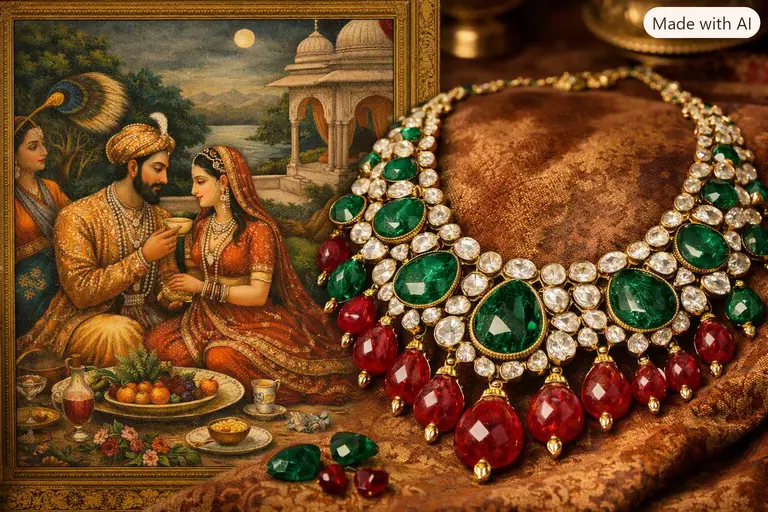
Indian art gives colored gemstones something plain advertising rarely delivers: deep cultural meaning. A ruby, an emerald, a sapphire, a spinel, or a tourmaline becomes far more memorable when placed inside a story about Indian painting, craftsmanship, or nature. Mughal-era jewelers, for instance, set emeralds, rubies, spinels, and pearls into elaborate gold pieces. Furthermore, they sometimes carved or inscribed the stones themselves to commemorate royal lineages. You can explore these historic pieces in GIA’s documentation on the Taj Mahal era.
Consequently, today’s opportunity for the jewelry industry isn’t simply to sell more colored stones based on carat weight. Instead, the industry can treat Indian art and gemstones as a unified visual language. By doing so, the same story reaches an older buyer through an exhibition, a younger buyer through a short video, and a family through a hands-on experience.
Indian Art and Gemstones in Storytelling
Colored gemstones naturally suit visual storytelling because vibrant color grabs human attention immediately. However, the industry often leads with cold specifications instead—carat weight, clarity, treatment, and origin—even though buyers first need an emotional reason to care.
Mughal Influences on Indian Art and Gemstones
Mughal miniature painting offers that reason by providing a rich vocabulary of flowers, birds, gardens, and courtly life. Surviving Mughal jewelry shows how artisans combined colored gems with gold, jade, and enamel to mirror these paintings. You can view these surviving pieces in the V&A’s guide to Mughal Empire arts. For example, a collection inspired by a specific floral painting could use emeralds for leaves and rubies for blossoms. As a result, the finished jewel communicates a sophisticated idea rather than just displaying a collection of expensive stones.
Crafting Indian Art and Gemstones Into Stories
Indian craftsmanship builds a sturdy bridge between fine art and rare gemstones. Kundan, the specific technique of setting stones in pure gold without heat, is the process most closely associated with Mughal jewelled arts. Some historians trace its roots back even further into ancient India. You can explore this heritage in the V&A’s feature on traditional Indian jewellery making.
Enamel Work for Indian Art and Gemstones
Meenakari, or enamel work, adds an entirely different layer of beauty. Interestingly, enamelling was unknown in India before the late 1500s. Mughal court goldsmiths likely adopted it from Europe and then paired it with kundan settings to add colorful enamel to a jewel’s reverse side. Therefore, a brand can show far more than a finished stone; it can show the initial sketch, the master cut, the setting, and the enamelist’s delicate brushwork. In turn, buyers understand that a jewel carries both material value and immense human skill.
Natural Palettes in Indian Art and Gemstones
Indian art also hands modern designers a massive vocabulary of natural forms, such as peacocks, parrots, lotus blooms, and vines. A designer could interpret a peacock through the use of blue sapphire and green tourmaline. Alternatively, they could capture a floral motif through rubies, emeralds, and pink sapphires.
Still, the ultimate goal should not be literal reproduction. Instead, designers can lift the colors and rhythm from a historical artwork and reinterpret them for today’s modern buyer. This approach also simplifies gemstone education. This is because a familiar image gives people a comfortable entry point before they have to learn a dozen complex gemstone names. For those looking for a starting point, check out our guide to buying your first colored gemstone.
Promoting Indian Art and Gemstones Digitally
The industry can carry the relationship between Indian art and gemstones far beyond traditional advertising. Jewelry brands, galleries, and gem dealers could stage small art-and-gemstone exhibitions in Indian cities. In this format, a painting hangs directly beside the jewel it inspired, while a lapidary demonstrates cutting nearby.
Multi-Channel Indian Art and Gemstones
This format makes jewelry feel less intimidating to the general public. Visitors can attend purely to see art rather than feeling pressured to spend money. In this way, art helps bring colored stones to the 99%, not only to elite collectors. Younger buyers can meet the same story through digital media. A short video could follow an artist sketching a peacock, a lapidary cutting a tourmaline, and a goldsmith finishing the jewel. Moreover, interactive quizzes turn digital content into an introduction rather than a sales pitch. You can start learning more by exploring our gemstone education hub.
Daily Wear Indian Art and Gemstones
This concept doesn’t need to stay confined to museum-quality pieces. In fact, its biggest potential may lie in everyday jewelry for the average consumer. A designer could shape an affordable silver pendant around an Indian flower and then explain the design story on a simple QR-linked page. As a result, colored gemstones stop looking like “cheaper” alternatives to diamonds. Instead, they start looking like individual expressions of color, culture, and personal creativity.
India doesn’t need to invent a new relationship between art and gemstones because the foundation already exists. Mughal jewelry shows the artistic use of colored gems, kundan shows the value of skilled setting, and meenakari adds a further layer of color. The industry simply needs to reinterpret that heritage for today’s buyer.
FAQ: Guide to Indian Art and Gemstones
How can Indian art promote colored gemstones?
Indian art provides colored gemstones with recognizable stories, motifs, and cultural context. These elements make the stones more relatable and memorable than technical specifications alone.
Which Indian art traditions work best for jewelry design?
Mughal miniature painting, kundan setting, and meenakari enamel work are the primary traditions. Additionally, Indian nature motifs like the lotus and peacock offer endless inspiration.
Can this approach reach everyday consumers?
Yes. By using silver or more affordable colored stones, brands can create “story-driven” jewelry that appeals to people based on art and craftsmanship rather than just high price tags.
Is it important to mention gemstone treatments?
Yes, absolutely. While the story creates interest, gemological accuracy creates trust. Brands must always disclose treatments and origins honestly to maintain long-term credibility with buyers.
Disclaimer
This article discusses Indian art, jewelry traditions, and cultural or astrological associations for educational and marketing purposes only. Astrological gemstone associations reflect traditional beliefs and should not be presented as scientifically proven effects. A gemstone’s value also depends on factors such as species, quality, color, clarity, treatment, rarity, and prevailing market conditions. The author has no financial affiliation with the brands or organizations mentioned.