
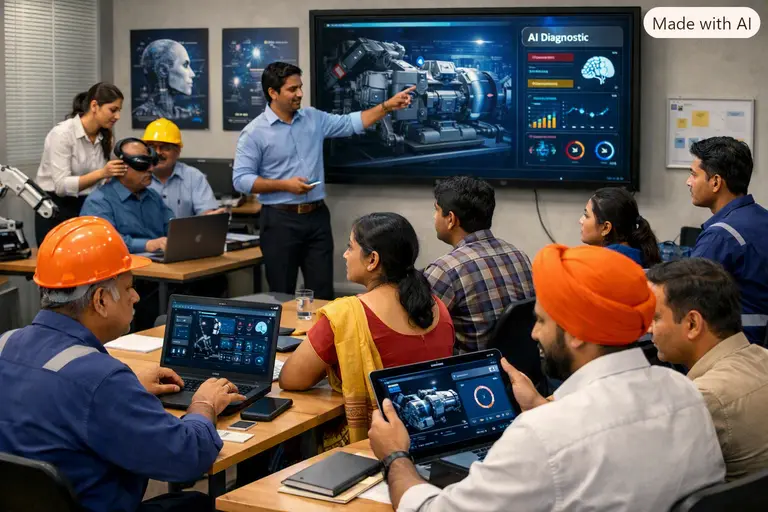
Introduction to Retraining India’s Workforce for AI
Artificial intelligence is quickly changing how Indian businesses operate at a fundamental level. Today, AI systems help companies analyze diamond clarity, manage complex inventories, and even personalize travel recommendations for global tourists. As a result, industries such as gems and jewelry, food and beverage, and hospitality are adopting automation faster than ever before. Consequently, the mission of retraining India’s workforce for AI has become an urgent national priority.
However, AI rarely eliminates the need for human talent. Instead, it reshapes the nature of work, as software increasingly handles routine data tasks while employees shift toward roles that demand emotional intelligence and creative judgment. Therefore, India’s biggest challenge involves preparing its millions of workers to use these tools effectively before the technology outpaces their current skills. Meanwhile, success will require localized solutions that reflect the unique needs of different states. To see how specialized skills currently compete with automation, you can read our guide on trade skills that stay ahead of AI in India.
Retraining India’s Workforce for AI in the Jewelry Sector
The jewelry trade illustrates the need for digital evolution more clearly than almost any other sector. Today, AI-assisted tools support diamond grading with incredible accuracy. Nevertheless, these technologies support trained gemologists rather than replacing them, since human experts must still make final decisions based on international laboratory standards.
Furthermore, customers in 2026 will increasingly ask about the GemFair diamonds supply chain and ethical sourcing. Consequently, professionals who understand both AI data and human communication will become the most valuable assets in the industry. Training programs in hubs like Surat and Jaipur must therefore emphasize digital design and ethical auditing alongside traditional bench skills. This transition is essential for building India’s global brands as centers of both heritage and high-tech transparency.
Sourcing New Skills for Food and Hospitality
Restaurants and cafés increasingly rely on AI to forecast seasonal demand and drastically cut food waste. As a result, managers can make faster, better-informed decisions regarding their supply chains. However, a memorable dining experience still depends on a creative chef and a welcoming waitstaff rather than a robot.
When retraining India’s workforce for AI in the hospitality sector, programs should focus on “Augmented Service.” This means teaching staff to use AI for background logistics while spending more time on the personal “human touch.” For example, a hotel concierge can use AI to find the perfect local experience for a guest, but only a human can deliver that recommendation with genuine warmth. This balance is a core part of the three business models: ants, spiders, and honeybees, where humans act as the “honeybees” who add value through transformation.
Regional Solutions: The Key to National Success
Although the central government has launched major digital initiatives, a single nationwide model will likely fall short of the goal. Instead, the country needs flexible training that reflects regional realities. Metropolitan cities such as Bengaluru already have strong digital foundations; however, many smaller towns still lack reliable broadband. Consequently, the process of retraining India’s workforce for AI must start from different baselines.
For instance, Keralam and Rajasthan should prioritize AI-assisted tourism training. In contrast, Maharashtra and Gujarat should focus on industrial AI for manufacturing and jewelry. Furthermore, using voice-based AI assistants in regional languages like Malayalam, Hindi, and Tamil could help workers with limited English proficiency participate in the new economy. For official updates on these initiatives, you can visit the IndiaAI Mission portal.
Challenges: Bridging the Digital Divide
Despite real progress, significant obstacles remain in our path. First, the digital divide continues to limit millions of rural workers. Because many Indians connect to the internet solely through low-cost smartphones, advanced training that requires high-performance computing remains inaccessible to many.
Second, labor protections need urgent attention. Some workers are already collecting the data that trains these AI systems without clear compensation or long-term job security. Finally, small and medium enterprises (SMEs) face financial limits when investing in expensive retraining software. Therefore, the Ministry of Skill Development and Entrepreneurship must provide affordable tools and public-private partnerships to ensure no one is left behind. This level of oversight acts as a “sheepdog” for the labor market, a concept we explore in our industry sheepdogs guide.
Conclusion: A Future of Human-AI Collaboration
AI will undoubtedly reshape the Indian service economy; yet, it does not signal the end of meaningful human work. Instead, it changes which skills employers value most. Workers who pair AI literacy with strong communication and adaptability will likely find the best opportunities in 2026. Ultimately, the success of retraining India’s workforce for AI depends on steady collaboration between the government, private educators, and the workers themselves. If we embrace this shift with curiosity and discipline, India can turn this technological challenge into its greatest economic advantage.
FAQ: Retraining India’s Workforce for AI
Will AI take my job in the Indian jewelry industry?
AI will likely automate the routine parts of your job, such as basic sorting or data entry. However, high-level grading and bespoke design will still require the human eye and creative judgment.
How long does it take to become “AI-literate”?
For most service roles, you can learn the basics of using AI tools in three to six months. However, staying competitive requires a commitment to continuous learning as the software evolves.
Are there free resources for retraining India’s workforce for AI?
Yes, the government’s “SWAYAM” and “NPTEL” platforms offer various free courses on artificial intelligence and data science for all Indian citizens.
Can AI improve hospitality in Keralam?
Indeed, AI can help Keralam resorts predict peak travel dates and manage energy use. This allows staff to focus entirely on providing the world-class service that the state is famous for.
Do I need a computer science degree to work with AI?
No. In 2026, most AI tools use “low-code” or “no-code” interfaces. This means you only need to understand how to guide the AI with the right questions rather than writing the code itself.
Disclaimer
This article draws on publicly available government initiatives and market trends as of August 2026. Projections regarding workforce changes and timelines are informed estimates rather than guaranteed outcomes. The author has no financial affiliation with the tech companies mentioned. Readers should consult with official career advisors and the Ministry of Skill Development before making major professional changes.