
Introduction to Aaron Davis Saving Coffee
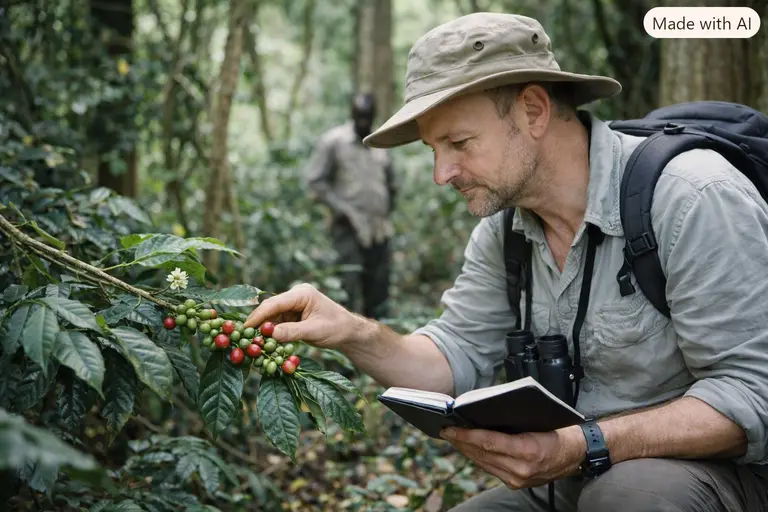
Rising global temperatures and erratic rainfall currently threaten the world’s most beloved beverage, making the mission of Aaron Davis saving coffee a vital scientific endeavor for 2026. As Head of Coffee Research at the Royal Botanic Gardens, Kew, Dr. Davis leads a global race against climate change by searching for resilient wild species in remote tropical forests. Millions of people start their morning with a cup of coffee; however, spreading pests and prolonged droughts now push many farms into a state of crisis. Consequently, identifying new genetic blueprints has become essential to ensure the survival of the industry for future generations. Therefore, the work of Aaron Davis—saving coffee—is not just a scientific pursuit; it is an economic necessity. To understand how other high-value industries manage their resources, you can read our guide on industry sheepdogs in tech and jewelry.
Global Climate Threats and Aaron Davis Saving Coffee
Arabica coffee, which currently accounts for the vast majority of the world’s premium market, requires very specific conditions to thrive. It needs steady rainfall and cool mountain air to produce its signature complex flavors. As global temperatures climb, coffee cherries ripen far too quickly. Consequently, the beans lose the time they need to build the natural sugars that create a rich taste.
Meanwhile, pests like the coffee berry borer are spreading into once-safer high elevations. Heavy rains and prolonged dry spells damage the delicate plants, meaning farmers face a more difficult harvest every year. Researchers at Kew warn that roughly 60% of all wild coffee species now risk extinction. Therefore, protecting these wild relatives is an urgent global priority. This biological diversity acts as a natural insurance policy, much like the hidden networks in nature and business that sustain our global economy.
Rare Wild Finds in Aaron Davis Saving Coffee
Unlike many scientists who work mostly indoors, Davis pairs intense botanical research with demanding expeditions through the forests of Africa. He hunts for species that already possess the natural ability to tolerate heat, drought, or local diseases. His most significant breakthrough occurred in Sierra Leone in late 2018.
There, alongside colleagues Jeremy Haggar and Daniel Sarmu, he rediscovered Coffea stenophylla. This specific species had remained unseen in the wild since 1954. Their findings, published in the journal Nature Plants, drew immediate global attention. Notably, stenophylla combines two exceptionally rare qualities. First, blind taste panels rated its flavor as being very close to premium Arabica. Second, it grows comfortably in far warmer conditions than Arabica can tolerate. As a result, scientists now view this discovery as a cornerstone of Aaron Davis saving coffee efforts. It provides the genetic blueprint for a new generation of resilient crops.
Indian Impact of Aaron Davis Saving Coffee
India grows approximately three to four percent of the world’s coffee supply, primarily across Karnataka, Kerala, and Tamil Nadu. Indian growers often shade their crops beneath a thick forest canopy; nevertheless, they increasingly battle rising heat and unpredictable monsoons. Interestingly, the genetic research led by Davis has reshaped our understanding of the tall trees that Indian growers have long called “Liberica.”
Recent analysis reveals that many of these trees actually belong to Coffea dewevrei, or Excelsa. This variety tolerates heat significantly better than Arabica while producing a unique, fruity, tart cup profile. Furthermore, researchers have identified natural hybrids called “Libex,” which blend the traits of Liberica and Excelsa. While their commercial future requires more long-term trials, they offer a promising path for Indian farmers in 2026. This focus on regional authenticity is a key lesson from building India’s global brands in the agricultural sector. For official updates on local production, you can visit the Coffee Board of India.
Comparing Botanical and Gemological Pioneers
While researching the efforts of Aaron Davis saving coffee, an interesting parallel emerges with the late Prof. Dr. Eduard Gübelin, the pioneering Swiss gemologist. Although they work in different fields, both men shared a commitment to “source-based” science. Prof. Gübelin traveled to gemstone-producing regions worldwide to study minerals at their source rather than relying only on laboratory samples.
Similarly, Davis undertakes demanding expeditions to locate rare coffee species before they vanish forever. Both pioneers chose fieldwork over convenience, understanding that the true story of a specimen lies in its origin. Their methods echo each other because they both rely on microscopic analysis to find the truth. Gübelin studied internal inclusions to reveal a stone’s history, while Davis applies genetic research to trace the evolution of wild coffee. Above all, conservation links their legacies. Just as Gübelin’s work strengthened trust in natural stones, Davis protects the genetic diversity that determines coffee’s survival. This level of critical thinking in modern gemology and botany is what keeps global industries honest.
Flavor Outcomes of Aaron Davis Saving Coffee
Will your coffee taste different in the future? Most experts agree that it very likely will. As temperatures rise, the flavor of Arabica in warmer regions will shift. At the same time, more growers are moving toward Robusta because it survives heat better. However, Robusta typically tastes stronger and more bitter.
Wild species such as stenophylla and Excelsa offer a “third way.” They potentially deliver the resilience of Robusta with the superior taste of Arabica. Consequently, the mission of Aaron Davis saving coffee provides hope that we can maintain quality without sacrificing the planet. Progress will eventually come from combining these diverse species through careful conservation and professional breeding. For India, this research arrives at a pivotal moment, offering the tools needed to protect a sector known for its sustainable, shade-grown character.
FAQ About Aaron Davis Saving Coffee
Who is Dr. Aaron Davis?
Dr. Aaron Davis is a world-renowned botanist and the Head of Coffee Research at the Royal Botanic Gardens, Kew. He is widely recognized for his work on the climate resilience of wild coffee species.
What is the most important discovery made by Aaron Davis?
His most famous discovery is the rediscovery of Coffea stenophylla in Sierra Leone. This species is heat-tolerant and has a flavor profile that rivals high-quality Arabica.
How does his research help Indian coffee farmers?
His research identifies specific varieties like Excelsa that can thrive in the warming climate of the Western Ghats. Consequently, this helps Indian farmers switch to more resilient crops.
Is wild coffee the same as the coffee I buy in a shop?
No. Wild coffee is the ancestor of the coffee you drink. It is often not suitable for direct sale but contains the “tough” genes needed to make commercial coffee stronger and more resilient.
Can I visit Kew Gardens to see these coffee plants?
Yes, Kew Gardens in London houses an extensive collection of coffee species. They offer various educational exhibits where you can learn more about Aaron Davis saving coffee initiatives.
Disclaimer
This article is intended for educational purposes and summarizes publicly available research as of August 2026. Coffee breeding and climate science are evolving fields; therefore, readers should consult the Royal Botanic Gardens, Kew, and the Coffee Board of India for the latest official findings. The author has no financial affiliation with the research institutions mentioned.