
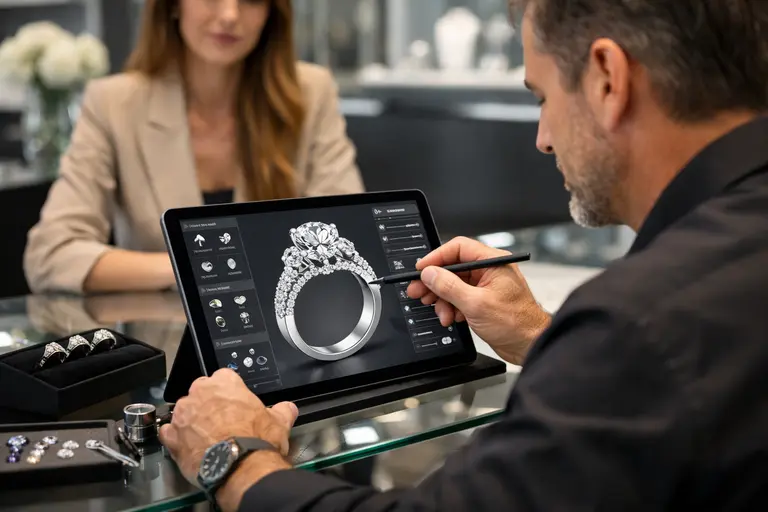
Introduction to AI in the Jewelry Industry
The global jewelry sector has always welcomed new tools and innovative ways of doing business. Over the past decades, jewelers have moved from simple hand tools and small workshops to computer-aided design (CAD) software and expansive online stores. Each shift brought new opportunities for growth and unique challenges for traditionalists. Today, in 2026, AI in the Jewelry Industry is driving the next major revolution. Specifically, businesses of all sizes are currently deciding how these technologies fit into their daily operations. Some jewelers see artificial intelligence as a chance to work faster and cut operational costs. Others worry that technology could weaken the personal connections that make jewelry buying so meaningful.
However, the real question is not whether to use technology, but rather how to use it wisely. After all, customers buy jewelry to mark the most important moments of their lives. At the same time, businesses require efficient systems to stay competitive in a digital world. Therefore, the future of jewelry retail will depend on finding the right balance between smart technology and genuine human care. You should also read our guide on gemstone buying mistakes to understand how maintaining quality standards remains vital during this high-tech transition.
How Automation Is Helping Jewelry Businesses Work Better
Like many other sectors, the jewelry industry faces growing pressure to serve customers faster and more accurately. Shoppers today expect quick responses and real-time stock information. As a result, automation has become a practical and necessary solution for many independent jewelers. Modern software now automatically tracks inventory and manages customer records without human error. Furthermore, many systems can sync information across websites, mobile apps, and physical stores simultaneously.
Because of these tools, businesses significantly reduce manual labor and avoid costly mistakes in logistics. In addition, gold and diamond prices can shift multiple times a day. Consequently, automated pricing systems help businesses stay consistent and protect their profit margins. For the latest industry data and trade standards, you can visit the Gem & Jewellery Export Promotion Council (GJEPC). By adopting these tools, even small boutiques can compete with massive national chains on a level playing field.
Where AI in the Jewelry Industry Adds the Most Value
The greatest benefits of AI in the Jewelry Industry often happen behind the scenes, away from the customer’s view. For example, inventory management traditionally required hours of manual counting. Today, AI-driven software handles this automatically, tracking stock movement in real-time.
Personalization and Predictive Analytics
Moreover, modern customer relationship management (CRM) systems store purchase histories and key dates like anniversaries. Consequently, jewelers can offer personalized service without having to remember every detail manually. Similarly, e-commerce platforms can automatically send order confirmations and shipping updates. As a result, customers stay informed while the staff direct their energy toward building relationships and advising buyers. Furthermore, predictive AI now analyzes past sales data to suggest which designs will trend in the coming festive season. This allows manufacturers to produce the right amount of stock, reducing the environmental impact of overproduction.
Why Human Relationships Still Matter Most
Although automation improves efficiency, it cannot replace the foundation of trust. Jewelry purchases often mark life’s biggest moments, such as engagements and weddings. Therefore, customers often need reassurance from a real, knowledgeable person before they spend significant money. A software system can calculate a price in seconds; nevertheless, it cannot understand a family tradition or an emotional wish.
Likewise, an AI chatbot can answer basic questions, but many customers still prefer to speak with an experienced jeweler when choosing an engagement ring. Trust is one of the most valuable assets any jewelry business can build. Customers who feel guided and respected are far more likely to return and recommend the store to others. As a result, businesses that rely entirely on AI in the Jewelry Industry risk losing the human touch that keeps customers loyal. You may also read our article on Understanding BIS Hallmark to see how verified human standards still define trust in the gold market.
The Rise of the High-Tech, High-Touch Approach
Increasingly, successful jewelry businesses are combining technology with personal service. Many industry experts describe this as a “high-tech, high-touch” model. Under this approach, software monitors inventory while the sales staff focus on educating the customer. Several major jewelry companies already follow this strategy with great success. For example, Tanishq has invested heavily in digital tools while maintaining a strong in-store service. Similarly, CaratLane blends online convenience with physical retail experiences through Augmented Reality (AR) try-on tools.
Importantly, these businesses use AI in the Jewelry Industry to support human interaction rather than replace it. Therefore, automation becomes a powerful business tool that empowers skilled staff to be more effective. For the latest global perspectives on this shift, you can refer to Rapaport News.
A Renewed Appreciation for Handmade Craftsmanship
One unexpected result of growing automation may be a stronger appreciation for handmade work. Machines excel at producing thousands of identical items with consistent precision. By contrast, skilled artisans create subtle variations that reflect personal technique and years of experience. Therefore, handmade jewelry offers qualities that automated production cannot easily replicate.
Many customers value the story behind a piece of jewelry. They appreciate the skill and creativity involved in its manual creation. As a result, small variations in texture often add charm rather than reduce quality. Furthermore, uniqueness remains an important form of personal expression in 2026. Consequently, the growth of AI in the Jewelry Industry may actually strengthen the market for genuine, soul-filled craftsmanship.
FAQ: AI in the Jewelry Industry
Will AI in the Jewelry Industry replace designers?
No. While AI can assist with rapid prototyping and motif generation, human creativity and cultural understanding remain essential for creating designs that resonate emotionally with buyers.
How does automation help small jewelers?
Small jewelers can use automation for repetitive tasks like billing, inventory alerts, and WhatsApp marketing. This saves time and allows the owner to focus on custom design work.
Is AI used to identify fake gemstones?
Yes. Advanced AI systems now work with spectrometers to identify synthetic stones, imitations, and treatments at a speed and accuracy level that far exceeds manual testing.
Does AI affect the price of jewelry?
Automation often makes manufacturing more efficient, which can lower prices for the consumer. However, AI also helps brands optimize their pricing based on real-time market fluctuations.
Are customers comfortable with AI in showrooms?
Most customers enjoy AI features like virtual try-on and 3D ring builders. However, for the final purchase, the majority still seek the advice of a human expert.
Disclaimer
This article is for educational and informational purposes only. Technology adoption varies based on business size and local market conditions. Jewelry business owners should evaluate their individual needs and seek professional advice before implementing AI solutions. The author has no financial affiliation with the tech companies mentioned.