Introduction to Portuguese and Indian Filigree Jewelry
Filigree jewelry is one of the oldest and most delicate crafts in the world. Skilled artisans twist and solder ultra-fine metal wires into lace-like patterns that look almost weightless. Many collectors and jewelry enthusiasts now admire Portuguese and Indian filigree jewelry for their unique beauty and the centuries of history that shaped their distinct styles. At first glance, both crafts look strikingly similar because both rely on intricate wirework techniques passed down through dozens of generations.
However, when you look more closely, they differ significantly in terms of metals, motifs, cultural meaning, and the specific markets they serve. This article walks you through those differences in plain language. By understanding these nuances, you can better appreciate the work of Portuguese and Indian filigree jewelry makers and make smarter choices when you buy. Whether you seek a symbol of love or a masterpiece of religious art, these two traditions offer unique perspectives on the same ancient skill.
Where Each Tradition Began and Flourished
Portuguese filigree developed over centuries in the northern regions of the country. In particular, the towns of Gondomar and Póvoa de Lanhoso became the global centers of filigree production. Today, artisans in those towns continue to produce some of Europe’s finest handmade jewelry. Specifically, the Portuguese government and UNESCO recently recognized the craft as part of the nation’s Intangible Cultural Heritage. To learn more about how quality is maintained in such trades, you can read our guide on industry sheepdogs in tech and jewelry.
Meanwhile, Indian filigree flourished primarily in eastern and southern India. Cuttack, located in Odisha, earned its famous nickname “Silver City” through its remarkable silver filigree tradition. Similarly, Karimnagar in Telangana built its own respected heritage over the same historical period. Both crafts share ancient roots that likely trace back to Mediterranean traders. Nevertheless, they evolved in very different cultural environments. As a result, their materials and artistic styles took separate paths. For a broader look at geographic branding, visit the World Intellectual Property Organization (WIPO) page on geographical indications.
The Metals: High-Carat Gold vs. Pure Silver
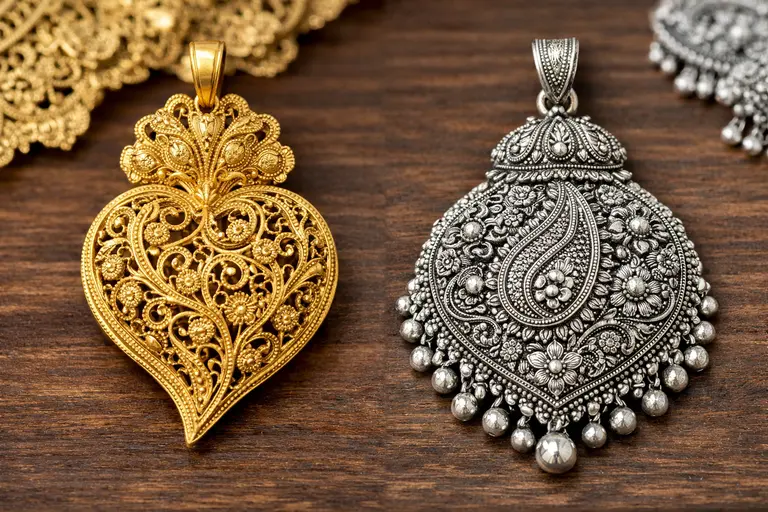
The most obvious difference between the two traditions is the choice of metal. Portuguese filigree traditionally uses high-carat gold, particularly the 19.2-karat standard. Most Portuguese gold jewelry carries this specific purity, which gives the metal a deep, rich color and high market value. In some cases, artisans also work with gold-plated silver to reach a broader market. Consequently, Portuguese pieces often display a warm, golden appearance that people associate with high luxury.
Indian Tarakasi, on the other hand, is primarily a silver art form. In this craft, artisans transform silver into thin, fine wires or foils. Therefore, Indian filigree appears much brighter and cooler in tone than its Portuguese counterpart. Because silver generally costs less than high-carat gold, Indian filigree reaches a wider audience. As a result, Tarakasi remains accessible to everyday buyers as well as serious collectors. Even so, both traditions demand exceptional skill. This focus on metal purity is a key element of the Chow Tai Fook business model, which emphasizes trust and material standards.
Different Designs and Cultural Stories
The design language of Portuguese and Indian filigree jewelry reflects their respective cultural histories. Portuguese filigree draws heavily on themes of love, religion, and the sea. The “Heart of Viana” is the most recognized filigree piece worldwide. Originally, this was a symbol of religious devotion, but it eventually became a global icon of Portuguese romantic tradition. Likewise, religious crosses and floral patterns continue to dominate many Portuguese collections.
In contrast, Indian filigree draws inspiration from mythology, nature, and grand temple architecture. Artisans in Cuttack create stunning miniature replicas of the Jagannath temple and the Konark Sun Temple. During the Durga Puja festival, these craftsmen create elaborate tableaus that showcase intricate filigree work for the Goddess. As a result, Portuguese filigree leans toward symbolic elegance, whereas Indian filigree tells detailed cultural stories. This storytelling ability is essential for building India’s global brands in the luxury sector. For more on Indian jewelry history, visit the National Museum of India.
Technical Execution: Airy Frames vs. Dense Textures
Although both traditions require extraordinary precision, artisans approach the actual construction differently. In Portuguese filigree, the frame of a piece defines the empty spaces that the artisan must fill. They then fill those spaces with twisted wires in sinuous patterns like spirals and curls. Consequently, finished pieces appear airy, balanced, and graceful. The deliberate open spaces form a vital part of the overall design aesthetic.
Indian artisans, however, generally focus on achieving a denser interior detail. They often pack large sections with tightly arranged zigzag patterns and microscopic coils. Therefore, many Tarakasi pieces display a richer and more textured visual effect overall. Furthermore, Indian filigree extends well beyond jewelry into the world of decorative arts. Artisans create silver plates, chariots, and even perfume containers. Portuguese filigree, by comparison, remains primarily a jewelry-focused tradition.
Challenges and the Future of Filigree
Like many traditional crafts, filigree faces real modern pressure from automation. Mass-produced jewelry competes directly with handmade work because factories produce items faster. As a result, fewer young people opt for careers in these time-consuming trades. To stay relevant, artisans must adapt, much like the trade skills that stay ahead of AI in India, which we have previously discussed.
Fortunately, both countries are taking steps to protect their heritage. Portugal actively promotes its “Filigrana de Portugal” certification to help buyers avoid machine-made imitations. Similarly, Cuttack’s Rupa Tarakasi recently received a Geographical Indication (GI) tag. Consequently, many experts believe filigree still holds a promising future, provided that governments and consumers continue to value authentic, handmade artistry over cheap alternatives.
FAQ About Portuguese and Indian Filigree Jewelry
Why is Portuguese gold filigree usually 19.2 karats?
Portugal has a unique legal standard for gold purity that dates back centuries. This specific 80% gold content provides the perfect balance between the metal’s natural beauty and the structural strength needed for fine wirework.
Is Indian silver filigree purely for jewelry?
No. While jewelry is popular, Tarakasi is famous for decorative objects. Artisans create silver models of temples, animals, and even large-scale stage backdrops for religious festivals.
Can I find Portuguese and Indian filigree jewelry online?
Yes, many specialized retailers now sell authentic pieces online. However, you should always look for certification marks, such as the BIS hallmark in India or the Filigrana de Portugal tag, to ensure you are buying genuine handmade work.
Does filigree jewelry tarnish easily?
Silver filigree can tarnish over time due to oxidation. Conversely, high-carat gold filigree remains much more resistant to tarnish. You should always store both types in airtight containers to preserve their luster.
How long does it take to make a single piece?
A simple pair of earrings might take a few days, but complex necklaces or temple replicas can take several weeks or even months of full-time labor.
Disclaimer
This article is for educational purposes only. The author has no financial affiliation with the jewelry brands or organizations mentioned. Market conditions and certification rules change over time; therefore, readers should consult professionals before making significant purchases.