Introduction: When Food Meets Gemology
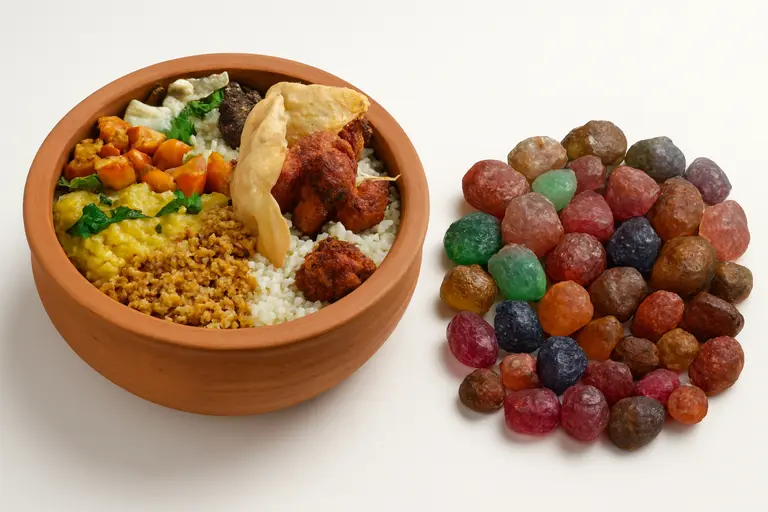
Colors enrich daily life. You see them clearly in Chatti Choru and Rough Gems, where raw tones appear in Kerala food and in uncut minerals deep within the Earth. Although a rustic clay-pot meal and rough gemstones seem unrelated, both express raw color, texture, and origin.
Because of this shared vibrancy, I see a natural link between gastronomy and gemology. This guide explores that connection through the theme “Raw Beauty.” It compares the short-lived palette of a Chatti Choru with the enduring hues of rough gemstones.
Chatti Choru — A Clay-Pot Color Symphony
Chatti Choru is a traditional Kerala meal served in an earthen pot (“chatti”). It brings rice, curries, fries, pickles, and sides together in one colorful setting.
As a result, the pot becomes a natural canvas of reds, greens, yellows, whites, and browns.
However, much like a rough gemstone, Chatti Choru is not about perfect symmetry. Instead, it celebrates authenticity.
Color Parallels in Chatti Choru and Rough Gemstones
Similarly, when you observe a Chatti Choru closely, you notice that the same color logic appears in the world’s most valued gemstones.
Red Tones in Chatti Choru and Rough Gems
Fish curry and fried fish glow with red and orange tones. These shades come from chili, turmeric, and spice blends used across Kerala.
Similarly, Rubies and Hessonite Garnets show warm red saturation.
In gemology, a Ruby’s red comes from chromium. On the plate, the chili pigment creates the heat and intensity.
For ruby value comparisons, you can read: Kempu Ruby: Tamil Nadu vs Kerala
Green Shades in Kerala Food and Rough Gemstones
Side dishes such as thoran and avial bring multiple shades of green. These greens echo Emeralds, Peridots, and Green Tourmalines.
Gemstones get their green from chromium or vanadium. Vegetables show green because of chlorophyll.
Both express vitality.
Yellow Colors in Chatti Choru and Gem Colors
Turmeric gives dals, curries, and rice their yellow glow. This warm tint matches the tones of Yellow Sapphire (Pukhraj) and Citrine.
In a Yellow Sapphire, iron impurities create color. In food, turmeric adds both color and nutrition.
Related reading: Healthy Living and Diet
Earthy Browns in Chatti Choru and Rough Gems
The clay pot adds earthy brown tones. Fried onions and roasted meats deepen this palette.
Similarly, Hessonite, Smoky Quartz, and Agate show warm brown shades. They reflect soil, rock, and natural stability.
The Science Behind Chatti Choru and Rough Gem Colors
The strongest parallel between Chatti Choru and rough gemstones lies in their use of “impurities.”
For example, spices act as impurities that tint food. Without them, the meal would be colorless.
Similarly, pure minerals are often colorless. Trace elements such as chromium, iron, and titanium create vivid gemstone colors.
You can explore the science further at: GIA Gem Encyclopedia
Ephemeral vs. Permanent Beauty in Chatti Choru and Rough Gems
Although their colors are similar, they differ in longevity.
For example, a Chatti Choru is fleeting. You mix it, enjoy it, and the moment disappears.
However, rough gemstones endure. They preserve their color for millions of years and often become heirlooms.
A meal nourishes your body for a day. In contrast, a gemstone carries memory for generations.
Final Thoughts on Chatti Choru and Rough Gems
The next time you enjoy a Chatti Choru, pause for a moment. Observe the red fish curry, the green vegetables, and the yellow dal.
These are the same hues seen in nature’s finest gemstones. Nature uses one palette—whether for a humble meal or a royal jewel.
FAQ — Chatti Choru and Rough Gems
How does seasonality affect Chatti Choru colors?
Seasonal vegetables change green and yellow tones throughout the year. Likewise, gemstones vary depending on the geological “season” they formed in.
Are rough gemstones always naturally colored?
Many rough stones show natural color. However, some are heat-treated after mining, just like cooking enhances raw ingredients.
Why do impurities create strong colors?
Spices and trace elements change how light interacts with matter. Even tiny amounts can shift color dramatically.
Can culinary colors inspire jewelry design?
Yes. A Chatti Choru palette—reds, greens, yellows, and browns—is already popular in Temple Jewelry.
Author Bio
P.J. Joseph, also known as Saju Elizamma, Gemstone & Gold Consultant serving Kerala, Tamil Nadu, and Karnataka.