Introduction
Because an octopus solves problems so cleverly, scientists study its biology closely. First, it changes its skin colour and texture within seconds. Next, it squeezes through tiny gaps and handles objects with eight flexible, independent arms. Most remarkably, it spreads much of its nervous system through those very arms. Therefore, this fascinating animal gives us a unique, unconventional lens for looking at our everyday objects. Consequently, this article shows how beautiful gemstones, precision watches, modern computers, and soft robots echo octopuses’ abilities. Importantly, you will also learn which links stem from real design inspiration and which arise merely from coincidence. Meanwhile, you can browse our science and nature articles to explore the wonders of the natural world further.
Gemstones That Echo Octopus Biology and Colour
Alexandrite: Octopus Biology and Light Changes
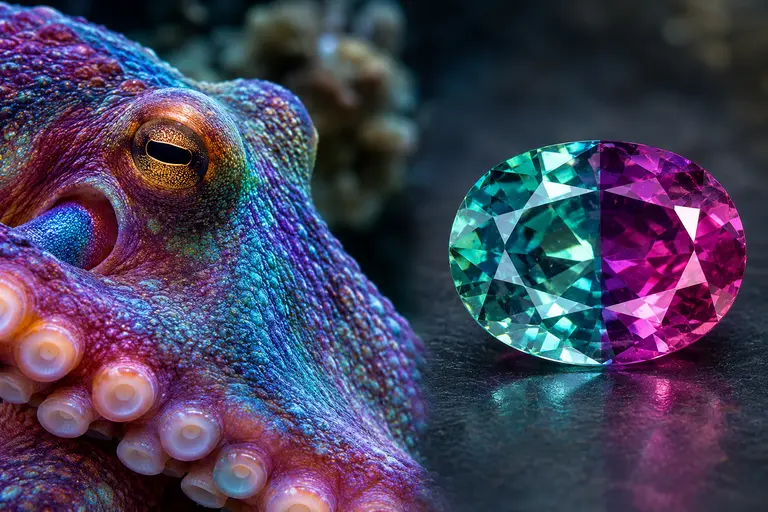
First, an octopus changes colour using chromatophores, which are tiny pigment sacs that muscles stretch open or squeeze shut. Similarly, alexandrite offers a visual surprise for collectors. This rare chrysoberyl looks bluish green in daylight, yet it turns purplish red under incandescent light. In fact, trace chromium causes this shift by absorbing different light wavelengths. However, alexandrite does not move any pigment. Instead, the surrounding light changes what your eyes perceive. Therefore, a simple lamp or a sunny window alters how the stone looks entirely. In addition, you can read the GIA guide to alexandrite for more detail. Furthermore, read our gemstone buying guide before you shop.
Opal: Octopus Biology and Structural Colour
Next, precious opal shows another biological parallel. In addition to skin colour, octopus skin contains reflective structures that create shimmering effects. Likewise, tiny silica spheres in opal diffract light into flashes of red, green, and blue. Consequently, the colours shift as you tilt the stone. Of course, the materials differ, since opal uses silica while octopus skin uses specialized proteins. Nevertheless, both examples show how internal structure creates vivid colour. Finally, read the GIA guide to opal for details.
Chameleon Diamonds and Octopus Biology Shifts
Meanwhile, chameleon diamonds add a further twist. Typically, these rare stones change from olive green to yellow when heated to about 150°C or after prolonged storage in darkness. However, the change is temporary and passive, so no diamond truly camouflages itself. Moreover, scientists continue to study exactly why this occurs. Therefore, jewellers rely on laboratory testing to confirm a genuine chameleon stone. Finally, the GIA research on chameleon diamonds explains the findings in depth.
Watches Inspired by Octopus Biology
Dive Watches and Octopus Biology Pressure
First, an octopus lives under constant, crushing water pressure. Likewise, dive watches must survive that same pressure at depth. For this reason, makers fit them with sealed crowns, reinforced crystals, and tightly gasketed cases. In addition, professional saturation dive watches include helium escape valves that release trapped gas during decompression. However, engineers designed these features for human divers, not by copying octopuses’ anatomy. Consequently, the link is a comparison, not a borrowed idea. Therefore, check our dive watch guide to choose a reliable model.
Art Watches and Octopus Biology Inspiration
Meanwhile, some luxury brands draw on animals for artistic inspiration. For instance, the Jacob & Co. Astronomia Art collection places miniature sculptures inside complex movements. Nevertheless, a sculpture does not reproduce how an animal moves. Likewise, a tourbillon rotates the escapement in a cage to reduce certain positional timing errors, but it does not mimic an octopus arm. Therefore, enjoy these watches as art rather than biomimicry.
Computers Inspired by Octopus Biology
Distributed Decisions in Octopus Biology
For example, the common octopus has roughly 500 million neurons. Remarkably, roughly two-thirds of them sit in its arms and body, so each arm handles much of its own sensing and movement. Meanwhile, the central brain guides the whole animal. Similarly, edge computing spreads work across a digital system. Instead of sending every piece of data to a distant server, smart cameras and sensors process information nearby. Consequently, they save bandwidth and respond faster. Still, engineers did not invent edge computing by studying octopuses. Therefore, the similarity lies in local processing, not in direct inspiration. Also, explore technology explainers for more.
Neuromorphic Chips: Learning from Octopus Biology
Next, neuromorphic computing takes a different step. In fact, researchers build chips that imitate selected features of biological neural networks. Although the octopus offers a useful example of distributed intelligence, this field draws on neuroscience as a whole. Therefore, nobody should call it “octopus technology.” Still, the lesson matters for everyday users, because future devices may grow more efficient by changing how they process information, not by simply adding raw power.
Soft Robotics and Smart Surfaces
Boneless Arms Inspire Gentle Robots
First, an octopus arm has no bones. Instead, its muscles form a “muscular hydrostat,” so the arm can bend, twist, shorten, and lengthen. For this reason, engineers study this design to build soft robots from flexible materials and air-powered actuators. Because these robots grip gently, they can handle fragile food, medical materials, and oddly shaped objects. Therefore, this counts as genuine biomimicry, since engineers deliberately applied a biological principle.
Texture-Changing Skin in Octopus Biology Research
Likewise, octopuses and cuttlefish raise small skin bumps called papillae to change texture. For example, in 2017, Cornell University researchers built a stretchable surface that mimics this skill, with advice from a scientist at the Marine Biological Laboratory. First, they combined silicone with an embedded, laser-cut mesh, and then they inflated a flat sheet into a three-dimensional texture. However, this work remains experimental, not a commercial camouflage product. Even so, it shows how nature can guide adaptive materials.
What Everyday Readers Learn from Octopus Biology
Look Beyond Appearance in Octopus Biology
First, alexandrite, opal, and chameleon diamonds show that similar visual effects can arise from different scientific causes. Therefore, learning how a gemstone works makes its beauty more meaningful. Also, this knowledge helps you ask better questions when you shop.
Separate Octopus Biology Inspiration From Coincidence
However, not every product that resembles an animal feature came from biological research. For that reason, you should distinguish genuine biomimicry from parallel science. As a result, you make more informed decisions about the gems, watches, and gadgets you buy.
Frequently Asked Questions
Which gemstone most resembles an octopus changing colour?
Alexandrite comes closest, because it changes colour under different light. However, it relies on light, not on active camouflage.
Do octopuses directly inspire any technology?
Yes, soft robots and texture-changing materials have drawn on cephalopod biology. However, many other technologies only resemble their traits.
Can computers match octopus intelligence?
Not yet, because distributed and neuromorphic systems copy only selected principles. They fall far short of full biological intelligence.
Does every octopus-like product come from biomimicry?
No. Some products simply share physical traits. Their designers arrived at similar solutions independently of biology.
Why should everyday readers care about these connections?
Understanding these links makes science accessible. Moreover, it helps you appreciate the materials and engineering inside everyday products.
Disclaimer
This article shares educational comparisons and biomimicry research. Similarities do not prove direct inspiration. Verify product details with professional sources. The author has no financial affiliation with the brands or organizations mentioned.