Introduction to Color-Change Gemstones and Ancient Glass
Some objects do something that stops you in your tracks; they change color right before your eyes. In fact, the ancient Lycurgus Cup and a handful of remarkable color-change gemstones share this unique ability. Although they belong to entirely different worlds—one is a Roman glass artifact, while the others are minerals formed deep inside the Earth—they all reveal one powerful truth. Color is not a fixed property. Instead, the quality and direction of light decide exactly what the human eye perceives.
Whether you love history, physics, or high-end jewelry, this story provides plenty of depth to explore. These items challenge our understanding of materials. Specifically, they demonstrate that “purity” and “impurities” work together to create beauty. To understand how modern technology manages such high-value materials, you can read our guide on industry sheepdogs in tech and jewelry. By studying the interaction between photons and atoms, we can appreciate why these rarities remain so coveted in 2026.
The Mystery of the Roman Lycurgus Cup
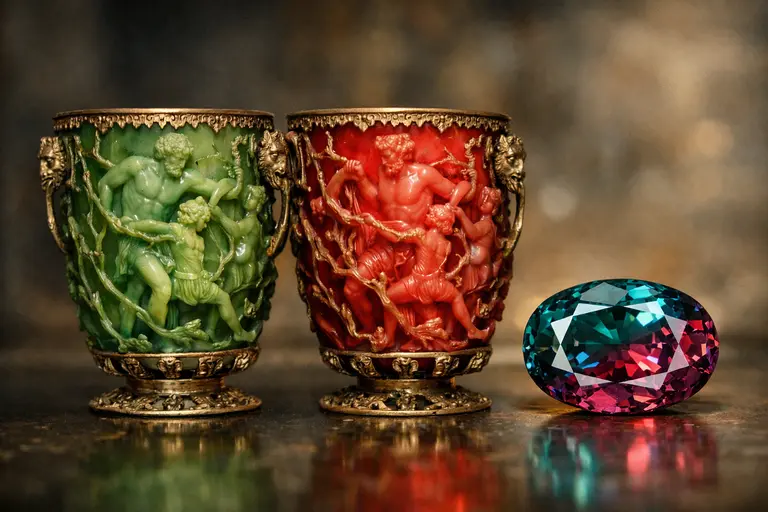
The Lycurgus Cup dates back to the 4th century AD and stands as one of the finest surviving examples of Roman glassmaking. Today, the British Museum in London keeps it on permanent display in Room 41. A specially designed lighting system in the gallery lets visitors witness its full optical magic. Under ordinary reflected light, the cup appears as a dull, jade-green color. However, when light shines through it from behind, the same cup transforms into a glowing, translucent ruby red.
For centuries, nobody could explain this dramatic shift. Eventually, modern electron microscopy cracked the puzzle. Roman craftsmen—almost certainly without realizing the full chemical scale—embedded tiny particles of gold and silver into the glass melt. These nanoparticles measure just 70 nanometers across, which is about a thousand times smaller than a grain of salt. As light strikes them, a process called Localized Surface Plasmon Resonance (LSPR) scatters wavelengths differently depending on the light’s direction. Consequently, the cup displays two completely different colors from a single physical body. Scientists today often describe the Lycurgus Cup as the world’s earliest example of nanotechnology.
Exploring Color-Change Gemstones: The Alexandrite Effect
Natural alexandrite is the most famous example of color-change gemstones, and it works through a completely different process than the Lycurgus Cup. In daylight, a fine alexandrite appears green or bluish-green. Under incandescent light, however, it shifts to purplish-red or raspberry. Gemologists call this the “Alexandrite Effect,” and trace elements—primarily chromium—drive it entirely.
Specifically, chromium ions absorb certain wavelengths of light within a narrow “window.” Because daylight carries more blue and green wavelengths, the stone reflects those colors to you. In contrast, incandescent light carries more red wavelengths, which the stone then reflects. Therefore, the stronger the color change, the rarer and more valuable the stone becomes. This phenomenon is a peak achievement of nature, much like how Indian designers choose raw diamond and Polki jewelry to highlight natural character. For a deeper technical overview of these minerals, visit the Gemological Institute of America (GIA).
The Physics of Light Absorption
To understand why this happens, we must look at the crystal lattice of the stone. In alexandrite, chromium replaces some of the aluminum in the chrysoberyl structure. This substitution creates a sensitive balance where even a slight change in the light spectrum causes a total visual flip. Consequently, the gemstone acts like a natural filter. Furthermore, other minerals like color-change sapphire and rare garnets follow similar principles, often using vanadium as the catalyst for the shift.
Pleochroism: Multi-Color Gems Without Light Shifts
Some gemstones do not require a change in the light source to display their variety. Instead, they display different colors depending purely on the angle from which you view them. Gemologists call this property pleochroism. Iolite, for example, shows violet, gray, and yellow tones as you rotate it. Likewise, tanzanite reveals blue, violet, and burgundy from different crystal directions.
Crystal structure drives this behavior because the gemstone absorbs light differently along separate internal axes. Consequently, rotating the stone changes which wavelengths reach your eye. Furthermore, andalusite offers this striking multi-color display at a fraction of the price of alexandrite. As a result, it makes an excellent choice for collectors who want something extraordinary without spending a massive fortune. This focus on “hidden” beauty is a central theme in , where the internal structure determines the external value.
Market Options: Buying Color-Change Gemstones in 2026
Can an everyday buyer own these wonders? Yes—and you have more options than you might expect. Laboratory-grown alexandrite shares the same chemical composition and optical properties as its natural counterpart. Manufacturers typically produce it through the Czochralski pulled-growth method. Similarly, laboratory-grown color-change gemstones such as synthetic sapphires are widely available at accessible prices.
However, buyers should stay alert during the purchasing process. Many inexpensive vintage rings sold simply as “alexandrite” actually contain synthetic corundum or spinel. Although the color change looks appealing, the material is not genuine chrysoberyl. Therefore, you should always request an independent laboratory certificate before spending serious money. This level of verification is essential for building India’s global brands in the jewelry sector, where trust is the primary currency.
FAQ About Color-Change Gemstones
What makes alexandrite different from other color-change gemstones?
Alexandrite is a variety of chrysoberyl that specifically uses chromium to flip between green and red. Other stones, like garnets, may change color but have different chemical structures and toughness levels.
Is the color change in the Lycurgus Cup permanent?
Yes. Because the gold and silver nanoparticles are part of the glass structure, the effect will last as long as the cup exists. It does not “wear out” over time.
Are lab-grown color-change gemstones considered “fake”?
No. Lab-grown stones are chemically identical to natural ones. They are “synthetic” because they are made by humans, but they are not “simulants” like glass or plastic.
Why is tanzanite not considered a color-change stone?
Tanzanite is pleochroic, meaning its colors depend on the viewing angle, not the light source. A true color-change stone looks different under a lamp versus under the sun.
How do I clean my color-change gemstones?
Most are durable, but you should use warm soapy water and a soft brush. Always avoid harsh chemicals that could react with the metal settings or the stone’s surface.
Disclaimer
This article is for general educational purposes only. The author has no financial affiliation with the museums or gem laboratories mentioned. Gemstone identification requires assessment by a qualified gemologist. Nothing in this article constitutes financial or investment advice. Readers should consult with professionals before making high-value purchases.