Introduction
Have you ever looked up at a full moon and noticed it glowing a deep, fiery orange or perhaps blushing a soft, delicate pink? Indeed, the moon can wear many surprising colors, and gem lovers often wonder whether specific gemstones can capture those fleeting lunar shades. In short, you can certainly match Moon Colors and Gemstones for a stunning jewelry palette. However, you must remember that this is a visual comparison, since the science behind lunar light and gemstone chemistry differs completely.
The moon does not actually own dozens of permanent colors. Instead, Earth’s atmosphere bends and filters the sunlight bouncing off the lunar surface. Consequently, the moon’s apparent shade shifts constantly based on its position in the sky. For instance, the celebrated Italian astrophotographer Marcella Giulia Pace spent roughly ten years documenting these shifts. She eventually selected 48 striking images for her famous composition, Colors of the Moon, which NASA later featured as its Astronomy Picture of the Day. Therefore, we should treat these 48 documented hues as a roadmap for our Moon Colors and Gemstones pairing guide.
Atmospheric Science of Moon Colors and Gemstones
Before we dive into the pairings, we must understand why the moon changes its “costume.” Earth’s atmosphere acts like a massive lens. When the moon sits high overhead, it typically looks white or pale gray. However, as it drifts toward the horizon, its light passes through a much thicker slice of the atmosphere.
Specifically, the atmosphere scatters away the shorter blue light waves, while the warmer yellow, orange, and red tones survive the journey to our eyes. During a total lunar eclipse, this process becomes even more dramatic. Sunlight filters through the edges of Earth’s atmosphere before reaching the moon, and the eclipsed moon often glows a deep copper or “blood red” as a result. Furthermore, environmental factors like volcanic ash or wildfire smoke can occasionally scatter red light instead. This rare event allows blue light to reach our eyes, creating a genuinely blue-looking moon.
Guide to Specific Moon Colors and Gemstones
Pairing Moon Colors and Gemstones is an artistic way to celebrate both the sky and the Earth. By using the hues documented by Marcella Giulia Pace, we can find a gemstone for every lunar mood.
Red and Orange Moon Colors and Gemstones
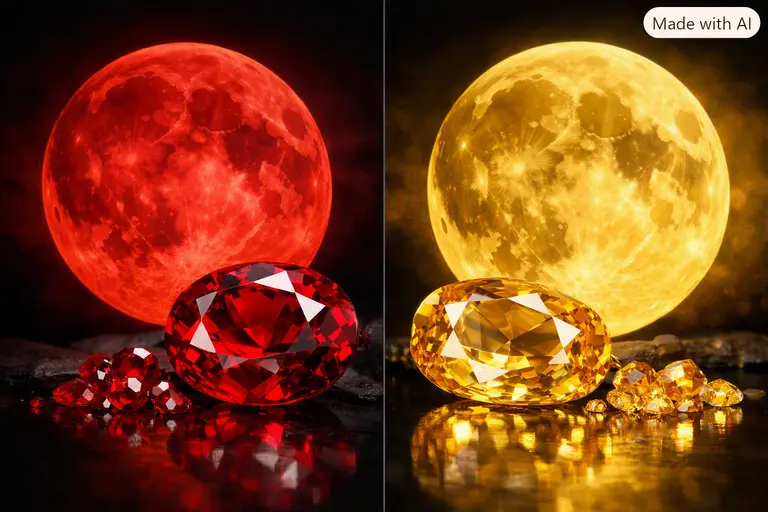
A deep, eclipsed red moon naturally recalls the “pigeon blood” red of a fine ruby or the intense saturation of a red pyrope garnet. Similarly, a rising, “harvest” moon that looks rusty and warm pairs beautifully with the earthy, translucent glow of carnelian. If the moon appears more tangerine than red, it closely resembles the vibrant fire of a spessartite garnet. For more on how to identify these rich colors, you can read our guide to gemstone color identification.
Golden and Yellow Moon Colors and Gemstones
Warm golden moons are perhaps the most common variations we see during the autumn months. These shades connect naturally with citrine, yellow sapphire, and even Baltic amber. Specifically, a bright lemon-yellow moon mirrors the crisp brilliance of a yellow tourmaline or a high-quality heliodor. Because these stones often represent joy and energy, they are perfect for jewelry that celebrates the “golden hour” of a moonrise.
Blue and Purple Moon Colors and Gemstones
While a “Blue Moon” is usually just a calendar term, atmospheric conditions can make the moon look genuinely blue. A vivid blue moon calls to mind the majestic depth of a blue sapphire. For a softer, mistier lunar look, blue chalcedony or blue lace agate provide a better match. Interestingly, Pace’s photographs also document subtle purple and lavender moons. In these cases, amethyst and lavender jade offer the most accurate color parallels.
Pink and Peach Moon Colors and Gemstones
Soft pink or peach moons often appear during the spring, leading to the popular term “Pink Moon.” To capture this lunar blush in a gemstone, you should look toward rose quartz, rhodochrosite, or peach morganite. Depending on how warm or pale the hue appears, these stones provide a romantic and ethereal connection to the night sky.
Moonstone in the Moon Colors and Gemstones Map
If one single gemstone could represent the entire Moon Colors and Gemstones concept, rainbow moonstone would win easily. Although it is technically a variety of labradorite, its pale gray-to-white body flashes with ethereal blue light. Gemologists call this specific phenomenon “adularescence.”
Visually, moonstone suggests a moon transforming under different lighting conditions. However, you must realize that this shimmer comes from light bouncing between microscopic layers of feldspar inside the stone, not from atmospheric scattering. Therefore, the connection between a moonstone and the actual moon stays symbolic and artistic. Because of its shifting light, moonstone has been a staple in Indian jewelry traditions for centuries, often representing intuition and the tides.
Lunar Minerals and Moon Colors and Gemstones
Beyond the atmospheric filtering, the moon’s rocks genuinely differ in their chemical composition. NASA’s research into lunar mineralogy confirms that the moon’s crust contains minerals like feldspar, pyroxene, and olivine. Most people are surprised to learn that the gem variety of olivine is peridot.
During the Artemis II mission, astronauts reported seeing an unusual green tint around the Aristarchus crater region. NASA scientists explain that this sighting likely reveals clues about the area’s rich olivine deposits. Consequently, peridot is a scientifically meaningful match for the moon. For the moon’s more familiar silvery glow, hematite suggests a metallic gray, while gray moonstone and pale labradorite echo the softer tones of the lunar highlands.
FAQ: All About Moon Colors and Gemstones
Does the moon really have 48 different colors?
No. The moon’s rocks are primarily gray and brown. However, atmospheric conditions can create at least 48 distinct photographed hues, as documented by astrophotographers like Marcella Giulia Pace.
What is the best gemstone for a “Blood Moon”?
A deep red ruby or a Bohemian garnet is the best match for the coppery, dark red color seen during a total lunar eclipse.
Can a “Blue Moon” actually be blue?
Yes, but it is rare. It usually happens after a volcanic eruption or a wildfire when specific smoke particles filter out red light. In terms of Moon Colors and Gemstones, blue sapphire or blue spinel are the closest matches.
Is moonstone actually from the moon?
No. Moonstone is a terrestrial mineral found in the Earth’s crust. It is named “moonstone” simply because its shimmery light resembles the glow of the moon.
Why does the moon look green in some NASA photos?
NASA often uses “false-color” imaging to highlight different minerals. In these images, green represents high concentrations of olivine. Therefore, peridot is the best gemological link to these scientific images.
Disclaimer
The gemstone comparisons in this article serve as visual and educational analogies only. They do not suggest that the moon physically contains these gemstones or that any gemstone causes lunar atmospheric color changes. Pace’s 48 images represent photographed lunar hues, not scientifically defined permanent moon colors. Gemstone color varies with composition, lighting, and individual specimen quality. The author has no financial affiliation with the labs or organisations mentioned.