Introduction
Nature often paints with the same brush on different canvases. NC Purple Honey and Four Peaks Amethyst come from entirely different worlds—one biological, the other geological. Yet they share fascinating similarities. Both boast a captivating purple hue, extreme rarity, and ties to unique regional minerals.
For instance, the mysterious Purple Honey emerges from beehives in North Carolina’s sandy flatlands. In contrast, the Amethyst sparkles from the rugged peaks of Arizona. As a Gemologist who loves natural phenomena, I see a chemical link here. Is it the soil? Is it the metal? In this article, we will explore their parallels in exclusivity, soil origins, and appeal. Discover why these “purple treasures” captivate collectors, beekeepers, and gem enthusiasts alike.
Exclusivity of NC Purple Honey and Four Peaks Amethyst
First and foremost, both treasures thrive in highly specific locations. You won’t find them just anywhere on Earth.
The Honey of the Sandhills
Consider NC Purple Honey. In fact, it primarily appears in the Sandhills region of North Carolina. This makes it a true geographic anomaly. Surprisingly, beekeepers there report hives turning violet unexpectedly. Meanwhile, neighboring states produce standard golden honey. Therefore, it draws honey lovers from across the U.S. who hunt for it like treasure.
The Gem of the Peaks
Similarly, Four Peaks Amethyst stands out for its exclusivity. Currently, the Four Peaks Mining Company runs the only commercial Amethyst mine in the United States. Its prized “Siberian Red” variety—which shows flashes of red inside the purple—once appeared only here and in Russia’s now-closed Ural Mountains mines. As a result, this gem remains a rare American exclusive. If you are interested in rare origins, read my guide on Tanzania’s Cloves and Tanzanite.
Soil Origins of NC Purple Honey and Four Peaks Amethyst
What gives these items their stunning purple color? Trace elements in local soils play a key role. Both draw from metals to create vivid violet shades.
Biological Alchemy
For NC Purple Honey, researchers point to the soil composition. Technically, high levels of Aluminum interact with the acid in the bee’s stomach. Additionally, Iron Oxide in the soil contributes to the hue. Consequently, when bees forage from flowers (possibly Kudzu or Sourwood) in these mineral-rich grounds, the honey transforms. Experts believe this process happens naturally during nectar processing. It is essentially “Liquid Litmus Paper.”
Geological Alchemy
On the gem side, Four Peaks Amethyst owes its color to Iron and natural Irradiation. For example, high concentrations of Iron and Manganese infuse the Quartz crystals as they form deep underground. Specifically, Iron creates the base purple, while Manganese adds the rare red flashes. Thus, the result is a gem with intense color depth. Unlike lab-grown versions, this natural infusion ensures authenticity. You can learn more about color causes in my Colored Stone Grading guide.
Rarity of NC Purple Honey and Four Peaks Amethyst
Neither NC Purple Honey nor Four Peaks Amethyst can be mass-produced. They rely on nature’s whims.
Purple honey appears sporadically. For example, one hive might yield “Violet Gold,” while a neighboring hive just ten feet away stays golden. Significantly, factors like weather, specific flower blooms, and rain must align perfectly. Therefore, beekeepers cannot predict or force it. Each jar becomes a collector’s prize.
Four Peaks Amethyst faces similar odds. Miners extract thousands of pounds of rough rock yearly. However, less than 5% is gem-quality. This yields just two handfuls of fine polished stones—twice a year. The mine’s harsh, high-altitude conditions (over 7,000 feet) make extraction difficult. In essence, rarity drives value. Both items remind us of nature’s unpredictability. This connects to the rarity of Kashmiri Saffron and Padparadscha.
Visuals of NC Purple Honey and Four Peaks Amethyst
Beyond color, both offer sensory surprises.
The “Siberian Flash”
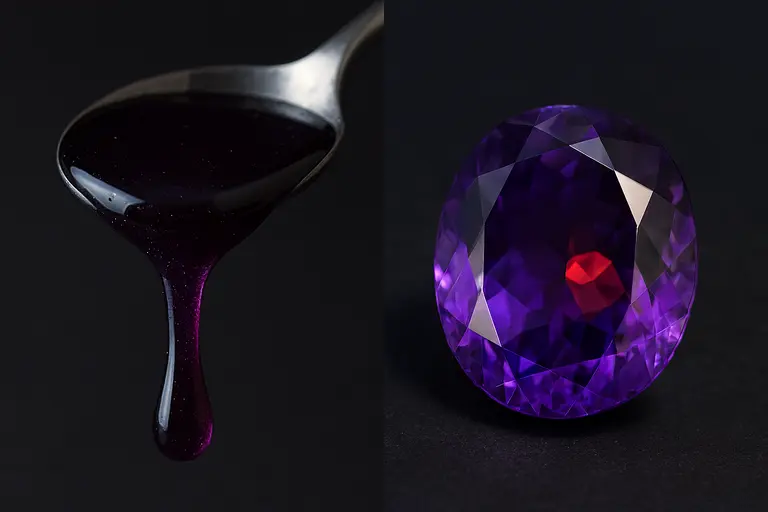
High-quality Four Peaks Amethyst features a unique optical trait called the “Siberian Red Flash.” Notably, under incandescent light, magenta-red sparks dance within the purple body. Jewelers cut facets to maximize this effect. For instance, it glows dramatically in candlelight. This makes it ideal for fine jewelry.
The “Grape” Taste
Purple honey matches this with taste. Often, beekeepers describe a fruity, grape-like profile. The mineral infusion adds tangy notes absent in regular honey. Visually intense, it spreads with a glossy violet sheen on toast. Therefore, it appeals to foodies and gem lovers alike. Together, these flashes—visual and flavorful—create shared excitement.
Conclusion on NC Purple Honey and Four Peaks Amethyst
Ultimately, NC Purple Honey and Four Peaks Amethyst are proof that “Terroir” matters. Whether it is the sandy soil that feeds a flower or the granite rock that feeds a crystal, the land dictates the beauty. For the collector, owning a jar of this honey or a ring with this stone is a way to hold a piece of that specific land.
In summary, nature keeps its best secrets hidden in the hills.
FAQ: NC Purple Honey and Four Peaks Amethyst
What causes the purple color in North Carolina honey?
Scientifically, it is widely believed to be a reaction between the Aluminum rich soil of the Sandhills and the acid in the bee’s digestive system, likely while foraging on specific plants like Kudzu or Sourwood.
Is Four Peaks the only U.S. Amethyst source?
Yes, it is the only commercially active mine producing gem-quality Amethyst. While you can find low-grade quartz elsewhere, the Four Peaks mine is unique for its “Siberian” quality.
How rare is gem-quality Four Peaks Amethyst?
Extremely rare. Unfortunately, less than 5% of the mined material is gem-grade. The majority is low-grade quartz. This scarcity keeps prices high.
Can you buy Purple Honey year-round?
No. It appears unpredictably. Some years there is a bumper crop; other years, there is none. You have to check with local NC beekeepers during the harvest season.
Do both share mineral influences?
Absolutely. Iron is the key player in Amethyst, and Aluminum/Iron are the key players in the Honey. Both are colored by the earth’s metals.
Author Bio
P.J. Joseph, also known as Saju Elizamma, Gemstone & Gold Consultant serving Kerala, Tamil Nadu, and Karnataka.