Introduction
Indian families rarely see jewellery as a mere accessory. Instead, they treat it as a marker of memory, identity, security, and celebration. However, today’s buyers also want comfort, individuality, and honest information about what they are paying for. As a result, Indian jewellery design across the country now balances four forces at once: perception, emotion, responsibility, and technology. These forces do not push tradition aside. Rather, they help designers reinterpret heritage so it fits real, everyday lives, from Kashmir to Kanyakumari. By understanding these shifts, you can make better, more meaningful purchases that last for generations.
How Perception Is Redefining Indian Jewellery Design Value
For decades, most buyers judged a piece mainly by gold purity, weight, and stone quality. These factors still matter, of course. Nevertheless, modern design adds a new layer to that equation. Lightweight construction, modular formats, and unconventional proportions let a piece look bold without weighing down the wearer. Consequently, a necklace or bangle can create real visual impact while still feeling comfortable enough for daily wear.
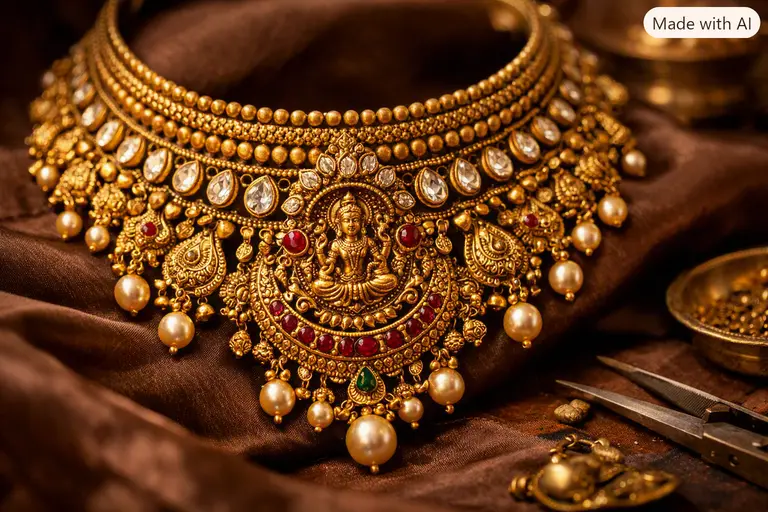
Traditional design languages such as Polki, Kundan, Meenakari, temple jewellery, and filigree continue to inspire creators. Even so, many designers now reinterpret these techniques through fresh proportions rather than copying historical pieces exactly. Some also experiment with titanium, ceramic, and wood alongside precious metals. Therefore, shoppers can learn to judge Indian jewellery design by craftsmanship and artistry, not only by metal content. Our guide to identifying genuine Kundan work explores this idea further.
Why Emotion Keeps Indian Jewellery Design Meaningful
Technology can reshape how a piece gets made, but emotion explains why people buy, wear, and pass jewellery down at all. Weddings, festivals, and family milestones still anchor the culture. At the same time, lifestyles have changed. Consequently, heavy ceremonial sets often sit in a bank locker for years rather than being worn.
Modular and detachable designs solve this problem neatly. A bride can remove certain elements from a necklace and wear the rest casually. This turns an occasional heirloom into an everyday companion. Personal storytelling also plays a growing role, since a piece can now reflect regional identity, a family memory, or simply individual taste. In short, modern jewellery does not need to abandon tradition to feel contemporary; it simply needs to carry personal meaning alongside cultural weight.
What Responsibility Means for Indian Jewellery Design
Responsible jewellery goes far beyond environmental slogans. It also concerns the karigars who design, craft, and finish every piece by hand. India’s jewellery heritage depends on skills that take years—sometimes decades—to master. Consequently, protecting these crafts requires steady demand, not just museum displays.
Cuttack’s silver filigree, known as Tarakasi, illustrates this well. This centuries-old craft earned a Geographical Indication (GI) tag, and the Government of India formally recognizes it for its intricate wirework. Even so, recognition alone cannot guarantee survival, since artisans still face real economic pressure. Buyers can help by choosing genuine, handcrafted pieces over mass-produced imitations.
Material choices matter too. Recycled precious metals and transparent sourcing address some environmental concerns. However, shoppers should still examine specific claims rather than assume every “sustainable” label means the same thing. Laboratory-grown diamonds raise a similar point. Buyers should weigh production methods, grading documentation, and price rather than assuming one category is automatically better.
How Technology Supports Modern Indian Jewellery Design
Technology now works as a genuine partner in Indian jewellery design. CAD software lets designers visualize and refine complex shapes before anyone touches precious metal. Likewise, resin and wax prototyping let manufacturers test a design safely before full production begins.
India has built real infrastructure around these tools. For instance, the Bharat Ratnam Mega Common Facility Centre in Mumbai offers CAD rendering, 3D printing, casting, hallmarking, and gemological testing under one roof. Still, technology never replaces human judgment entirely, since gemstone selection, setting, and finishing depend on a trained eye.
One Country: Many Indian Jewellery Design Stories
North India pairs Kundan, Polki, and Meenakari with strong Mughal and Rajput influences. Today’s designers lighten these forms without losing their richness. South India leans on high-karat gold and temple jewellery, which designers now adapt for daily wear. East India’s Tarakasi shows how technology can support artisans through documentation and market access rather than replacing their skill. Meanwhile, West India blends Surat’s diamond industry with Gujarat and Rajasthan’s silver craft traditions. Together, these regions prove there is no single formula for modern design, only different answers to the question of relevance.
What Everyday Buyers of Indian Jewellery Design Should Learn
Shoppers do not need a gemology diploma to buy wisely. Still, this framework can guide better questions. First, look beyond weight and consider comfort and craftsmanship. Second, ask whether a piece holds personal meaning. Jewellery worn often creates far more memories than jewellery locked away. Third, ask about sourcing and artisan conditions, because genuine demand helps preserve disappearing skills. Above all, ask yourself what you are truly paying for: gold weight, gemstone quality, craftsmanship, heritage, or innovation.
Frequently Asked Questions
Is modern Indian jewellery moving away from tradition?
Not really. Designers adapt traditional motifs and techniques to fit new lifestyles and tools, so heritage stays visible even as pieces feel current.
Does technology lower the value of handmade jewellery?
No, not automatically. CAD and 3D printing assist with planning, yet human skill still shapes gemstone selection, setting, and finishing.
How can an ordinary buyer shop more responsibly?
Ask about gold purity, hallmarking, and gemstone documentation. Then, choose pieces you will actually wear rather than buying purely for trends.
What is the biggest lesson for jewellery buyers?
Value has several layers. Gold and gemstones matter, but so do design, craftsmanship, comfort, and emotional meaning. The best purchase stays meaningful long after you buy it.
Disclaimer
This article offers a general, educational overview of contemporary Indian jewellery design. Practices vary widely between designers, manufacturers, artisans, and regions. Therefore, readers should verify specific claims—such as “sustainable” or “ethical”—before relying on them. For significant purchases, consult a qualified jeweller or gemologist and request proper documentation. The author has no financial affiliation with the brands or organizations mentioned.