
Introduction
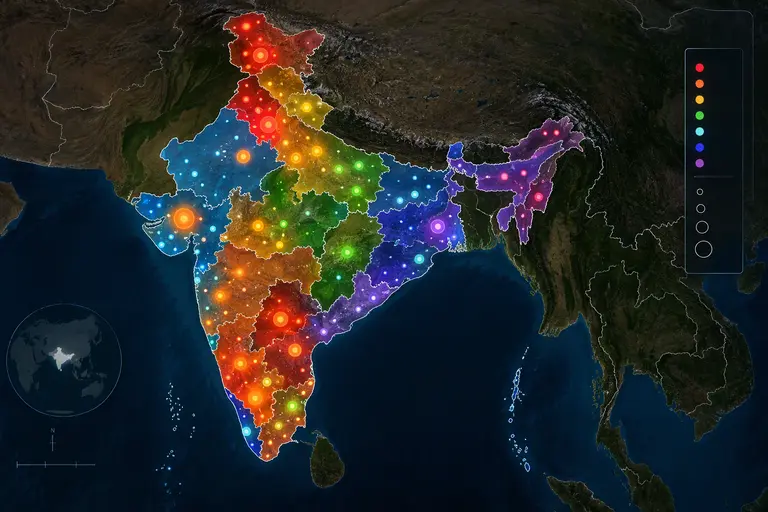
Indian businesses can study local consumer demand effectively using hyperlocal marketing through six-digit Postal Index Number (PIN) codes. Moreover, this analytical approach perfectly suits the 99% of businesses that cannot afford costly, large-scale market research. Independent jewellers, watchmakers, food producers, technology startups, travel operators, and wellness entrepreneurs can all leverage these geographic insights. India is not one uniform market; in fact, neighbouring areas in the same city often differ significantly in occupations, spending habits, and priorities. Therefore, businesses should use hyperlocal marketing to assess local demand precisely instead of relying on broad Tier 1 and Tier 2 labels. Our guide to understanding Indian consumers explores this vital idea further.
How Hyperlocal Marketing Spots Local Opportunities
Combining PIN Code Data for Hyperlocal Marketing
Public sources rarely offer comparable household income figures for every specific PIN code. Consequently, businesses must combine several indicators to paint a clear picture. Sales records, average order values, repeat purchases, and delivery coverage reveal the most promising customer groups. In addition, personal conversations with local retailers explain exactly why demand changes from one street to the next.
Rising property prices alone, however, do not always prove strong buying intent. Therefore, businesses should test real demand before they commit significant capital. For example, the Kearney India Retail Index 2026 surveyed 880 cities and more than 8,000 urban PIN codes. Kearney found that nearly 10% of those PIN codes qualify as growth hotspots. Nevertheless, each business must carefully compare such findings with its own specific products, target customers, and operational costs.
Hyperlocal Marketing Opportunities Across Sectors
Hyperlocal Marketing for Jewellery Retail
Jewellers can track local enquiries, wedding-season purchases, and demand for gold, diamonds, and coloured gemstones. As a result, a small jeweller may find a lucrative opportunity in a growing residential district instead of opening an expensive showroom in an already crowded market. Still, customer trust matters most in this industry. Transparent pricing, accurate descriptions, BIS hallmarking where it applies, and dependable after-sales service help independent retailers compete with large, established chains. Above all, data should create openings for family businesses and skilled karigars. Readers can also explore our gemstone buying guide.
Hyperlocal Marketing for Watches and Technology
Independent watchmakers can study online enquiries and regional sales to find buyers for high-end mechanical watches. Meanwhile, technology businesses can analyse service requests and delivery times to choose exactly where to offer repairs or product demonstrations. Furthermore, temporary exhibitions and retailer partnerships let smaller brands test demand cheaply. Consequently, they learn from real customers before they sign expensive, long-term leases. Our watch collecting guide offers more context.
Hyperlocal Marketing for Food and Artisanal Goods
Tea, coffee, snack, and artisanal food producers can compare repeat orders and delivery costs across PIN codes. For instance, a coffee producer may find strong demand for single-origin beans near growing specialty cafés. Similarly, small manufacturers can approach local stores and regional distributors before they expand nationally. For regional inspiration, see our Keralam food stories.
Hyperlocal Marketing for Hospitality and Travel
Hotels, homestays, and travel companies can analyse booking origins and seasonal enquiries. For example, a Keralam homestay owner may find promising guests in Bengaluru, Chennai, or Hyderabad. However, high income alone does not guarantee bookings. Travel time, transport links, and guest budgets also shape final decisions. Our Keralam travel features show what visitors typically seek.
Hyperlocal Marketing for Wellness and Ayurveda
Yoga studios and Ayurveda practitioners can track enquiries, repeat visits, and specific service demand. Nevertheless, health marketing demands high responsibility. Businesses should support their claims with evidence, protect customer privacy, and avoid selling traditional practices as proven medical cures.
Tools for Data-Led Hyperlocal Marketing Expansion
Starting Hyperlocal Marketing With Existing Data
Small businesses can begin with their own sales records, customer feedback, website analytics, and advertising reports. Next, they can add public demographic data and powerful mapping tools such as MapmyIndia and Esri India.
The Department of Posts recently built DIGIPIN with IIT Hyderabad. This geocoded system divides India into grid cells of roughly four metres by four metres. Unlike a standard PIN code, DIGIPIN pinpoints a precise geographic spot. However, it reveals nothing about local income or consumer preferences, so businesses must gather that specific information separately.
Building a Responsible Hyperlocal Marketing Strategy
Test Hyperlocal Marketing Before Expanding Nationally
Brands should begin with a few representative markets and compare results carefully. Then, once they know what works, they can expand across states and union territories while they adjust for language, culture, purchasing power, and seasons. For instance, a Keralam business should never assume that Kochi, Kozhikode, and smaller towns share the same tastes.
Throughout, businesses should use aggregated or lawfully obtained data, strictly follow privacy laws, and avoid intrusive profiling. Furthermore, they should measure repeat purchases, customer satisfaction, and actual profit instead of digital clicks alone. Ultimately, hyperlocal marketing should help businesses serve many customer groups, not only affluent neighbourhoods.
Frequently Asked Questions
Can small Indian businesses use PIN code marketing?
Yes. Small businesses can start with customer records, local sales comparisons, and modest digital advertising campaigns.
Does DIGIPIN identify wealthy customers?
No. DIGIPIN marks geographic locations, not income or wealth. Therefore, businesses need separate, lawfully obtained demographic data.
Does hyperlocal marketing guarantee business growth?
No. It improves location choices and reduces wasted spending. However, product quality, pricing, service, and trust still drive final results.
Can this approach work across all states and union territories?
Yes, in principle. Nevertheless, data infrastructure and consumer behaviour vary by region, so businesses should adapt their methods to local conditions.
Disclaimer
This article provides general business information and does not guarantee commercial results. Businesses should verify local conditions, follow applicable privacy laws, and test assumptions before investing. The author has no financial affiliation with the brands or organizations mentioned.