
Introduction
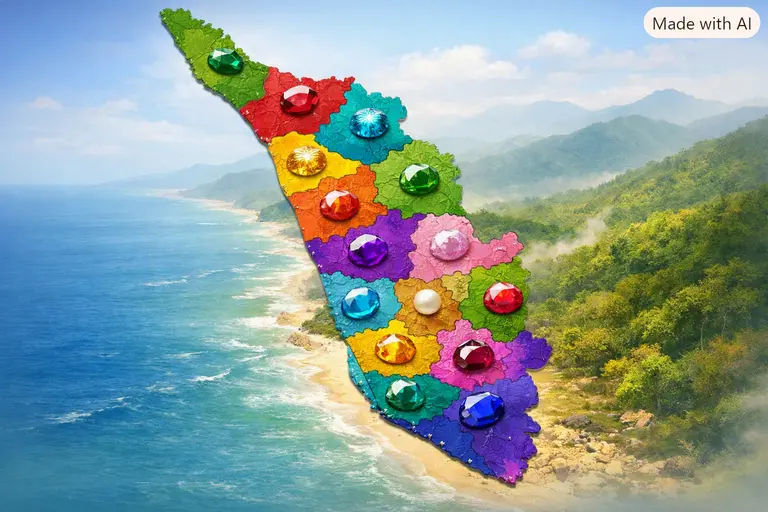
What if the 14 Colors of Keralam became the definitive way to explore the state, where every district carried its own signature color and gemstone? Keralam already offers travelers an extraordinary visual journey, since its landscape shifts from beaches and backwaters to paddy fields, plantations, forests, mountains, and temples. However, visitors often experience these attractions as separate stops rather than as chapters of one larger story.
Therefore, a district-specific color system could change how travellers understand the state. Specifically, by giving each of its 14 districts a distinctive color and a matching gemstone, tourism marketers could build a simple visual language that visitors remember, photograph, and collect. Importantly, the 14 Colors of Keralam remains a creative branding proposal rather than an official government classification. Indeed, Kerala Tourism officially recognises 14 districts and promotes their individual destinations, but this guide adds a new layer of storytelling to the journey.
Why Color Helps Travelers Understand Keralam
Color can make complicated information easier for the human brain to grasp. For example, blue naturally suggests water, while green suggests forests or agriculture, and red can evoke ritual, celebration, or ancient architecture. As a result, a color identity could help visitors recognize a district’s character even before they arrive. In a world driven by visual social media, the 14 Colors of Keralam could turn the entire state into an interactive art gallery.
Notably, the concept becomes more distinctive once each color receives a gemstone association. However, these gemstones should function purely as storytelling symbols rather than as claims about geological deposits. Keralam does not possess commercial deposits of every gemstone proposed here, yet the symbols help in gemstone identification and cultural appreciation. By linking a stone to a place, we create a tangible memory for the traveler.
The 14 Colors of Keralam: A District Breakdown
The Southern Heritage Districts
Thiruvananthapuram carries Royal Gold with yellow sapphire. This is because the Sree Padmanabhaswamy Temple is closely associated with gold and the profound Travancore heritage. Similarly, Kollam adopts Cashew Crimson with almandine garnet. This color reflects its history as a global cashew trading hub and a vital stop on the historic Spice Route.
Furthermore, Pathanamthitta takes on Saffron Orange with carnelian. This echoes its pilgrimage identity and deep connection to the Sabarimala sanctuary. Each of these districts uses color to bridge the gap between ancient history and modern tourism.
The Water and Land Districts
Alappuzha wears Lagoon Blue paired with aquamarine. Since its backwaters and houseboats naturally evoke tropical water, this pairing feels intuitive. Likewise, Kottayam, often called the “Land of Letters, Lakes, and Latex,” carries Latex White with white moonstone. This honours its rubber-cultivation heritage and its serene inland waterways.
Idukki’s misty mountains inspire Mist Green with peridot. Because the district is home to vast tea plantations and wildlife sanctuaries, this refreshing green captures its soul. Ernakulam, as the commercial hub of Keralam, receives a modern Neon Cyan paired with apatite. This represents the vibrant, fast-paced energy of Kochi’s metropolitan life.
The Cultural and Agricultural Heartland
Thrissur, the cultural capital, earns Pooram Orange with spessartite garnet. This captures the fiery energy of the Thrissur Pooram festival. Similarly, Palakkad, the “Granary of Kerala,” wears Paddy Green with tsavorite garnet. This honours its sprawling rice-growing landscape and the Palakkad Gap.
Malappuram carries Teak Brown with tiger’s eye, celebrating the world-famous Nilambur teak plantations. Moreover, Kozhikode adopts Spice Red with sunstone. This color is shaped by its Malabar Coast trading past, where spices were once as valuable as gold.
The North Malabar Mystique
Wayanad’s dense forests and high altitudes inspire Emerald Green with emerald. Because this district remains a bastion of biodiversity, the deep green represents its untouched wilderness. In addition, Kannur takes on Theyyam Red with ruby. Since red recurs across almost every Theyyam ritual, this stone symbolises the district’s spiritual intensity.
Finally, Kasaragod completes the 14 Colors of Keralam with Laterite Ochre and red jasper. This choice draws on its laterite architecture and the majestic Bekal Fort, which stands as a silent witness to centuries of history.
Turning the 14 Colors of Keralam into Experiences
The strongest opportunity for the 14 Colors of Keralam lies in turning these hues into physical experiences. For instance, tourism authorities could create a “Color Passport.” Travellers would collect a district-specific stamp or a small mineral token after visiting participating heritage sites. Consequently, this gamification of travel would encourage tourists to visit all 14 districts rather than sticking to the usual “tourist triangle.”
Additionally, the concept could extend to physical infrastructure. Imagine if visitor centers in Wayanad featured Emerald Green accents, or if Alappuzha’s maps were printed in Lagoon Blue. Moreover, the gemstone concept could support a local souvenir program. Artisans could produce affordable glass or ceramic pendants representing each district’s stone. This would create a sustainable income stream for local craftsmen while providing tourists with a unique, affordable keepsake.
A Tourism Brand for the 99 Percent
Ultimately, the real strength of the 14 Colors of Keralam lies in its simplicity. Indeed, a luxury traveller may appreciate sophisticated branding, but the average traveller seeks something more relatable. They want a color to remember, a story to photograph, and a small souvenir to take home. Therefore, the idea appeals to families, students, and backpackers alike.
Furthermore, it could encourage travellers to explore beyond heavily promoted spots. Instead of stopping only at Munnar or Kochi, visitors would feel compelled to complete the “14-color collection.” Consequently, this would distribute tourism wealth more evenly across the state. By using minerals and colors, we connect nature, culture, and craftsmanship within a single, easy-to-understand framework.
FAQ: Understanding the 14 Colors of Keralam
Is the 14-color system an official Keralam Tourism program?
No, it is currently a proposed branding concept. While Keralam officially has 14 administrative districts, these color and gemstone assignments are interpretive suggestions to enhance the visitor experience.
Are these gemstones actually mined in these districts?
Not necessarily. These gemstone associations are primarily visual and symbolic choices. For example, while Wayanad is associated with “Emerald Green,” it is not a commercial emerald-mining hub. These stones function as “visual ambassadors.”
How can travelers participate in the 14 Colors of Keralam?
Travellers can use the guide to plan their itineraries based on the “mood” of each district. In the future, local businesses could adopt these colors in their décor or merchandise to signify their district identity.
Why are gemstones used instead of other symbols?
Gemstones are universally admired and carry timeless value. They offer a tangible, collectible element that is more durable than a sticker or a postcard, making the memory of the trip last a lifetime.
Does this campaign help local communities?
Yes. By creating a demand for district-specific souvenirs, the 14 Colors of Keralam provides a platform for local artisans to showcase their work in jewelry, pottery, and textiles.
Disclaimer
This article presents a creative tourism-branding proposal. The district colors and gemstone associations are interpretive rather than official classifications. These pairings do not claim that the named gemstones occur commercially in the corresponding districts. Instead, they function only as visual and storytelling symbols. Before implementing such a campaign, tourism authorities should independently verify cultural references. The author has no financial affiliation with the organisations or brands mentioned.