Introduction to Hurlbutite from Myanmar
Most gem lovers have never heard of hurlbutite. Even seasoned collectors rarely encounter it in the market. However, a recent discovery of hurlbutite from Myanmar has moved this mineral from obscurity into serious gemological conversation. This shift makes the mineral worth understanding for anyone interested in rare earth materials.
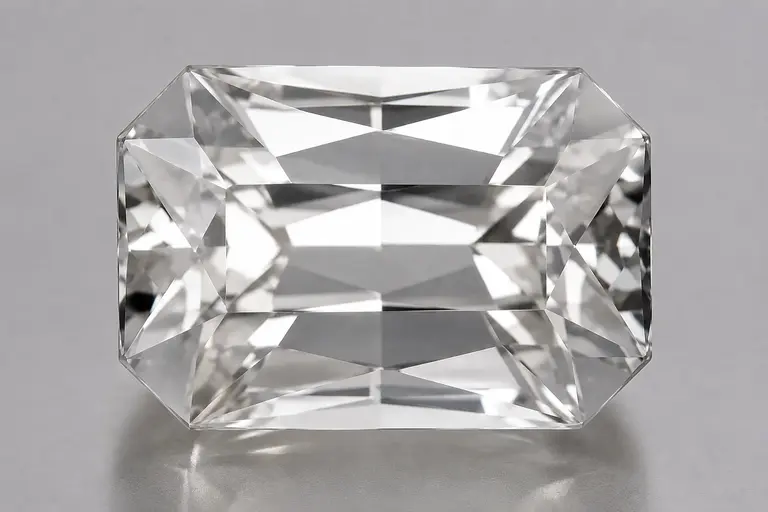
Hurlbutite is a calcium beryllium phosphate mineral with the chemical formula CaBe₂(PO₄)₂. Mineralogists have known about this species for decades; nevertheless, faceted gem-quality material has remained extremely uncommon until recently. Consequently, when researchers in Myanmar identified a crystal clean enough to cut into faceted stones, the global gem world took notice. The larger of the two finished stones weighed 2.56 carats and featured a rectangular scissor cut. This specific event turned hurlbutite from a mere mineralogical curiosity into a documented collector gem of significant importance.
Defining the Rare Hurlbutite from Myanmar
Hurlbutite is a mineral that scientists find fascinating but rarely see in a commercial jewelry case. It usually appears as colorless, pale yellow, or greenish-white crystals. Furthermore, it carries a vitreous to slightly greasy luster. This luster gives finished stones a clean, glassy appearance when viewed under professional lighting.
In terms of durability, hurlbutite scores 6 on the Mohs hardness scale. To put that in perspective, a steel file usually scores between 6.5 and 7; therefore, everyday wear would scratch the surface of this stone relatively easily. Its specific gravity sits at approximately 2.88. This means the stone feels lighter in the hand than common gems like sapphire or spinel. Because of these specific physical properties, hurlbutite belongs to the world of collector gems rather than daily-wear jewelry. Scientists first described the mineral from the Smith Mine in Newport, New Hampshire. Although it remains its type locality, gem-quality material there was extremely scarce. For more context on such rarities, see our guide to rare collector gemstones.
Significance of the Hurlbutite from Myanmar Find
Researchers recently examined a near-colorless hurlbutite crystal from Myanmar measuring approximately 17 × 10 × 7 mm. This rough crystal weighed around 2 grams. Subsequently, the team cut the crystal into two distinct gems. One became the 2.56 ct rectangular scissor-cut stone mentioned earlier, while the other became a 0.64 ct round brilliant.
For everyday gem buyers, these carat weights may seem modest. However, for this specific species, they represent a monumental find. Transparent, facetable material of this mineral is exceptionally rare. Therefore, a clean stone weighing over two carats is a genuinely important gemological event. Additionally, the researchers performed rigorous testing to confirm the finding. They used Raman spectroscopy and powder X-ray diffraction to verify the atomic structure. In other words, they relied on hard science rather than market speculation to establish their identity.
Scientific Studies on Hurlbutite from Myanmar
A dedicated research team presented the study, titled “Hurlbutite from Myanmar,” at the International Gemmological Conference. The team included experts like Denis Gravier, Aurélien Delaunay, and Emmanuel Fritsch. The Laboratoire Français de Gemmologie in Paris also contributed significant resources to the work.
The researchers described the rough crystal as a short lozengic prism. Moreover, they recorded unusual luminescence behavior during their analysis. Under long-wave UV light, the stone produced a weak greenish-white glow. Interestingly, it shifted to a weak orange luminescence under short-wave UV light. Photoluminescence data also suggested that the crystal contained trace rare-earth elements. These elements often influence the optical properties of rare minerals. Consequently, this data provides a new baseline for identifying future finds of hurlbutite from Myanmar.
Geological Source of Hurlbutite from Myanmar
Myanmar is famous for world-class gem localities. Mogok, in particular, carries a legendary status among collectors of ruby and spinel. However, the published study does not disclose the precise mine for this find. It confirms only that the crystal originated within Myanmar.
Therefore, we should avoid claiming that this hurlbutite came from Mogok without official confirmation. Myanmar contains many mineralized zones where pegmatite-related minerals occur. Until a later study identifies the exact coordinates, the source remains the broad region of Myanmar. This region continues to surprise the world with new species, much like the deep-sea mining benefits and risks we discuss elsewhere, which uncover hidden Earth resources.
Rarity of Faceted Hurlbutite from Myanmar
Three primary factors keep hurlbutite out of the mainstream gem market. First, it forms only in specialized geological environments, primarily complex granitic pegmatites. These are evolved rock systems that produce rare minerals in very small quantities. Consequently, the probability of finding gem-quality crystals is low.
Second, most hurlbutite in nature is not transparent. It typically appears as opaque masses or poorly developed crystals. Because of this, gem-quality rough is extraordinarily uncommon even compared to other rare minerals. Third, its hardness and brittle character make it difficult to cut. Even when a cutter finds suitable material, the risk of fracturing the stone during the process is very high. As a result, very few faceted examples ever reach the market. This rarity is similar to the Indian designer’s preference for raw diamonds, where the unique nature of the material defines its value.
Market Value of Hurlbutite from Myanmar
Technically, a jeweler could set hurlbutite into a piece of jewelry. Practically, however, it works best in items like brooches or pendants that do not face heavy impact. It is certainly not a sensible choice for an engagement ring. The stone is simply too delicate for that kind of use.
Furthermore, no public sale price currently exists for the 2.56 ct Myanmar stone. Any specific dollar figure would be purely speculative at this stage. What is clear is that such a stone holds value as a unique collector’s object. Its price depends on its documented provenance and the intense interest from museums or high-end collectors. This emphasizes the importance of the industry sheepdogs in tech and jewelry who verify and protect the integrity of such rare assets.
FAQ About Hurlbutite from Myanmar
What exactly is hurlbutite?
Hurlbutite is a rare phosphate mineral containing calcium and beryllium. While mineralogists have known it since the 1950s, it almost never appears as a transparent, faceted gemstone.
Is hurlbutite from Myanmar the only gem-quality source?
While Myanmar is the most recent and significant source for faceted stones, small amounts have historically appeared in the United States and Brazil. However, the Myanmar find is notable for its clarity and size.
Can I buy hurlbutite at a standard jewelry store?
No. You will only find hurlbutite through specialized rare gem dealers, mineral shows, or high-end auctions. It is a “collector’s stone” rather than a commercial jewelry stone.
How do I clean a hurlbutite gemstone?
Because the stone is brittle and has a hardness of 6, you should only use warm soapy water and a soft brush. You must avoid ultrasonic cleaners and harsh chemicals at all costs.
Why is beryllium important in this mineral?
Beryllium is a relatively rare element in the Earth’s crust. It allows for the formation of unique crystal structures that are often colorless or pale, leading to the distinct look of hurlbutite.
Disclaimer
This article draws on current gemological research. Certain details, such as precise mine locations or private ownership, remain unverified in public scientific literature. Readers should treat price estimates as speculative unless supported by a formal auction record or laboratory report. The author has no financial affiliation with the research teams mentioned.