
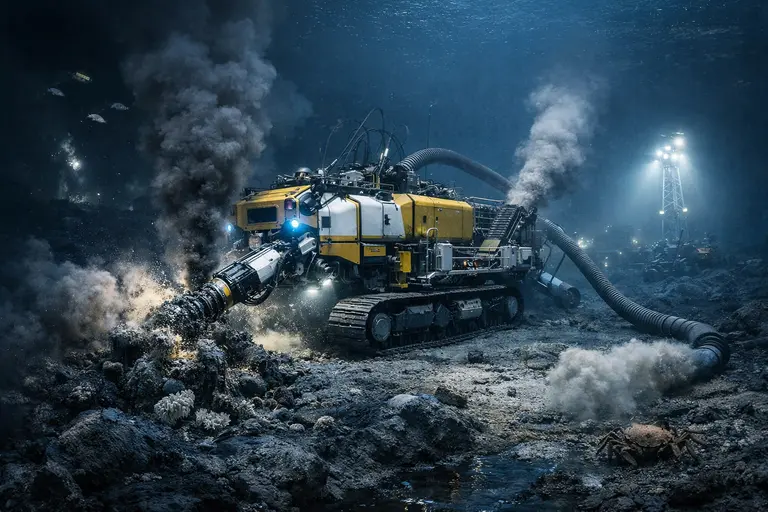
Introduction to Deep-Sea Mining Benefits and Risks
Deep-sea mining has become one of the most important environmental and economic debates of the 21st century. Because demand for electric vehicles and renewable energy continues to rise, understanding deep-sea mining benefits and risks has become essential for global industries. While the ocean floor offers a potential solution to mineral shortages, extracting these resources could permanently damage fragile ecosystems that scientists barely understand.
However, critics argue that mining the deep ocean could permanently damage ecosystems that scientists barely understand. As a result, a fundamental question has emerged: should we mine minerals from the bottom of the sea to support modern technology? To answer this, we must examine the deep-sea mining benefits and risks, the long-term consequences, and the potential alternatives for both people and the planet.
Understanding the Mining Process and Target Minerals
Deep-sea mining refers to the extraction of mineral deposits from the ocean floor, typically at depths exceeding 4,000 meters. Miners primarily target three types of deposits: polymetallic nodules, seafloor massive sulphides, and cobalt-rich crusts. In particular, the vast Clarion-Clipperton Zone has attracted global attention because it holds over 21 billion metric tons of nodules rich in battery metals.
Several countries and mining companies have invested heavily in exploration projects over the past few years. This rush for resources is similar to how industry sheepdogs in tech and jewelry manage complex supply chains to ensure stability. For more on seabed governance and exploration rules, visit the International Seabed Authority (ISA), which regulates all mineral-related activities on the international seabed.
Why Supporters Favor Ocean Extraction
Supporters believe deep-sea mining can help secure the raw materials that the global energy transition urgently needs. For example, electric vehicle batteries require substantial amounts of nickel and cobalt. Otherwise, without a reliable supply of these minerals, the shift to clean energy could stall. Furthermore, proponents argue that ocean mining may reduce pressure on land-based mining operations.
In many regions, terrestrial mining drives deforestation, habitat destruction, and social conflict. Therefore, some experts view seabed extraction as a potentially less disruptive alternative. In addition, governments are seeking greater supply security. Currently, a relatively small number of countries dominate the production of critical minerals. As a result, supply chains remain vulnerable to geopolitical tensions. Supporters argue that a diversified mineral supply could improve economic stability and speed up the adoption of clean-energy technologies worldwide.
Environmental Risks and Scientific Concerns
Despite these potential benefits, scientists and environmental organizations continue to raise serious concerns about deep-sea mining. The primary risks involve habitat destruction and the disruption of the water column.
Habitat Destruction and Sediment Plumes
First, mining machinery would physically tear up the seabed. Specifically, many deep-sea organisms depend on habitats that have developed over millions of years. If mining equipment removes these habitats, recovery could take centuries. Second, deep-sea mining creates sediment plumes—large clouds of fine particles that spread far beyond the mining site. Consequently, these plumes can smother marine organisms and interfere with the feeding patterns of fragile species across wide areas.
Noise Pollution and Light Disturbance
Third, mining equipment generates intense noise and artificial light in environments that are naturally dark and silent. Consequently, marine animals experience stress and breakdowns in communication. Moreover, scientists believe that many species living in proposed mining zones remain undiscovered. In fact, researchers have already identified over 5,000 species entirely new to science in the Clarion-Clipperton Zone alone. Therefore, critics argue that we should fully understand these ecosystems before approving industrial-scale extraction.
Who Actually Gains from Deep-Sea Mining?
The question of who actually benefits sits at the heart of this debate. On one hand, mining companies and technology manufacturers could gain access to new mineral supplies. Consequently, they may strengthen supply chains and support future technological growth. On the other hand, everyday consumers could benefit indirectly through more stable supplies of battery materials.
Meanwhile, environmental organizations point out that the ocean receives no direct benefits from seabed extraction while bearing most of the ecological risks. Likewise, coastal communities worry that sediment plumes could damage fisheries that support local livelihoods. Therefore, the distribution of benefits and risks remains deeply uneven. Corporations stand to gain the most, while fishing communities and ocean ecosystems face the greatest threats.
Alternatives: Recycling and Innovation
Rather than rushing toward commercial extraction, high-tech industries should first maximize existing alternatives. For example, companies can expand battery recycling programs and circular economy initiatives. As a result, valuable materials already in circulation can re-enter manufacturing supply chains without any new mining at all.
In addition, manufacturers can invest in alternative battery technologies. Lithium iron phosphate batteries already reduce dependence on cobalt, while sodium-ion batteries may further reduce demand for scarce minerals. Furthermore, several major companies—including Google and Samsung—have formally committed to a moratorium on deep-sea minerals. Consequently, many firms are shifting toward recycled materials and responsible sourcing strategies. At the same time, continued investment in battery efficiency research can reduce the overall quantity of raw materials needed per device.
FAQ About Deep-Sea Mining Benefits and Risks
What minerals are found in deep-sea mining areas?
The ocean floor holds nickel, cobalt, copper, manganese, and rare earth elements used in technology and renewable energy systems.
Why is deep-sea mining controversial?
The controversy centers on the conflict between mineral demand and environmental protection. While industries need metals, scientists fear irreversible ecological damage.
Can recycling replace the need for ocean mining?
Yes, recycling and “urban mining” can significantly reduce the demand for newly extracted resources by keeping existing metals in the supply chain.
What is the precautionary principle?
The precautionary principle suggests that if an activity could cause permanent environmental harm, decision-makers should wait until scientific certainty is established.
Who regulates the international seabed?
The International Seabed Authority (ISA) manages mineral activities in international waters under the UN Convention on the Law of the Sea.
Disclaimer
This article is for educational and informational purposes only. The author has no financial affiliation with the companies mentioned in this article. Deep-sea mining remains an evolving scientific and regulatory issue. Readers should consult scientific studies and regulatory agencies for the most up-to-date information before making business or policy decisions.