Introduction
Understanding the Holi Colors Meaning is essential as streets across India—and the world—burst into a spectacular riot of color every spring. This is Holi, the ancient Hindu festival that celebrates the triumph of good over evil.
From the sacred red of Goddess Durga to the divine blue of Lord Krishna, the colors are not chosen at random. They are a language. As a Gemologist who studies color every day, I see Holi as a celebration of the “Navaratna” spirit—where every hue has a purpose. In this guide, we will trace the symbolism, natural origins, and shared values that give Holi its enduring power.
The Spectrum: Decoding Holi Colors Meaning
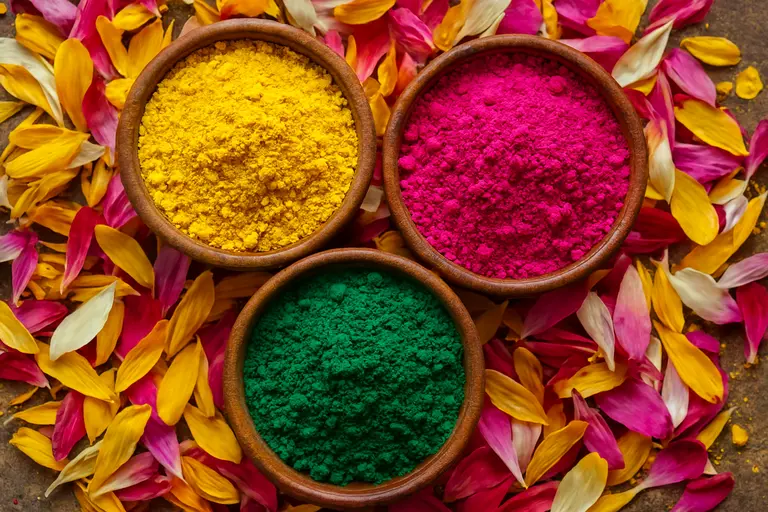
First, let’s look at the palette. Each color used during Holi carries a distinct symbolic identity rooted in Hindu mythology.
Red: The Color of Shakti
Undeniably, red is perhaps the most emotionally charged. It symbolizes love, fertility, passion, and the sacred bond of marriage (Sindoor). In many regions, red is associated with Goddess Durga, representing victory over darkness. Ideally, this connects to the Kempu Ruby—the stone of the Sun and energy.
Yellow: The Color of Wisdom
Yellow radiates warmth and optimism. Specifically, it represents happiness, prosperity, and good health. Closely tied to Turmeric (Haldi), it is also the color of Lord Vishnu. Therefore, throwing yellow is an act of blessing. This mimics the glow of Sula Muscat Blanc and Heliodor.
Green: The Color of Life
Significantly, green carries the promise of new beginnings. Symbolically, it represents the harvest, nature’s renewal, and the heart chakra. Gemologically, this aligns with Emeralds and Muzo vs Bahia Emerald Buying, symbolizing growth and fertility.
Blue: The Divine
Spiritually, blue holds a special place because it is the color of Lord Krishna. Beyond divinity, moreover, blue evokes tranquility and the infinite sky. It mirrors the Kashmir Sapphire vs Grandala comparison—a color of depth and calmness.
Natural Origins of Holi Colors Meaning
Historically, artisans derived all Holi colors entirely from plants. This was not simply a practical matter—it reflected a deep respect for nature.
The Flame of the Forest
The most iconic source is the Palash Tree (Tesu). People boiled their vivid orange blossoms to produce rich saffron dyes. For instance, turmeric provided a yellow, while beetroot offered a deep crimson. For blue, artisans turned to indigo or the Butterfly Pea flower. As for green, dried neem leaves and henna served double duty—providing color while acting as a skin antiseptic. Consequently, traditional Holi was a medicinal bath, not a chemical hazard.
Safety and Holi Colors Meaning
Unfortunately, modern commercial Holi powders often replace plants with synthetic dyes. Labs often find Mercury Sulphite in red powders, while Copper Sulphate appears in green ones. As an expert, I warn you: These can damage skin and eyes.
How to spot the difference:
- Texture: Natural powders (Gulal) are fine and silk-like (often Cornstarch base). Conversely, synthetics are gritty or shiny (Mica/Glass).
- Smell: Typically, natural colors smell earthy or floral. Synthetics smell chemical.
- Reaction: If it stings, wash it off immediately.
Therefore, seeking out certified “Herbal Gulal” or making your own is strongly encouraged. This “Purity” mindset aligns with my advice on Ayurvedic vs Gemstone Treatments.
Rituals: More Than Just Play
The festival is a multi-layered event. It begins the night before with Holika Dahan, a ceremonial bonfire. Metaphorically, the flames represent the burning away of ego and negativity. Subsequently, the following day—Rangwali Holi—is when the colors take over.
Naturally, food is equally central.
- Gujiya: A sweet dumpling filled with coconut and nuts.
- Next, Thandai: A spiced milk drink with almonds, saffron, and fennel. These culinary customs bind communities together. If you love festive food, check my post on Paragon Biriyani or Kozhikode Halwa.
Phoolon ki Holi: The Flower Festival
Perhaps the most beautiful variant is Phoolon ki Holi (Holi of Flowers). Usually, priests celebrate this famously in Vrindavan (Banke Bihari Temple); this version replaces powder entirely with flower petals. Devotees shower each other with Marigolds and Roses. Remarkably, this transforms the celebration into an act of worship. Ultimately, it is a reminder that at its heart, Holi is an offering of love. You can read about the Marigold color connection in Sphalerite vs Autumn Flowers.
Social Values: Unity and Forgiveness
Beyond mythology, Holi embodies social values relevant to 2026. Essentially, the festival serves as a “Reset Button” for society. Fittingly, the phrase “Bura na mano, Holi hai” (Don’t be offended, it’s Holi) captures the spirit of inclusivity.
Furthermore, Holi is a festival of forgiveness. Effectively, old grudges are washed away with the color. In this sense, the colors become a metaphor: just as they wash away from the skin, resentment washes away from the heart.
Conclusion on Holi Colors Meaning
In summary, Holi Colors Meaning goes deeper than the skin. Rather, it is about renewing our relationships with nature, the divine, and with each other.
Ultimately, life should be colorful. Whether you celebrate with a pinch of turmeric or a shower of petals, let the spirit of Holi brighten your year.
FAQ: Holi Colors Meaning
What is the main purpose of Holi?
Fundamentally, Holi celebrates the arrival of spring (harvest) and the victory of good over evil (Holika Dahan). Crucially, it is a social festival that encourages unity and the repair of broken relationships.
What is the specific Holi Colors Meaning?
For example, Red = Love/Strength. Yellow = Prosperity/Health. Green = New Life. Blue = Divinity (Krishna). Pink = Friendship.
Are Holi colors safe for skin?
Most natural colors are safe. However, cheap industrial powders often contain heavy metals like Lead or Mercury. Ideally, always buy “Herbal” or “Food Grade” colors.
What is Phoolon ki Holi?
Ultimately, it is a devotional version of Holi celebrated in Vrindavan where flower petals are used instead of colored powder. Indeed, this version is considered gentler and more spiritual.
When does Holi take place?
Calendar-wise, it falls on the Full Moon (Purnima) of the Hindu month of Phalguna, which typically occurs in late February or March.