Introduction
Movies do far more than add glamour to our screens. In fact, they introduce millions of ordinary people to diamonds, coloured gemstones, pearls, mining, trading, theft, and luxury culture. Because most viewers never study gemology, cinema often becomes their first entry point into this complex subject. However, filmmakers tell stories rather than teach gemology. Therefore, viewers should separate cinematic fiction from verified fact. A fictional diamond, for instance, can still spark real curiosity about natural stones. Similarly, a dramatic heist can lead someone to ask better questions about security and provenance. For structured learning, the Gemological Institute of America (GIA) offers formal education. Consequently, gem and jewelry movies work best as a starting point rather than a final authority.
How Gem and Jewelry Movies Connect Gems With Human Stories
Furthermore, the psychological impact of these portrayals cannot be overstated. When a filmmaker chooses a specific gemstone for a protagonist, they are often using color psychology and cultural symbolism to tell the audience something about the character’s inner life. A sapphire might represent a search for truth and loyalty, while a ruby could signal a hidden, fiery ambition. Consequently, as the audience watches the drama unfold, they are simultaneously being conditioned to value these stones in specific ways. This subconscious messaging shapes trends in the real world, as jewelers often see spikes in demand for specific colored gemstones immediately following the release of a high-profile film. By recognizing this, you can learn to distinguish between genuine, long-term personal taste and the fleeting influence of cinematic trends, allowing you to make purchases that resonate with your own story rather than a fictional character’s journey.
Old Hollywood Glamour in Gem and Jewelry Movies
Iconic Moments in Gem and Jewelry Movies
- The Maltese Falcon (1941): This classic places a fictional jeweled statuette at the center of a crime story. Although the falcon is not a real stone, the film teaches a lesson about perceived rarity and desire.
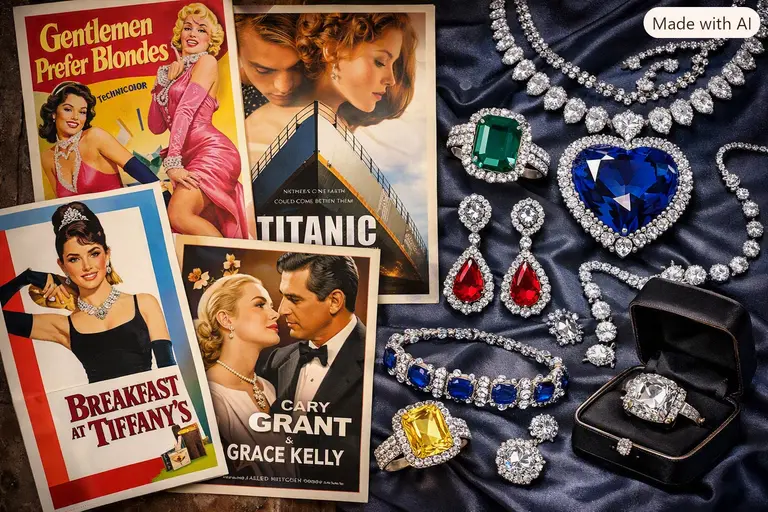
- Gentlemen Prefer Blondes (1953): Marilyn Monroe’s performance of “Diamonds Are a Girl’s Best Friend” remains iconic. Interestingly, the gems in that number were costume paste. During the promotional tour, however, Monroe wore the genuine 24.04-carat Moon of Baroda, a pear-shaped Fancy Yellow diamond.
- To Catch a Thief (1955): Alfred Hitchcock’s film combines the French Riviera, high society, and theft. Therefore, it presents jewelry as both a status symbol and a portable store of wealth.
- Breakfast at Tiffany’s (1961): Audrey Hepburn’s appearance outside Tiffany & Co. reinforced the link between pearls, sophistication, and modern femininity.
The Reality Behind Gem and Jewelry Movies Sparkle
The Pink Panther (1963) centers on a fictional pink diamond containing a panther-shaped inclusion. Notably, this has a real gemological parallel, because inclusions genuinely help identify individual stones. In practice, though, gemologists rely on microscopes and laboratory testing rather than a glance across a room. Similarly, Diamonds Are Forever (1971) connects diamonds with smuggling and market manipulation, prompting questions about supply chains.
Modern Gem and Jewelry Movies and Consumer Awareness
Luxury Retail in Gem and Jewelry Movies
Pretty Woman (1990) features a ruby and diamond hearts necklace by FRED, chosen from the jeweller’s Rodeo Drive boutique. Beyond the piece itself, the scene reveals how presentation, exclusivity, and service shape luxury retail. Likewise, Titanic (1997) introduced millions to the fictional Heart of the Ocean. Its design deliberately evokes legendary blue diamonds, proving that invented jewelry can still become culturally powerful.
Ethics and the Trade in Gem and Jewelry Movies
By contrast, Blood Diamond (2006) delivers a serious lesson by bringing conflict diamonds to a mass audience. The Kimberley Process exists to curb the trade in conflict rough. Nevertheless, it controls rough-diamond flows only and therefore cannot guarantee ethical sourcing by itself. Similarly, Ocean’s 8 (2018) introduces high jewelry by drawing on Cartier’s 1931 necklace for the Maharaja of Nawanagar. Cartier worked from archive drawings and produced a version in cubic zirconia set in white gold, as reported by The Hollywood Reporter.
Uncut Gems and Reality in Gem and Jewelry Movies
Moreover, the film effectively strips away the polished veneer of the luxury industry to reveal the frantic, high-pressure environment that often exists behind the scenes of a clean, quiet boutique. While most consumers interact with a salesperson in a calm, climate-controlled setting, the reality of the gemstone trade is frequently far more chaotic and reliant on instant, high-stakes decisions. This portrayal serves as a stark reminder that every gemstone you purchase has likely traveled through a complex web of hands, negotiations, and risks before reaching your jewelry box. It emphasizes the importance of trust and verification, as the film depicts how easily misinformation can circulate in a high-speed environment. Therefore, understanding this reality should drive a consumer toward documented, laboratory-certified sources, where the information is verifiable and the risks of impulse or manipulation are minimized by standardized professional protocols.
Why Gem and Jewelry Movies Matter to the 99 Percent
Most people will never earn a gemology diploma, yet many will eventually buy gold, diamonds, or pearls. Movies therefore hand them a vocabulary for asking smarter questions, such as whether a stone is natural, treated, or laboratory-grown. Ultimately, however, cinema should never replace gemological education. Instead, it should spark curiosity that leads consumers toward museums, laboratories, and qualified experts.
Frequently Asked Questions
Can movies teach gemology?
Movies can introduce ideas such as rarity, provenance, and inclusions. However, they cannot replace professional education or laboratory testing.
Are movie jewels valuable simply because they appeared on screen?
Not necessarily. Although a film association boosts interest, value still depends on quality, rarity, craftsmanship, and documentation.
Why are villains so common in gem and jewelry movies?
Because jewelry is portable, visible, and valuable, theft makes an effective plot device. Additionally, such stories raise genuine questions about security and insurance.
Can movies influence jewelry buying?
Yes, because cinema shapes fashion and symbolism powerfully. Even so, consumers should base major purchases on verified information rather than on-screen impressions.
Disclaimer
Movies blend fact, fiction, and dramatic exaggeration. This article uses films purely as cultural and educational examples, not as gemological, valuation, or investment advice. Readers should verify important claims through qualified gemologists, reputable laboratories, and trusted industry sources. The author has no financial affiliation with the brands or organizations mentioned.