Introduction
India spreads across 28 states, and each carries its own landscape and living symbols. Indeed, one simple way to understand this diversity is through state flowers, from the golden blossoms of Keralam to the delicate Siroi Lily of Manipur. Coloured gemstones, meanwhile, offer a fresh way to read these flowers. However, India has no official system linking a gemstone to any state flower. Therefore, every pairing here represents a creative colour association based on hue and tone rather than tradition or geology. Notably, this distinction matters, since the flowers are recognized state symbols, while the gemstones simply offer a contemporary lens for storytelling. By connecting biological diversity with geological history, we gain a new appreciation for the natural beauty across India.
Understanding State Flowers and Gemstone to Any State Flower Colours
Admittedly, India lacks a single, consolidated list covering every state flower, so sources occasionally disagree. This section, therefore, separates well-established flowers from cases where sources genuinely differ.
Southern and Northern Gemstone to Any State Flower Highlights
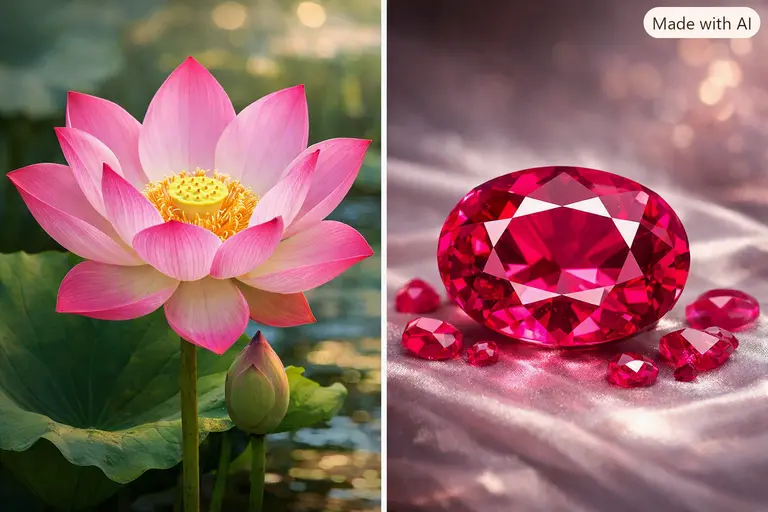
Andhra Pradesh honours Jasmine, so white sapphire, white topaz, or quartz suit it naturally. Likewise, Goa embraces Red Jasmine, suggesting ruby, red spinel, or carnelian. In addition, Haryana and Karnataka both recognize the Lotus, suggesting pink sapphire or rose quartz. Meanwhile, Keralam celebrates Kanikonna, the Golden Shower, whose brilliant yellow blooms suggest yellow sapphire or citrine. In turn, Tamil Nadu celebrates the Flame Lily, suggesting ruby, while Telangana honours Tangedu, suggesting heliodor or citrine.
Eastern and Western Gemstone to Any State Flower Pairings
Bihar favours Kachnar, suggesting pink tourmaline, amethyst, or white quartz. Similarly, Maharashtra favours Jarul, suggesting pink tourmaline, while Manipur treasures the Siroi Lily, pairing with pink sapphire or kunzite. In turn, Meghalaya honours the Lady’s Slipper Orchid, inspiring amethyst. Meanwhile, Odisha honours Ashoka, inspiring orange sapphire or carnelian. Sikkim treasures the Noble Orchid, pairing with amethyst or violet sapphire. Tripura favours Nageswar, inspiring white zircon with yellow sapphire. Finally, West Bengal celebrates Shiuli, inspiring pearl paired with carnelian.
For example, readers seeking deeper botanical detail can explore the Botanical Survey of India, while the Gemological Institute of America (GIA) explains gemstone identification, treatments, and properties for further reading.
What a Gemstone to Any State Flower Pairing Teaches Readers
Furthermore, this exercise in matching a gemstone to any state flower encourages us to look at our surroundings with a more observant eye. When you learn that the Kanikonna of Keralam shares a hue with yellow sapphire, you begin to notice the specific saturation of that yellow in both the petals and the stone. This deepened observation is the first step toward true appreciation. It transforms a simple walk in the park or a visit to a jeweller into an opportunity to compare textures, light reflection, and natural pigments. Over time, this habit creates a bridge between the wild world and the curated one. You no longer see these two domains as separate; instead, you perceive them as parts of a single, continuous spectrum of natural beauty that defines the Indian landscape.
Should Indians Wear the Gemstone to Any State Flower Symbol?
These pairings offer a meaningful design language, though designers should always clarify that any pairing remains a creative interpretation rather than an ancient tradition or official designation. Jewellery offers one natural medium, since pendants and rings can interpret a state’s floral colours through gemstones. Meanwhile, textile designers can bring the same palettes into sarees. Artisans, too, stand to benefit, since Indian jewellery centres already work with coloured gemstones. Designers can build regional collections without claiming the stones originate from that state.
A Cultural Language for the Gemstone to Any State Flower Concept
Moreover, this concept serves as a powerful educational tool for the next generation. By linking a tangible, durable object like a gemstone to a seasonal, fleeting flower, we teach children about the different scales of time. They learn that while a flower represents the cycle of a season, a gemstone represents the cycle of an era. This dual perspective fosters a sense of stewardship for the environment. It prompts students to ask why certain flowers flourish in specific climates and why different geological conditions give rise to specific gemstone colours. It turns a casual interest into a structured, lifelong curiosity. Whether in a classroom, a home, or a design studio, this cultural language invites everyone to participate in the conversation about India’s heritage without needing an expert’s background. It democratizes the appreciation of both botany and mineralogy, making them accessible to anyone who loves the vibrant colours of our country.
Frequently Asked Questions
Are the gemstone equivalents official?
No. In fact, India maintains no official system linking gemstones to state flowers, so these pairings remain creative, colour-based associations meant for education and storytelling.
Do the gemstones actually occur in the corresponding states?
Not necessarily. Each pairing reflects colour alone, so it makes no claim that a particular gemstone occurs naturally in that state.
Why do sources disagree about certain state flowers?
No single government source lists every state flower consistently, so reference sources occasionally differ. Assam, Chhattisgarh, and Madhya Pradesh illustrate why this distinction matters.
Can these pairings be used in jewellery or design?
Yes. Designers can apply them to jewellery, watches, textiles, and souvenirs, provided they describe each pairing accurately as a creative interpretation rather than an official symbol.
What is the core value of this concept?
In closing, its value lies in storytelling. Flowers represent living biodiversity, while gemstones represent geological history, and together they offer an accessible route into India’s natural and cultural heritage.
Disclaimer
State-flower information can vary across published sources because India does not maintain one consolidated statutory list of every state floral emblem. This article highlights genuine uncertainty rather than presenting disputed claims as fact. Likewise, the gemstone equivalents remain creative colour associations only; they carry no status as official symbols, geological occurrence claims, or purchase recommendations. The author has no financial affiliation with the brands or organizations mentioned.