Introduction
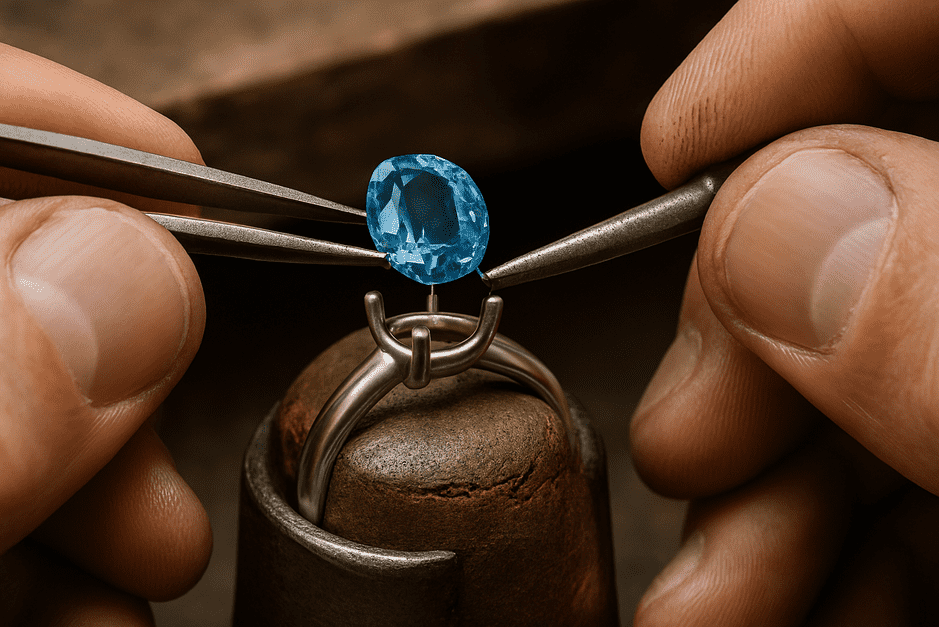
Ancient Roman intaglios can still become the centerpiece of modern jewelry nearly 2,000 years after craftsmen carved them. Today, a small group of jewelers creates contemporary designs around genuine ancient, engraved gems. As a result, archaeology, gemology and jewelry increasingly meet in the same object.
Parisian jeweler Marc Auclert has become known for this ancient-meets-modern approach. Rather than treating an antiquity simply as a gemstone, he creates a modern setting around its individual shape and character. For example, his work includes jewelry built around Hellenistic and other ancient engraved gems.
However, this field requires more than good design. Collectors must also understand gemology, provenance, archaeology and cultural-property law before they buy an ancient object.
What is an Ancient Roman Intaglio Gem?
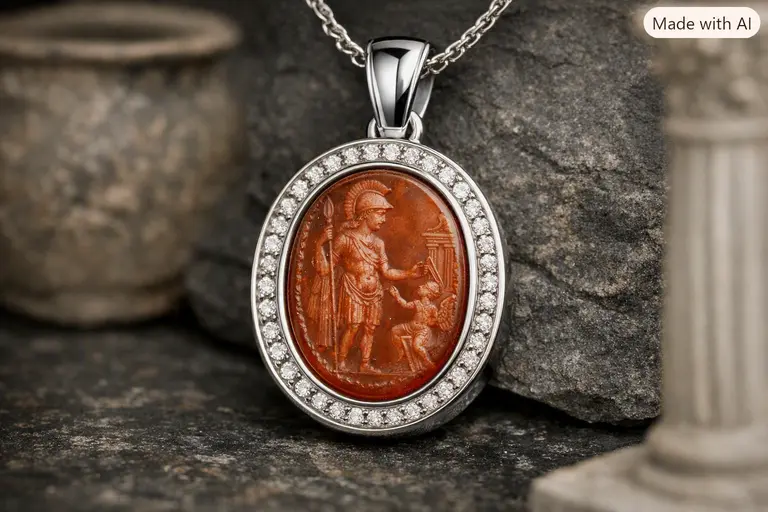
An ancient Roman intaglio carries an image carved below the surface of a gemstone. In antiquity, people often used engraved gems as personal seals because pressing the recessed design into wax produced a recognizable impression. They also wore intaglios as jewelry, amulets and personal objects.
Roman and Graeco-Roman craftsmen worked with materials such as carnelian, quartz and jasper. They carved portraits, gods, animals, mythological figures and other subjects.
However, collectors should use the word “Roman” carefully. Greek, Hellenistic and Roman glyptic traditions overlap considerably. Furthermore, later craftsmen copied classical subjects and styles. Therefore, specialists may describe an object as Hellenistic, Graeco-Roman, Roman or Roman-inspired, depending on the evidence.
For readers who want to understand gemstone identification, our guide to reading a gemstone certificate provides a useful starting point.
Marc Auclert and Ancient Roman Intaglio Jewelry
Modern jewelry designers can give ancient engraved gems a second life without pretending that the objects themselves are modern creations.
Marc Auclert takes this approach by incorporating ancient, engraved gems into contemporary jewelry. Instead of forcing an old gem into a standard mount, he designs the setting around its form. Consequently, the finished jewel can preserve the visual identity of the ancient object while adding a clearly contemporary framework.
This approach offers an important lesson. A modern setting should support an ancient artifact rather than overwhelm it. In other words, the jewelry should create a conversation between past and present.
Ancient Roman Intaglios and Engraved Gems Found in India
India played an important role in long-distance trade with the Mediterranean world. Archaeological discoveries from southern India therefore provide valuable evidence of cultural exchange during the early centuries of the Common Era.
Nevertheless, an engraved gem found at an ancient trading center does not automatically prove Roman manufacture. Researchers must distinguish imported objects from locally made pieces and from local interpretations of Mediterranean designs.
Roman Intaglios at Arikamedu
Arikamedu, near present-day Puducherry, produced important evidence of Indo-Mediterranean exchange. Archaeological records describe a quartz intaglio of Graeco-Roman workmanship showing Cupid and a bird. Researchers also recorded a gem reportedly depicting Augustus, although the latter object was a less secure find and subsequently disappeared from view.
Therefore, these discoveries demonstrate contact with the Mediterranean world, but they do not establish that every engraved gem found at Arikamedu came directly from Rome.
Roman Intaglios and Engraved Gems at Pattanam
Pattanam in Keralam offers an even more intriguing case. Archaeologists have recovered several engraved gems, including a striking sphinx intaglio. Recent research has also raised the possibility that Pattanam supported an ancient gem-working industry.
That possibility matters because it could change how researchers understand ancient gemstone production in South India. Instead of viewing India merely as a supplier of raw materials or an importer of finished Mediterranean gems, researchers can now investigate whether local craftsmen produced or adapted engraved gems themselves.
Current scholarship already distinguishes imported engraved gems from locally inspired examples in South Asia.
Roman Intaglios and Ancient Gems at Karur
Karur, an important center of the ancient Chera kingdom, also participated in long-distance trade. Archaeological research has identified Roman-related material in and around the region, while scholarly studies identify Karur and nearby Vellalur as important locations for engraved-gem discoveries. However, many finds from this area are stray rather than securely excavated.
Consequently, collectors should never use location alone to establish provenance. Instead, they should examine the carving style, material, wear, archaeological context and ownership history together.
Pre-Columbian Amulets and Ancient Roman Intaglios
Pre-Columbian artifacts belong to the ancient cultures of the Americas before sustained European contact. Therefore, a genuine Pre-Columbian amulet does not originate archaeologically in India.
Nevertheless, such an object can enter an Indian collection through modern trade, inheritance or other transfers. Thus, collectors should distinguish an artifact’s place of origin from its current location.
The distinction also matters when modern jewelers incorporate ancient objects into contemporary designs. Cultural history should remain part of the object’s identity.
How Experts Authenticate Ancient Roman Intaglios
Gemology provides an important first step when experts examine an ancient Roman intaglio. A gemologist can identify the gemstone and investigate treatments, inclusions and other physical characteristics. Advanced techniques, including Raman spectroscopy, can provide additional information.
However, gemology alone cannot establish an object’s complete archaeological history.
Experts must also study the engraving. They examine carving techniques, tool marks, wear, iconography and comparisons with securely dated examples. Importantly, an ancient gemstone does not necessarily carry an ancient carving. A craftsman could have engraved an old stone centuries after its formation.
Therefore, specialists should evaluate the stone and the engraving separately before reaching a conclusion.
Ancient Roman Intaglios, Provenance and Indian Law
Provenance becomes especially important when collectors consider ancient engraved gems. A confident label such as “Roman” or “excavated in India” needs supporting evidence.
In India, the Antiquities and Art Treasures Act, 1972 regulates antiquities and art treasures. The Act prohibits private export of antiquities and art treasures, subject to the statutory framework for authorized government export and permits.
Internationally, the UNESCO 1970 Convention addresses the illicit import, export and transfer of cultural property. India deposited its ratification instrument in 1977.
For that reason, buyers should obtain qualified advice before buying, selling, importing or exporting ancient cultural objects.
Why Ancient Roman Intaglios Still Matter
Ancient Roman intaglios remain fascinating because they combine gemstone science, miniature art, history and human identity.
Moreover, modern jewelry gives these tiny objects a new context. A contemporary ring can therefore connect a wearer with an artifact created many centuries ago.
However, responsible collecting requires patience. Instead of chasing a dramatic story, collectors should ask simple questions: Where did the object come from? Who owned it? How did experts identify it? Can its history be documented? Is its ownership legal?
Ultimately, the best ancient jewel is not merely beautiful. It also has a credible history.
Frequently Asked Questions About Ancient Roman Intaglios
Are Roman intaglios found in India?
Yes. Archaeological sites in southern India, including Arikamedu and Pattanam, have produced engraved gems associated with Graeco-Roman traditions. However, researchers distinguish imported objects from locally produced or locally inspired pieces.
Is every intaglio from an Indo-Roman site actually Roman?
No. Trading centers brought together imported objects, local products and artistic influences. Therefore, specialists must examine each gem individually.
Why does Pattanam matter?
Pattanam has produced significant engraved gems, including a sphinx intaglio. Researchers are also investigating whether ancient gem-working took place at the site.
Do Pre-Columbian amulets originate archaeologically in India?
No. Genuine Pre-Columbian artifacts originate in the Americas. However, individual objects can later enter Indian collections.
Can a gemologist fully authenticate an ancient Roman intaglio?
Usually not. A gemologist can identify the material and contribute scientific evidence. However, archaeological expertise, stylistic analysis and provenance research also matter.
Can an ancient gemstone carry a modern carving?
Yes. An old gemstone can receive a much later engraving. Therefore, experts must assess the age of the stone and the age of the carving separately.
Can collectors freely export ancient Indian artifacts?
No. Indian law places significant restrictions on the export of antiquities and art treasures. Collectors should obtain professional legal advice before attempting any cross-border transfer.
What should a newcomer check first?
Start with provenance. Then examine the gemstone, carving, condition and ownership history. Finally, obtain an independent opinion from appropriately qualified specialists.
Disclaimer
This article provides general educational information only. It does not provide authentication, valuation or legal advice. Anyone handling ancient engraved gems or archaeological artifacts should consult appropriately qualified specialists and obtain independent guidance on provenance, ownership and applicable cultural-property laws before buying, selling, importing or exporting such objects. The author has no financial affiliation with the brands or organizations mentioned.