Introduction
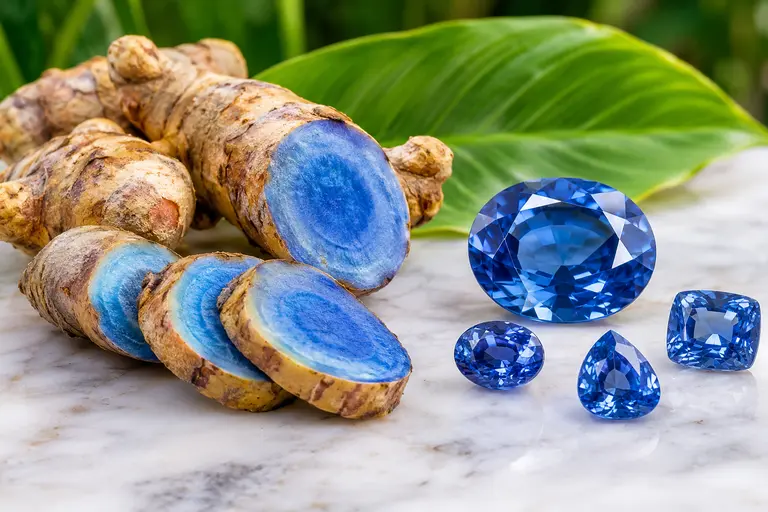
Nature often creates surprising similarities between completely unrelated materials. For example, a freshly cut blue turmeric rhizome can resemble a dark-blue gemstone. However, buyer confusion goes far beyond colour. Shoppers also face wrong botanical names, dyed stones, and inflated claims. Therefore, this guide explains blue turmeric and gemstones in simple language. Moreover, it helps ordinary buyers avoid costly mistakes without special equipment. First, explore our gemstone buying guide for extra background.
Understanding Blue Turmeric and Its Colour
What Is Authentic Blue Turmeric?
Botanists classify blue turmeric as Curcuma caesia in the ginger family. Many people also call it black turmeric or Kali Haldi. Moreover, its interior ranges from bluish grey to dark indigo. The rhizome also releases a camphor-like aroma from compounds like camphor and ar-turmerone. However, compound levels shift with soil and climate. Furthermore, Kew records its native range across India, Bhutan, and Bangladesh. Nevertheless, regional origin in Manipur, Assam, Meghalaya, or Chhattisgarh never guarantees quality alone. Also, visit Kew Science Curcuma caesia or our guide to Indian spices and herbs.
Which Gemstones Resemble Blue Turmeric?
Several minerals share striking visual similarities with this rhizome. For instance, sodalite shows earthy navy blue, while dumortierite displays denim and slate tones. Similarly, dark lapis lazuli appears opaque ultramarine, and hawk’s eye shows silky blue-grey bands. Meanwhile, indicolite tourmaline shifts from greenish blue to deep blue. In addition, iolite shows violet-blue shades that change with viewing angle. Although these stones echo the rhizome’s colour, their mineral structure differs completely. Therefore, never identify blue turmeric and gemstones by colour alone.
How to Identify Genuine Blue Turmeric
Examine the Whole Rhizome
First, buy whole or sliced dried rhizomes instead of powder. Grinding destroys the physical traits that help you inspect the material. Next, check a fresh cross-section for the bluish-grey interior. However, natural colour fades during drying and storage, so appearance cannot prove species. Furthermore, sellers should share the botanical name, batch number, packing date, and source. In India, packaged foods must carry FSSAI licensing details. Nevertheless, an FSSAI licence never certifies botanical identity for every batch.
Why Household Tests Are Not Enough
Many websites promote water tests, paper-rub tests, and taste tests. However, these shortcuts cannot separate genuine samples from adulterated products. Similarly, colour bleeding does not automatically prove synthetic dye. Therefore, never taste suspicious samples. Instead, send high-value batches to an accredited laboratory. Moreover, analysts use HPTLC, HPLC, and GC-MS with proper reference materials to distinguish Curcuma species. Finally, consult this scientific review on Curcuma caesia for technical context.
Treatments for Blue Turmeric and Gemstones
First, the gemstone trade accepts disclosed treatments, including heating, irradiation, dyeing, and impregnation. Consequently, buyers must confirm whether a stone is natural, treated, synthetic, or a simulant (imitation). Food, however, follows stricter rules. For instance, FSSAI regulations prohibit unauthorised colouring matter in food. Moreover, the FSSAI turmeric powder standard forbids added colour. Because that standard specifies Curcuma longa, general FSSAI additive and labelling rules govern blue turmeric. In contrast, no treatment turns a substituted rhizome into real Curcuma caesia. Likewise, artificial flavouring cannot prove identity. Read the official FSSAI Food Additives Regulations directly.
Practical Tips for Buying Blue Gemstones
Do Not Trust Appearance Alone
Although polished blue stones look striking, appearance never proves mineral identity. For example, dyed howlite and coloured glass often imitate costly gems. Meanwhile, a 10x loupe can spot dye pooling inside cracks and pits. However, visual checks remain preliminary. Likewise, coolness and heft cannot catch every imitation. Therefore, avoid expensive gem purchases based on sight alone.
Ask for Independent Gemstone Reports
First, request an independent lab report for expensive indicolite, iolite, or lapis lazuli. For instance, the GIA Coloured Stone Identification Report identifies material and detectable treatments. However, GIA issues Identification and Origin Reports only for specified gems like emerald, ruby, and sapphire. Consequently, match the report to the stone’s value. Meanwhile, testing often costs more than modest sodalite beads. Therefore, choose accountable sellers, demand itemised invoices, and check return policies. Explore GIA Coloured Stone Reports and our how to read a gemstone certificate.
Consumer Protection for Blue Turmeric and Gemstones
Buyers need neither a doctorate nor lab gear to shop wisely for both products. For blue turmeric, prioritise whole rhizomes, clear botanical names, and traceable suppliers. Similarly, for gems, demand mineral names, treatment disclosures, and itemised invoices. Moreover, separate organic certification from botanical authentication, because organic labels audit farming rather than species. Likewise, BIS hallmarking verifies precious metal purity, not ring stones. Therefore, a hallmarked ring never guarantees natural gems. Finally, question exaggerated medicinal or rarity claims and walk away from evasive sellers. Ultimately, informed buying belongs to everyone.
Frequently Asked Questions
Can sellers colour blue turmeric artificially?
Yes, dishonest sellers can apply artificial dyes. However, food laws ban unauthorised colouring, so request traceable details or lab verification.
Which gemstone looks most like blue turmeric?
Sodalite and dumortierite match closest because their opaque, earthy-blue tones echo the rhizome’s interior. However, their mineral properties differ completely.
Is Northeast India the best source of blue turmeric?
Northeast India produces significant Curcuma caesia, yet evidence does not crown one region best. Instead, quality reflects species identity, cultivation, curing, and storage.
Do all blue gemstones need laboratory certificates?
No, because lab reports make financial sense mainly for costly stones. For modest buys, however, transparent sellers, clear invoices, and fair return policies work well.
Can a water test identify genuine blue turmeric?
No, because water tests cannot confirm botanical identity or catch every adulterant. Instead, laboratory profiling provides reliable proof.
Disclaimer
This article offers general consumer education on botanicals, food authenticity, and coloured gemstones. However, it does not replace lab testing, gem appraisal, or legal food-safety advice. Therefore, verify high-value claims independently. The author has no financial affiliation with the brands or organizations mentioned.