Introduction
What does it take to become a world-class professional in the Gemology and AI Future? The answer to this question keeps shifting as digital technology advances, but one fundamental truth stays constant: technology never replaces deep gemological knowledge. Instead, the rise of machine learning raises the market value of solid human judgment.
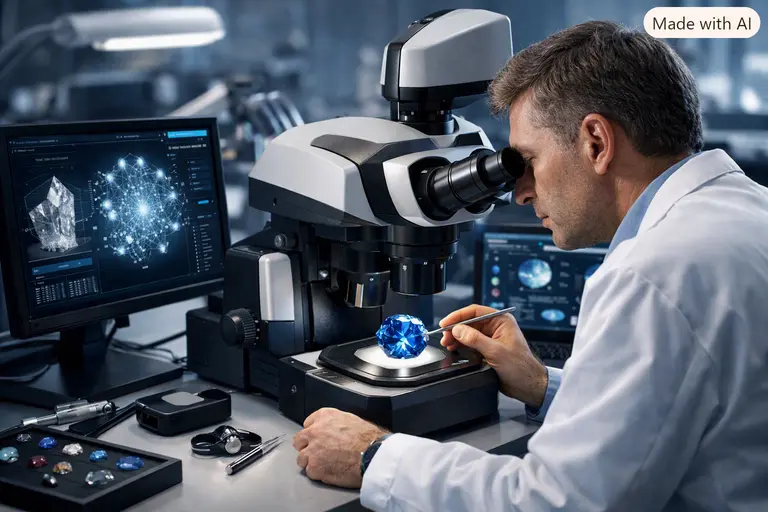
Artificial intelligence now processes complex gemological data and spots subtle patterns that would take a human grader far longer to find. Researchers at the Gemological Institute of America (GIA) have shown that machine learning can support gemstone classification, provenance research, and treatment detection alongside traditional methods. Similarly, the Gübelin Gem Lab built Gemtelligence, a deep-learning system that helps identify coloured gemstones while still pairing that output with a trained professional’s check.
Therefore, a good gemologist today needs more than just sharp eyesight and a loupe. Instead, the modern professional needs scientific grounding, technology literacy, critical thinking, and firm ethical judgment. If you are just starting your journey, our guide to essential gemstone testing methods covers the fundamental techniques that this digital evolution builds upon.
Technology Literacy in the Gemology and AI Future
First and foremost, a modern gemologist must understand technology without leaning on it blindly. AI processes massive datasets quickly and recognizes patterns in chemical composition that the human eye cannot see. However, the gemologist must still understand what the system measured and what that specific result means for the stone’s value.
For that reason, “plausibility checking” has become an essential career skill. A gemologist should always compare an AI-assisted result against the stone’s physical appearance, internal inclusions, and optical properties. For example, if an algorithm identifies a stone as a “natural ruby” but the gemologist sees curved striae, they must recognize that the result calls for extra testing. Consequently, the most successful professionals will not compete with AI. Instead, they will learn to use it as a powerful assistant to improve their own accuracy.
Why Foundational Knowledge Anchors the Gemology and AI Future
Second, the emergence of AI makes fundamental gemological training more valuable than it was in the past. A good gemologist still needs to understand refractive index, specific gravity, pleochroism, and microscopic features. They must also understand how geology shapes a gemstone’s formation over millions of years.
The Importance of Microscopic Reality Checks
This scientific foundation provides a crucial reality check against digital errors. Furthermore, algorithms can sometimes suffer from “data bias.” If an AI has only seen samples from one specific mine, it may misidentify stones from a newly discovered deposit. An experienced gemologist, however, can ask whether an automated conclusion actually matches the stone’s geological “fingerprint.” Moreover, as unfamiliar treatments enter the market, human observation remains the first line of defense against fraud.
Human Judgment and Ethics in the Gemology and AI Future
Third, while technology can generate a vast amount of information, humans still carry the ultimate responsibility for the final decision. A gemologist often needs to explain why a stone cannot receive a definitive origin determination. They may also need to explain why two similar-looking stones carry very different price tags.
Because gemstones often carry deep financial and emotional weight, buyers and insurers need professionals who communicate uncertainty with absolute honesty. Therefore, ethics sits at the very center of the Gemology and AI Future. In an era where “deepfakes” and synthetic growth techniques are advancing, a gemologist’s signature on a report is a promise of integrity that an algorithm cannot duplicate.
Communication as a Core Professional Skill
A technically brilliant scientist can still fall short if customers cannot follow their explanation. Therefore, the best modern gemologists translate complex findings into plain language. They explain why a natural sapphire differs from a lab-grown stone in terms of rarity and long-term value. In short, today’s professional works as a scientist, a data interpreter, and a trusted adviser all at once.
Career Hubs for the Gemology and AI Future
Major global hubs such as New York, Antwerp, Geneva, Bangkok, Mumbai, and Surat connect laboratories with traders. These cities offer valuable exposure to high-end equipment and expert mentors. Dubai, in particular, has emerged as a significant player in the Gemology and AI Future.
According to the Dubai Multi Commodities Centre (DMCC), the city’s diamond trade hit a record $41.7 billion in 2025. Furthermore, the GIA Laboratory DMCC opened in Uptown Tower in 2024 to serve this growing demand. While these centers provide excellent resources, they are not the only places to build a career. Training programs now operate across the globe, allowing students in Africa, India, and Southeast Asia to build modern skills from their home regions. For more advice on entering the field, visit our beginner’s guide to a gemology career.
FAQ: Navigating the Gemology and AI Future
Will AI eventually replace human gemologists?
No. Machine learning complements traditional methods but cannot replace human judgment. AI is excellent at pattern recognition, but it lacks the critical thinking required to handle “outlier” cases or newly invented gemstone treatments.
Do I still need to learn how to use a microscope?
Absolutely. Foundational microscopic skills are the only way to verify if an AI’s conclusion is physically possible. In the Gemology and AI Future, the microscope remains the most important tool for observing internal diagnostic features.
Which computer skills should a gemologist learn?
Professionals should focus on data literacy and understanding how spectroscopy software works. Knowing how to interpret Raman, FTIR, and EDXRF data is becoming just as important as knowing how to use a refractometer.
Is a career in gemology still a safe investment?
Yes. The luxury market’s reliance on trust and authentication is growing. As long as you stay updated with technological shifts, your role as an expert authenticator will remain highly sought after by jewelry houses and auction firms.
How does AI help with gemstone origin determination?
AI compares the trace-element chemistry of a stone against thousands of known samples in a database. This allows for a more statistical and objective approach to determining if a sapphire is from Kashmir, Madagascar, or Sri Lanka.
Conclusion
Ultimately, the Gemology and AI Future is not about choosing between a person and a machine. Instead, it is about the “augmented gemologist”—a professional who uses digital tools to reach higher levels of precision. By combining traditional scientific study with modern technology literacy, you can build a resilient career in this fascinating industry. For the 99 percent of people entering this field, the message is simple: stay curious, stay ethical, and never stop looking through the loupe.
Disclaimer
This article serves general educational purposes only. Gemstone identification, treatment detection, and valuation often require specialized laboratory testing. Readers should never treat AI-assisted results as a substitute for an independent gemological examination by a qualified expert. The author has no financial affiliation with the labs or organizations mentioned.