
Introduction
Do ordinary Indians really love jewelry, or does that love belong only to celebrities? Certainly, some influencers and business leaders flaunt spectacular diamonds, but they make up only a tiny fraction of the market. In fact, the more compelling question concerns the other 99 percent and the enduring nature of Indian jewelry affection. Specifically, does the average farmer, teacher, or office worker genuinely care about their ornaments? Indeed, the answer is yes, as jewelry remains deeply tied to weddings, festivals, and family wealth. Understanding this bond helps explain why India remains a global leader in the gemstone and precious metal trade.
Meanwhile, rising gold prices in late 2026 are reshaping how people buy. Today’s consumers increasingly balance tradition, fashion, affordability, and value. In this article, we explore the cultural and financial pillars that sustain this unique relationship between a nation and its gems.
The Cultural Foundation of Indian Jewelry Affection
First and foremost, India remains one of the world’s most important gold markets. Consequently, gold continues to shape weddings, festivals, gifting, and family savings. For many households, gold jewelry offers a rare combination: people can wear it and later exchange, sell, or pledge it. That said, one should avoid claiming that every rural family treats jewelry as its main savings account.
After all, India has expanded banking access considerably over the last decade. Nevertheless, families still trust gold because they understand it intuitively and can convert it into cash quickly when needed. The World Gold Council frequently tracks exactly this relationship between gold prices and everyday consumer behavior. This trust forms the bedrock of Indian jewelry affection, ensuring that even during economic shifts, the demand for gold remains resilient.
Why Gold Drives Indian Jewelry Affection
Because gold jewelry serves two purposes at once, families often call it “wearable wealth.” For instance, a family might buy a heavy necklace for a daughter’s wedding, then later exchange it for a newer design or pledge it against a business loan. In this way, the jewelry is an active part of the family’s financial portfolio.
Even so, buyers should distinguish between the metal’s resale value and the price they originally paid. Specifically, making charges, taxes, and design premiums rarely return in full during a resale. Therefore, jewelry works as both a cultural product and a financial asset, though not necessarily as a pure investment like a fixed deposit. This dual nature is a primary reason why Indian jewelry affection persists across generations. To understand how these values are calculated, you can read our guide to gemstone and jewelry verification.
Regional Influences on Indian Jewelry Affection
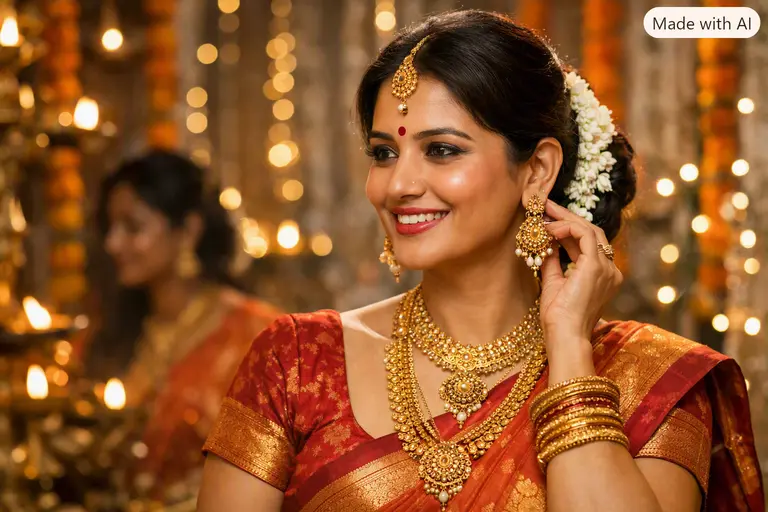
Naturally, Indian weddings sustain the country’s enduring affection for jewelry. Gold often forms a central part of bridal trousseaus, and many communities attach deep emotional weight to jewelry gifted to a bride. However, writers should use the term stridhan carefully, since its legal meaning depends on specific circumstances regarding ownership.
Local Variations in Indian Jewelry Affection
Meanwhile, regional traditions vary enormously across the 28 states. For example, a Keralam bride typically chooses jewelry quite different from a bride in Rajasthan, Bengal, or Tamil Nadu. In the south, the focus often stays on high-purity yellow gold with intricate “Temple” designs. In contrast, northern styles may incorporate more Polki or Kundan work. As a result, no single “Indian style” truly exists. This diversity allows Indian jewelry affection to manifest in thousands of unique local forms. Read more about Keralam’s bridal jewelry traditions here.
Buyer Knowledge and Indian Jewelry Affection
Interestingly, many Indian consumers carry considerable practical knowledge into every purchase. For example, they often distinguish 22-karat from 18-karat gold and compare prices, weight, and making charges before finalizing a deal. They are not passive shoppers; they are active negotiators who understand the “spot price” of gold.
Nevertheless, this practical knowledge differs from professional gemological expertise. Most buyers cannot independently grade a diamond’s clarity or identify a treated gemstone. Instead, they rely on market wisdom passed down through families. This blend of traditional knowledge and modern price-checking tools makes the Indian consumer one of the most sophisticated in the world. Consequently, brands must be more transparent than ever to satisfy this Indian jewelry affection.
Building Trust and Indian Jewelry Affection
Additionally, hallmarking has changed how buyers evaluate gold purity and trust. The Bureau of Indian Standards (BIS) assigns a Hallmark Unique Identification number, or HUID. Consumers can verify this number instantly through the BIS Care App. This digital verification has significantly reduced the fear of being cheated.
Still, HUID does not appear on every item. This is because BIS exempts certain categories, including articles under two grams and jewellers below a specific annual turnover threshold. Therefore, buyers should confirm applicable rules rather than assuming universal coverage for every small silver or gold trinket. This regulatory framework has strengthened Indian jewelry affection by adding a layer of modern security to an ancient habit.
Economic Resilience of Indian Jewelry Affection
Although gold prices have climbed sharply as of September 2026, Indian demand has not disappeared. Instead, it has adapted through “lightweighting.” Consequently, many buyers now choose thinner chains, smaller earrings, or lower-carat, diamond-studded designs instead of heavy, solid pieces.
Even so, 22-karat gold remains essential for ceremonial purchases where purity is a matter of pride. Meanwhile, 14-karat and 18-karat options have gained visibility for everyday wear among urban office workers. In short, India is not abandoning its gems; rather, Indian consumers are finding innovative ways to maintain their Indian jewelry affection within a stricter budget.
FAQ: Guide to Indian Jewelry Affection
Do Indians really still love jewelry in the digital age?
Yes, indeed. While digital investments are rising, jewelry remains deeply tied to weddings and festivals. It serves as a tangible link to heritage that a digital screen cannot replicate.
Do all Indians prefer gold over other metals?
While gold remains dominant, silver, platinum, and lab-grown diamonds are growing in popularity. Younger buyers, in particular, often seek a variety of price points for fashion jewelry.
Is 22-karat gold still the standard for weddings?
Yes, for most traditional ceremonies, 22-karat gold is considered the minimum standard for auspiciousness and value.
How do I verify if my gold is genuine?
You should look for the BIS hallmark and the HUID number on the piece. You can then verify these details using the official BIS Care mobile application.
Why is jewelry called “wearable wealth” in India?
This term is used because jewelry can be worn for beauty while retaining a high intrinsic value that can be liquidated in times of financial need.
Conclusion
Ultimately, Indian jewelry affection is not merely about vanity or display. It is a complex blend of culture, family security, and artistic pride. From the smallest village to the largest metro city, jewelry remains a core part of the Indian identity. As the market evolves with new technology and rising prices, the heart of the tradition stays the same. Millions of ordinary Indians will continue to cherish their jewelry, proving that some loves are truly timeless.
Disclaimer
This article describes broad jewelry and consumer trends across India. Individual preferences differ substantially by state and income level. Because jewelry purchases involve real financial considerations, readers should independently verify gold purity and pricing before buying. This content serves general informational purposes only and does not constitute financial or legal advice. The author has no financial affiliation with the brands or organizations mentioned.