
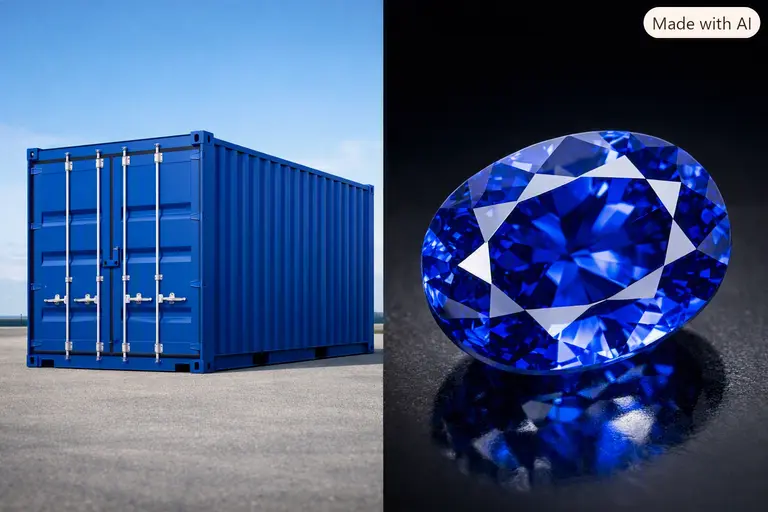
Introduction
At first glance, shipping containers and colored gemstones share almost nothing in common. However, both actually rely on the same simple tool: the science of color. Containers travel through ports, ships, and truck terminals every day, while gemstones move through mines, cutting centers, and retail counters. Although these industries work very differently, both use color to communicate vital information quickly. Therefore, understanding the container and gemstone colors relationship helps us see how standardized visual systems prevent errors in global trade.
Still, the comparison only goes so far. For instance, container colors never form a universal cargo code, and gemstone color alone can never confirm a stone’s identity, origin, or treatment. Instead, both systems simply show how standardized visual references improve recognition and efficiency. As a result, this shared idea can help everyday buyers make smarter decisions when navigating high-value markets. Consequently, we should view color as a helpful starting point rather than a final conclusion.
Importance of Container and Gemstone Colors Standards
Color seems simple until someone tries to describe it precisely to a third party. For example, two viewers might call a gemstone “blue,” yet one may notice a subtle violet tint while the other sees a deeper, greenish shade. Therefore, gemologists rely on three specific pillars—hue, tone, and saturation—to describe color accurately. According to GIA’s colored-stone grading system, these components allow for a universal language that minimizes human error.
Meanwhile, shipping terminals face a different challenge. Because thousands of containers often fill a single yard, color offers a fast clue about a fleet or an equipment type. Even so, logistics workers never rely on color alone; instead, they confirm every detail through identification numbers and official digital documentation. In both worlds, the container and gemstone colors used serve as a visual shorthand that saves time during initial sorting.
Logistics Logic for Container and Gemstone Colors
First of all, you must realize that container color rarely reveals the specific cargo sitting inside the steel walls. Instead, these colors typically reflect the branding of the shipping line or the owner of the equipment.
Branding Trends in Container and Gemstone Colors
A blue container, for example, does not automatically hold electronics, and a green container does not automatically carry agricultural produce. Generally, standard container colors instead reflect shipping-line branding, leasing practices, or manufacturer choices. Consequently, shoppers and logistics staff alike should treat color as a hint rather than a guarantee. By recognizing the carrier’s color, port workers can direct traffic more efficiently toward the correct loading zone.
Practical Container and Gemstone Colors in Shipping
Refrigerated containers, often called “reefers,” illustrate how color can serve a purely functional purpose. Because lighter surfaces reflect solar radiation more effectively, many reefers use white or pale finishes to reduce heat absorption. This thermal management is critical for preserving perishable goods during long sea voyages. Nevertheless, a white container does not automatically mean it is refrigerated. Therefore, workers still check equipment specifications and identification tags before making any assumptions about the contents.
Grading Systems for Container and Gemstone Colors
Colored gemstones create an even trickier color puzzle because they interact directly with light. As mentioned earlier, gemologists describe color through hue, tone, and saturation. However, these three terms alone cannot capture everything the human eye perceives.
Faceted stones often show bright reflections, dark extinction zones, and shifting tones depending on the viewing angle. For this reason, professional tools give experts a shared visual reference for comparing complex gemstone colors. For a deeper look at how to verify these details, you can explore our guide to gemstone identification.
Furthermore, shared references improve everyday communication between buyers and sellers. Instead of relying on vague, subjective phrases like “nice blue” or “deep red,” professionals compare a stone directly against a reference chart. Even so, no single chart captures every possible shade in nature. Therefore, buyers should treat these guides as communication tools rather than as absolute proof of a stone’s quality or value.
Reducing Risk with Container and Gemstone Colors
Interestingly, color guides reduce uncertainty in both industries, even though they cannot replace expert judgment or scientific testing. In the shipping sector, mismatched identification can cause costly delays or legal disputes. In the gemstone sector, a synthetic ruby can display a color remarkably similar to a natural one. Therefore, professional laboratory testing remains essential whenever origin or treatment truly matters.
Consequently, shoppers should never buy a gemstone simply because a seller attaches an attractive, romantic name to it. Terms such as “royal blue” or “pigeon’s blood” are marketing labels that vary across different markets and laboratories. In short, the container and gemstone colors you see are just the surface level of a much deeper data set. To ensure you are protected, always ask for a lab report from a reputable organization.
Buying Tips for Container and Gemstone Colors
Ultimately, both container colors and gemstone colors convert complex visual information into a practical shorthand. A shipping worker recognizes a familiar carrier color instantly, while a gemologist recognizes a promising hue at a glance. However, both professionals then move beyond that first glance toward rigorous verification.
Consequently, everyday consumers should apply the same habit: use color as a helpful starting point, then look for documentation, certification, or expert testing before making an important financial decision. Whether you are tracking a shipment or buying an engagement ring, data always trumps a first impression.
FAQ: Guide to Container and Gemstone Colors
Do container colors identify the cargo inside?
No. Instead, container colors typically reflect branding, leasing arrangements, or manufacturer choices. You cannot tell if a container holds gold or grain based on its exterior paint.
Does a white container always mean it is refrigerated?
Not necessarily. While many “reefers” are white to reflect heat, many standard containers are also painted white for aesthetic or branding reasons. Always check the ID tags.
Can a color guide identify a gemstone’s origin?
No. A color guide helps describe appearance, but only laboratory testing through spectroscopy and microscopy can determine identity and geographic origin.
Why do gemologists use hue, tone, and saturation?
Together, these three elements give professionals a precise, shared vocabulary. This allows for more accurate communication between international traders and reduces the chance of misrepresentation.
Does color alone prove a gemstone is natural?
No. Natural and synthetic stones can share nearly identical colors. In fact, many lab-grown gems are specifically engineered to match the “ideal” colors of natural stones.
Disclaimer
This article offers general educational information about color references used in shipping and gemology. Container-color practices vary among shipping lines. Similarly, gemstone color terminology varies among laboratories and markets. Because color alone cannot confirm cargo type or gemstone identity, readers should always seek appropriate documentation or professional advice before making significant financial decisions. The author has no financial affiliation with the brands or organizations mentioned.