Introduction
What happens when a jewelry brand stops asking students to sketch another generic design and instead asks young Indian jewelry designers to tell a specific story through their craft? This question becomes incredibly relevant today because British watchmaker Mr Jones Watches recently launched a Young Designers competition for creatives aged 18 to 25. The brief asks these young entrants to build a limited-edition watch that tells a story while displaying time in a pictorial way. According to WatchPro, the winner will develop a 300-piece edition, earn a £3,000 design fee, and receive ongoing royalties from future sales.
However, the real lesson here has little to do with the horology industry itself. Instead, it points toward how constraints, storytelling, and fresh minds can produce unexpected innovation. For the local industry, this approach could become a powerful experiment for young Indian jewelry designers. It could push them to see gold, diamonds, and gemstones through a fresh, narrative-driven lens rather than just traditional patterns. Consequently, by reframing the design process, Indian brands can tap into a reservoir of untapped creative energy that currently sits idle in classrooms across the country.
Mr Jones Competition Lessons for Young Indian Jewelry Designers
At first glance, the Young Designers Open Call looks like an ordinary creative contest. Yet the brief demands far more than an attractive sketch. In addition, entrants must explain exactly what happens in their design and why it matters. Also, notably, applicants do not need any prior watch-design experience to enter. This lowers the barrier to entry while raising the standard for conceptual thinking.
Therefore, the competition successfully reframes the creative challenge. Instead of asking “can you design a beautiful watch,” it asks “can you make a watch communicate a complex idea.” That distinction matters because a beautiful object paired with a meaningful story makes people stop and remember it. Furthermore, it creates a deeper emotional bond between the wearer and the item. For young Indian jewelry designers, this shift from “aesthetic” to “narrative” is the key to standing out in a crowded global marketplace.
Encouraging Young Indian Jewelry Designers to Tell Stories
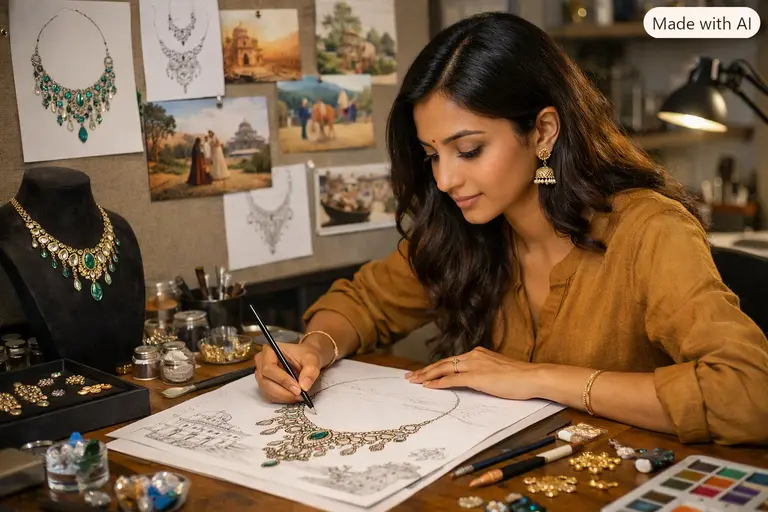
For instance, picture an Indian jewelry brand launching a similar “Young Jewelry Storytellers” Open Call. The brand could invite creators aged 18 to 25 to design one piece that tells a distinctly Indian story. To make it interesting, they could include a single meaningful constraint, such as a moving component, a reversible surface, or a hidden message. Suddenly, the exercise stops being a simple drawing task and becomes a complex design problem.
Consequently, the young creator must solve a mechanical puzzle while still telling a story that resonates with a modern audience. This is where young Indian jewelry designers can truly shine, as they bridge the gap between ancient heritage and modern functionality. If you want to learn more about how to identify the materials used in such creative designs, you can explore our guide to gemstone identification.
Mechanical Constraints for Young Indian Jewelry Designers
Complete freedom rarely produces the strongest creative results. This is because too many possibilities often leave a designer unsure of where to begin. A clear constraint, however, gives the designer a specific starting point. For example, a brief as simple as “design a pendant that tells a story when it moves” could inspire one person to capture monsoon clouds and another to interpret a Kathak dancer’s motion.
In this way, the constraint redirects creativity toward unexpected places instead of shrinking it. Furthermore, it forces the designer to understand the physical properties of the metal and stones. When young Indian jewelry designers work within these limits, they learn to think like engineers. They must ensure that the “story” they are telling is durable and wearable in the real world. This practical experience is often more valuable than years of theoretical study in a design school.
Narrative Examples for Young Indian Jewelry Designers
India offers an extraordinary reservoir of stories tied to landscapes, architecture, and regional traditions. Importantly, young Indian jewelry designers need not recreate historical jewelry to be successful. Instead, they can reinterpret everyday Indian experiences. For example:
- Architecture: A designer might draw from the complex geometry of an ancient stepwell in Rajasthan.
- Urban Life: Another creator might capture the rhythmic chaos and neon lights of a Mumbai local train.
- Nature: A designer from Keralam could transform monsoon rain or backwater boat races into an abstract, wearable narrative.
The Storytelling Edge for Young Indian Jewelry Designers
Indian storytelling does not always have to mean mythology or ancient history. Indeed, the modern Indian experience is rich with its own unique visual language. When a brand empowers young Indian jewelry designers, it allows these new perspectives to enter the luxury market. Moreover, this approach helps the industry move away from the “copy-paste” culture that often plagues mass-market jewelry.
By focusing on original stories, brands can create pieces that are impossible to replicate by machines. This uniqueness adds value to the product and justifies a higher price point for the consumer. Furthermore, storytelling provides a natural way to market the jewelry on social media platforms, where “meaning” often drives engagement more than “bling.”
Gemstone Narratives by Young Indian Jewelry Designers
In a narrative-driven piece, the gemstone itself can anchor the story. For example, an opal could represent changing Himalayan skies, and a moonstone could suggest a quiet night journey. As a result, the gemstone becomes a character in the narrative rather than just a raw material. This gives buyers a fresh way to connect with the piece. To understand the financial value of these stones, you can read our jewelry investment strategies.
Fair Royalties for Young Indian Jewelry Designers
For this model to work, brands must treat their contributors with professional respect. Specifically, a brand should avoid restricting entry to jewelry students alone. Instead, it should welcome illustrators, architects, and industrial designers. An “outsider” view can often produce ideas that a conventional team might never reach.
On the financial side, the brand should follow the Mr Jones Watches model. They should offer a meaningful design fee alongside a royalty system. When young Indian jewelry designers see a clear path to financial reward, they are more likely to invest their best ideas into the project. In fact, beyond the winning piece, the creative journey itself can become high-quality marketing content. The brand can show early sketches and follow the idea from paper to finished luxury jewelry.
FAQ: Guide for Young Indian Jewelry Designers
Could an Indian brand realistically use a royalty model?
Yes. While it is rare in India, a royalty model ensures that young Indian jewelry designers are invested in the commercial success of the product. It creates a long-term partnership rather than a one-time transaction.
Should the competition be limited to design students?
Not necessarily. Opening the contest to architects or graphic designers often produces more innovative mechanical solutions. However, the brand must provide a technical mentor to help turn these “outsider” ideas into feasible jewelry.
How does storytelling help with gemstone sales?
A compelling story gives the buyer an emotional reason to choose a specific stone. For example, a “monsoon” themed piece makes a blue sapphire feel more personal than just a “precious blue stone.”
Does this only work for high-end luxury?
No. Storytelling works at every price point. Even silver jewelry or accessible gold pieces benefit from a strong narrative, as it makes the item feel unique regardless of the metal weight.
Conclusion
Ultimately, the future of the Indian jewelry industry lies in its ability to innovate through narrative. By empowering young Indian jewelry designers, brands can move beyond traditional patterns and create items that truly resonate with a global, modern audience. The Mr Jones Watches competition proves that a simple brief and a fair reward can unlock incredible creativity. For India, a similar commitment to storytelling could turn every necklace or ring into an unforgettable chapter of our national story.
Disclaimer
This article uses the 2026 Mr Jones Watches Young Designers Open Call as a real-world example and proposes a hypothetical model for the Indian industry. The suggested Indian competition and royalty arrangements are illustrative only and do not represent an existing offer from any Indian jewelry company. Readers should verify official terms before relying on details mentioned here. The author has no financial affiliation with the brands mentioned.