
Introduction
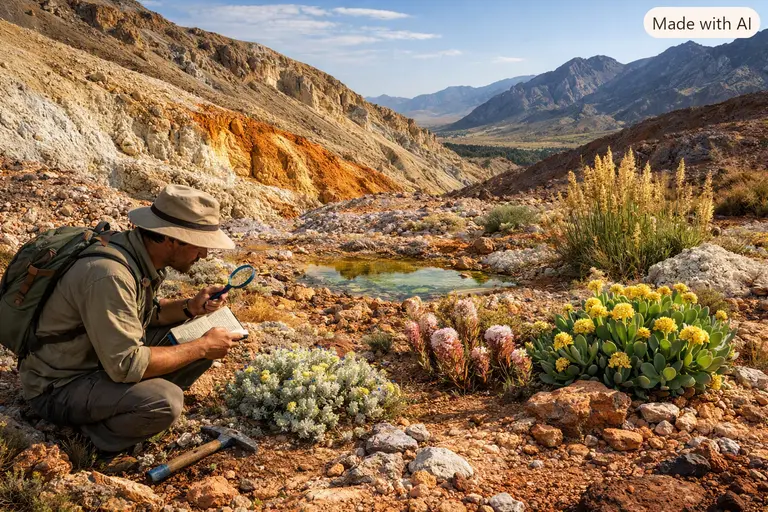
At first glance, plant hunting and gemstone hunting look like unrelated pursuits. However, both hobbies rely on the same core skills, such as sharp observation and geographic knowledge. Most importantly, both fields involve Reading Landscapes for Treasures by interpreting the natural signs found in the terrain. Plant hunters search for rare species, while gemstone hunters search for minerals hidden in rocks, soils, and river gravel. Interestingly, these two worlds sometimes overlap through geobotanical and biogeochemical prospecting. In these fields, plants offer vital clues about the chemistry of soil or the rocks beneath them.
As a result, vegetation can help geologists narrow down areas that deserve a closer look. Furthermore, the US Geological Survey documented botanical prospecting techniques decades ago to assist in mineral discovery. Still, one distinction matters: a plant never points directly to a diamond, a ruby, or a sapphire. Instead, it simply responds to chemical conditions that sometimes accompany mineralization nearby. Consequently, successful exploration requires a multidisciplinary approach that blends biology with geology.
How Vegetation Assists in Reading Landscapes for Treasures
Naturally, plants draw water and nutrients through their roots. Consequently, some plants also absorb trace elements from soil, groundwater, or weathered rock as they grow. Scientists can then study leaves, bark, and twigs to spot unusual concentrations of chemical elements. Geologists call this specific approach biogeochemical exploration. For example, the Geological Survey of Canada has surveyed vegetation in regions linked to gold, uranium, and copper for years.
Similarly, experts explain biogeochemistry as the practice of sampling plants to study chemical properties connected to the ground beneath them. Therefore, the plant itself never becomes the treasure map. Instead, its chemistry adds one more layer of evidence for the prospector. In many cases, “hyperaccumulator” plants can thrive in soils that would be toxic to other species. When a plant hunter finds these specific species, they are essentially reading landscapes for treasures by identifying soil anomalies.
Diamond Mining and Reading Landscapes for Treasures
Diamonds provide one of the most fascinating links between geology and prospecting. This is because natural diamonds usually form in kimberlite and related volcanic rocks that carry them from great depths toward the surface. Consequently, diamond exploration typically starts by searching for evidence of these host rocks rather than searching directly for visible stones.
Notably, the African palm Pandanus candelabrum has drawn significant attention as a possible vegetation indicator. This plant appears to favor certain kimberlitic environments in West Africa. Nevertheless, calling it a “diamond detector” would mislead most readers. This is because its presence alone cannot prove a kimberlite pipe contains diamonds. In fact, indicator minerals such as pyrope garnet or ilmenite often provide more direct evidence. These minerals survive heavy weathering and allow explorers to trace them through stream sediments back to their source. For those interested in the technical side of identification, check our guide to gemstone verification.
Wider Context for Reading Landscapes for Treasures
However, the relationship grows more complex once we move beyond diamonds. Ruby and sapphire both belong to the mineral species corundum, yet they form in several different geological environments. According to the Gemological Institute of America (GIA), primary corundum deposits occur in magmatic and metamorphic settings. Meanwhile, weathering can concentrate corundum into secondary alluvial placers or riverbeds.
Therefore, no single plant can reliably guide explorers toward ruby or sapphire deposits everywhere. Instead, successful explorers study the entire ecosystem. They examine host rocks, soil pH, local drainage patterns, and indicator minerals. This same principle applies across garnet, spinel, and emerald discovery. Because each gemstone forms in a distinct geological setting, reading landscapes for treasures requires a unique “key” for every mineral type.
Indian Examples of Reading Landscapes for Treasures
For instance, India offers an excellent example of integrated exploration. The country has a long history of recovering diamonds from alluvial deposits. Meanwhile, modern exploration also investigates primary sources such as kimberlites. Notably, the Wajrakarur Kimberlite Field in Andhra Pradesh remains a vital site for diamond research.
In this region, geologists combine remote sensing, geochemistry, and indicator-mineral studies to map the terrain. Therefore, it would be inaccurate to say Indian exploration depends mainly on certain plants. Instead, Indian geologists rely on several complementary methods together to ensure accuracy. This historical context proves that reading landscapes for treasures is a skill honed over centuries of trial and error.
New Tools for Reading Landscapes for Treasures
Plant hunters and gemstone hunters also share another trait: both increasingly lean on modern technology. Traditionally, a plant hunter identified a species from its leaves and habitat. Similarly, an experienced prospector recognized a promising landscape from its rocks and drainage. Today, however, satellites, drones, and laboratory analysis greatly expand that field of vision.
Specifically, remote sensing can identify geological structures and vegetation stress over massive areas. Thus, modern prospecting never replaces traditional fieldwork. Instead, technology simply helps explorers decide where their fieldwork should happen next. By using spectral signatures, scientists can detect subtle changes in plant health that might indicate underlying mineral deposits.
The Critical Skill of Reading Landscapes for Treasures
Ultimately, plant hunting and gemstone hunting share one core skill: reading a landscape closely. A plant hunter asks why one species grows in a particular spot. Simultaneously, a geologist asks why a mineral appears in one rock but not another nearby. When these disciplines work together, the landscape becomes an open-air laboratory.
Moreover, each clue strengthens or weakens a potential target. At the same time, modern prospecting should always minimize environmental disturbance. These non-invasive techniques help explorers narrow their targets before they ever disturb the ground. For the average enthusiast, the lesson stays simple: a gemstone hunter does not always start by looking for a gemstone. Sometimes, the first clue is a soil anomaly or even a humble, persistent plant.
FAQ: Guide to Reading Landscapes for Treasures
Can plants really help find diamonds?
Yes, but only indirectly. Some plants respond to soil chemistry linked to kimberlite environments. However, a plant cannot prove diamonds sit beneath it; it only suggests the right host rock might be present.
Is Pandanus candelabrum a genuine diamond detector?
No, it works better as a possible vegetation indicator for kimberlite pipes. Its presence suggests the right soil type, but it does not guarantee that diamonds exist nearby.
Can plants point toward rubies and sapphires?
Plants can sometimes offer geochemical clues through the elements they absorb. However, because corundum forms in many different settings, explorers must study the specific local geology.
Does geobotanical prospecting work in every climate?
No, its usefulness depends on climate, soil depth, and the type of mineralization. An indicator that helps in a tropical rainforest might offer zero value in a dry desert.
Does India rely on modern exploration methods?
Yes, Indian diamond exploration combines geological investigation, remote sensing, and detailed mineral studies. The Wajrakarur area is a prime example of this integrated approach.
Is plant hunting the same as gemstone prospecting?
No. While both pursuits share observational skills and involve reading landscapes for treasures, their goals differ. Plant hunters seek living organisms, while gemstone prospectors investigate geological systems.
Disclaimer
This article serves general educational purposes only. Geobotanical and biogeochemical indicators remain indirect exploration tools. They never guarantee the presence of diamonds or gemstones. Professional geological assessment and appropriate legal permits are essential before making exploration or investment decisions. The author has no financial affiliation with the organizations mentioned.