Introduction to the Language of Gemology
Mastering the Language of Gemology is essential if you have ever felt confused while walking into a high-end jewelry store. Specifically, technical terms like refractive index, pavé, and the D-to-Z color scale often make gemstone shopping feel like visiting a foreign country. The good news is that this specialized terminology exists to help you rather than confuse you. Consequently, once you understand these basics, you can shop smarter, ask better questions, and avoid costly financial mistakes.
Gemologists, jewelers, and lab professionals all use the same Language of Gemology to identify, evaluate, and describe precious stones. This system pulls together materials science, artistic design, and international trade standards into one shared framework. As a result, a diamond graded in New York carries the same meaning to a buyer in Mumbai. Consequently, this guide breaks down the essential terminology in plain English so you can navigate the market with total confidence. You should also read our guide on gemstone buying mistakes to understand how the wrong terminology can lead to poor investments.
Scientific Roots of the Language of Gemology
To master the Language of Gemology, you must first realize that every gemstone starts as a crystal. Crystallography is the rigorous science of how atoms arrange themselves inside a mineral. These microscopic arrangements control every physical property you see—the hardness, the color, and even the way the gem splits under pressure. As a result, crystallography serves as the scientific foundation of the entire industry.
For example, diamonds and garnets belong to the cubic crystal system. Likewise, emeralds and aquamarines belong to the hexagonal system because both grow as varieties of the mineral beryl. Meanwhile, tanzanite crystallizes in the orthorhombic system. These categories do more than just organize minerals into boxes. Instead, they explain how gemstones behave under intense heat and light. Furthermore, they explain why two stones that look similar can behave so differently in the hands of a cutter. For a deeper look at these structures, the Gemological Institute of America (GIA) offers detailed educational resources.
Optical Science and the Language of Gemology
While crystal structure provides the foundation, light reveals a gemstone’s unique personality. Professionals use specialized instruments to measure how light behaves inside each stone, and these measurements act like a digital fingerprint. Specifically, these optical properties allow gemologists to tell one gem from another with 100% confidence.
Light Refraction in the Language of Gemology
One of the most important tools in this field is the Refractive Index, or RI. This number measures exactly how much light bends when it enters a gemstone. Because every gem species has a unique RI range, gemologists rely on it as a primary identification tool. Another key term is “dispersion.” This measures how well a gemstone splits white light into individual spectral colors. Consequently, stones with high dispersion display those colorful flashes that people call “fire.” Diamonds are famous for this fire; however, stones like sphene and zircon also deliver impressive displays.
Color Terms in the Language of Gemology
Furthermore, some gemstones show pleochroism—the ability to display different colors depending on the viewing angle. Tanzanite, for instance, is strongly trichroic. This means it can show three distinct colors: violet, blue, and green. This is not just a visual trick; instead, it helps gemologists identify the stone without any expensive equipment. Therefore, understanding these optical terms is vital for anyone using the Language of Gemology to verify authenticity.
Standard Grading in the Language of Gemology
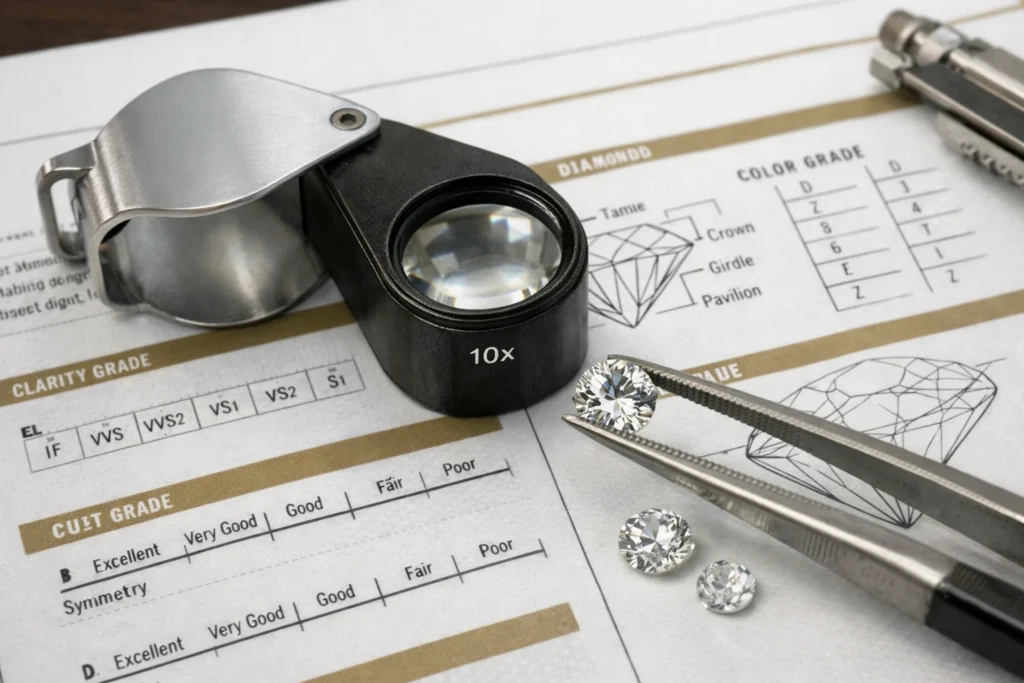
Even after a gemologist identifies a stone, the industry still needs a shared language to describe its quality. That is where the 4 Cs come in. The GIA established the 4 Cs—Color, Clarity, Cut, and Carat Weight—as a globally recognized grading system.
- Color: This measures the presence or absence of body color. In colorless diamonds, less color generally results in a higher grade on the D-to-Z scale.
- Clarity: This evaluates internal characteristics called “inclusions” and surface blemishes. As a result, stones with fewer visible imperfections command higher prices.
- Cut: This measures how well the gemstone facets interact with light. A well-cut diamond reflects light efficiently and produces greater brilliance.
- Carat Weight: This measures the stone’s physical mass. Specifically, one carat equals exactly 0.2 grams.
These four standards give buyers a universal vocabulary. Moreover, labs around the world now use this shared Language of Gemology in official reports. Consequently, you receive consistent information no matter where you shop. To learn more about how these stones move through the trade, check our guide on how gemstones go from mine to market.
Hallmarks and the Jewelry Language
Gemology covers the stones, but the jewelry itself carries its own language stamped right onto the metal. These tiny marks, known as hallmarks, provide essential information about the purity of the piece. For example, the number “750” stamped inside a ring means the item contains 75% pure gold, which is the standard for 18-karat gold. Similarly, the number “925” identifies sterling silver. In India, the Bureau of Indian Standards (BIS) regulates these marks to protect consumers. You may also read our article on Understanding BIS Hallmark to see how these stamps ensure you get exactly what you pay for.
FAQ: The Language of Gemology
What is the “Language of Gemology” exactly?
It is a combination of scientific terms from crystallography, optics, and standardized grading systems (like the 4 Cs) used to identify and value gemstones accurately.
Why should a casual buyer learn these terms?
Understanding this language protects you from fraud. Specifically, it allows you to read laboratory reports and verify that the stone’s quality matches the seller’s claims.
What does “Fire” mean in a diamond?
“Fire” refers to dispersion, which is the way a diamond breaks down white light into a rainbow of spectral colors.
Is a hallmark the same as a brand logo?
No. A hallmark is an official stamp that certifies the purity of the metal. While a brand logo shows who made the piece, the hallmark proves what the piece is made of.
Where can I find a dictionary of gemology terms?
You can find comprehensive glossaries on the websites of major gemological institutions like the GIA or Gempedia.
Disclaimer
This article is for educational purposes only. Gemstone identification and grading require professional expertise and specialized equipment. Always consult a qualified gemologist or an accredited laboratory before making significant jewelry investments. The author holds no financial affiliation with the institutions mentioned.