Introduction
Jharkhand Tribal Jewellery tells a profound story that stretches back several thousand years. Specifically, resilient communities such as the Santhal, Munda, and Oraon have crafted and worn these handmade ornaments for generations. Every individual piece does far more than simply look beautiful; instead, it signals identity, marital status, and great cultural pride. Today, people across India and the global market are actively rediscovering this rich craft tradition. Whether you intend to buy a piece or simply wish to learn more about the art, this guide covers everything you need to know. You should also read our guide on gemstone buying mistakes to understand how the principles of quality and authenticity apply to all high-value ethnic acquisitions.
The Cultural Foundations of Jharkhand Tribal Jewellery
Tribal artisans in Jharkhand initially began crafting ornaments from natural materials, including forest seeds, river shells, and plant fibers. Over time, they successfully transitioned to working with metals like brass, copper, bronze, and high-purity silver. As a result, the jewellery developed a unique character—earthy, bold, and entirely meaningful.
One of the most vital techniques behind Jharkhand Tribal Jewellery is Dokra, also known as the lost-wax casting method. Although artisans practice this ancient method across central India, it plays an especially central role in the regional tradition. Specifically, the technique dates back over 4,000 years to the Indus Valley Civilisation. To create a piece, the artisan first shapes a clay core and coats it in beeswax. After carving fine details into the wax, they cover the model in more clay. When the artisan heats the mould, the wax melts away, and molten metal fills the space. Consequently, every finished piece turns out slightly different because the clay mould breaks after each use. To learn more about the history of this process, visit the Crafts Council of India.
Iconic Ornaments of the Santhal, Munda, and Oraon
Each specific community in Jharkhand maintains its own signature ornament styles. Understanding these differences helps you appreciate the vast diversity of the region.
Santhal Silver and Filigree Mastery
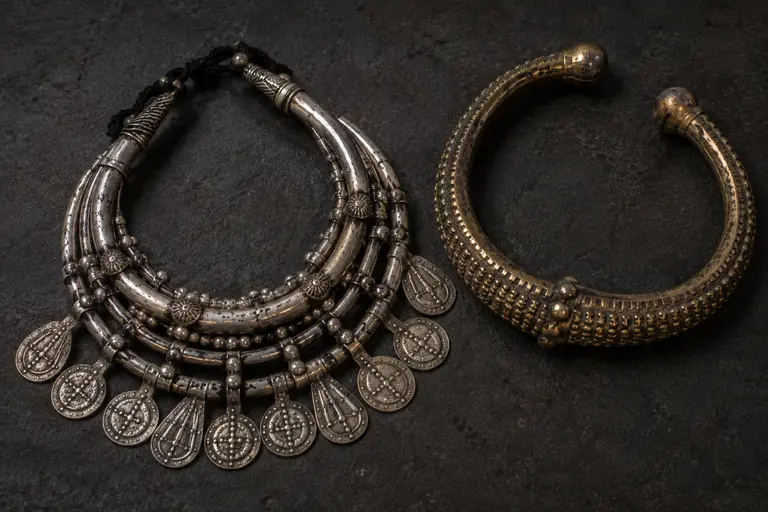
Santhal women typically wear thick, heavy silver necklaces known as Rajohar or Gahne. In addition, they favor delicate filigree earrings that feature intricate geometric patterns. Furthermore, they often wear small bells, known as ghungroos, on fine chains as decorative accessories. This overall look is bold and deeply rooted in the imagery of the natural world.
The Distinctive Styles of the Munda and Oraon
The Munda tribe, by contrast, celebrates an elegant simplicity. Their artisans utilize brass, white metal, and vibrant, colorful beads to create distinctive pieces like Kanjari bangles. Moreover, Munda craftspeople often decorate their ornaments with cowrie shells to add an organic touch. The Oraon community, a Dravidian-speaking group, possesses its own recognizable traditions. Their jewellery features elaborate silver work and a traditional nose ring called the Phoolkathi. This striking ornament covers most of the nose and clearly signals the wearer’s marital status. Consequently, it remains one of the most iconic pieces in the world of Jharkhand Tribal Jewellery.
The Materials and Hand-Finishing Techniques
Traditional artisans in the region prioritize locally available materials. In the past, they relied heavily on forest produce and recycled metals. Today, many still work with brass and oxidized silver-toned alloys to keep the craft connected to its historical roots.
Most authentic pieces carry a heavy oxidized finish. This gives the jewellery a dark, antique appearance that collectors highly prize. Importantly, this is a deliberate aesthetic choice, not a manufacturing defect. This finish makes the metal look grounded and traditional. Some contemporary versions also include enamel accents or shell details; however, the core look stays earthy rather than glossy. Therefore, if a piece looks too perfectly shiny or feels suspiciously light, it is likely a mass-produced commercial imitation. For professional standards on metal purity, you can refer to the Bureau of Indian Standards.
How to Identify Authentic Jharkhand Tribal Jewellery
The modern market includes many imitation products that use plastic and machine-made finishes to copy the tribal look. While these are fine for costume wear, a serious buyer should know how to spot the real thing.
First, you must check the weight; genuine handmade pieces feel solid in your hand. Next, you should look closely at the surface. Authentic items always show small irregularities and natural textures from the hand-casting process. Furthermore, you should ask the seller directly about the metal content. Trustworthy vendors will tell you exactly what materials the piece contains and which village it originated from. Finally, you should avoid pieces that look “too perfect.” Machine-made jewellery lacks the slight asymmetry that makes Jharkhand Tribal Jewellery so soulful. You can also explore our article on Understanding BIS Hallmark to see how certification protects jewelry buyers.
Why Tribal Jewellery is the Sustainable Choice in 2026
Choosing Jharkhand Tribal Jewellery aligns perfectly with modern sustainable values. To begin with, the artisans utilize recycled metals, beeswax, and natural clay. As a result, they produce very little industrial waste compared to large-scale factories.
In addition, many pieces come from women-led craft collectives in rural districts. Consequently, your purchase directly supports real livelihoods and preserves ancient skills that might otherwise vanish. If you care about ethical fashion, this is one of the most meaningful choices you can make. You receive something beautiful and rooted in heritage rather than a factory-stamped copy. To find verified, authentic pieces, you should look for the GI (Geographical Indication) tag or shop at Tribes India, the government platform that supports tribal artisans directly.
FAQ: Jharkhand Tribal Jewellery
What is the “Haasli” necklace?
The Haasli (or Hansuli) is a rigid, curved neck ornament that rests on the collarbone. Artisans typically engrave it with symbols of fish or flowers to represent fertility and nature.
Is Dokra jewellery durable?
Yes, brass and bell-metal Dokra pieces are very durable. However, you should avoid exposing them to harsh chemicals or moisture to preserve the oxidized finish.
Where can I buy authentic Jharkhand Tribal Jewellery?
You should visit government emporiums or reputable tribal cooperatives. Brands like Tribes India ensure that the proceeds go directly to the rural craftspeople.
How do I clean oxidized tribal jewelry?
You should only use a soft, dry cloth to wipe away dust. Specifically, avoid soaps or jewelry cleaners, as these can strip the intentional dark patina from the piece.
Are these designs influenced by modern trends?
While many artisans stick to traditional motifs, some are now creating lightweight versions and accessories like hair clips to suit modern urban lifestyles.
Disclaimer
This article provides general educational information about Jharkhand Tribal Jewellery. Traditions and materials vary by region and artisan group. Always verify authenticity and pricing with reputable sellers before making a high-value purchase. The author holds no financial affiliation with the institutions mentioned.